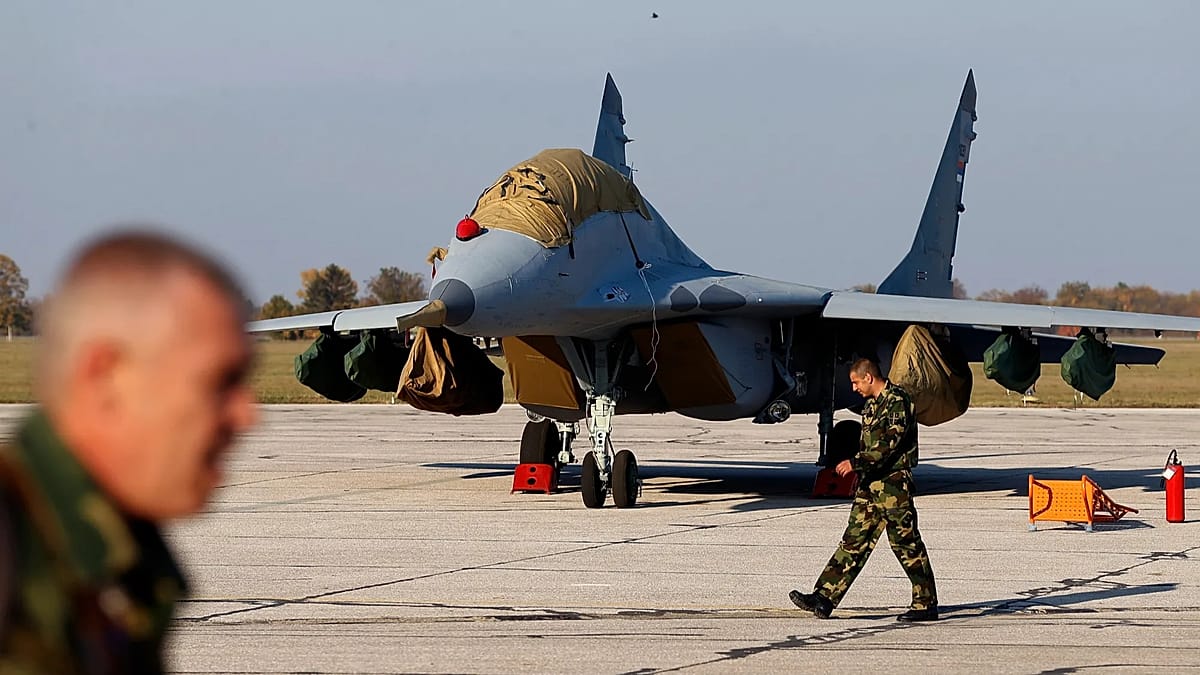
A Serbian Air Force MiG-29 fighter jet crashed on Tuesday morning near the town of Stara Pazova, just north of Belgrade, killing the pilot, the country's defence ministry has confirmed. The aircraft went down at approximately 8:45 am local time, and military police were immediately dispatched to the scene.
The pilot has been identified as Major Goran Bulajić, a 53-year-old veteran who had served in the Serbian military since 1996. The defence ministry expressed its condolences to his family, noting that he is survived by two children. The ministry also announced the formation of a commission to investigate the accident, with a mandate to establish the circumstances and determine whether any military personnel bore responsibility. An expert air force commission has been tasked with identifying the technical cause of the crash.
Video footage circulating on social media appears to show the aircraft engulfed in flames in a field, though the authenticity of the clips has not been independently verified. The crash site has been secured, and the investigation is expected to take several weeks.
A legacy Soviet fighter in Serbian service
The MiG-29, developed by the Soviet Union's Mikoyan-Gurevich Design Bureau in the early 1970s, entered service with the Soviet military in 1983. It was designed as a counter to American fighters like the F-16 and was described by the National Museum of the United States Air Force as posing a “formidable threat” to Western air forces. The aircraft is armed with a 30 mm cannon and can carry up to six air-to-air missiles, as well as bombs and rockets.
Serbia inherited a fleet of MiG-29s from the former Yugoslavia and has since received additional aircraft from Russia, some of which were modernised. The crash is a significant loss for the Serbian Air Force, which has been working to upgrade its ageing fleet. In recent years, Belgrade has explored options to replace its Soviet-era jets, with discussions about acquiring new fighters from Western or other European suppliers. This incident may accelerate those deliberations, as the safety and reliability of the remaining MiG-29s come under scrutiny.
The crash also highlights broader questions about the maintenance and operational readiness of legacy Soviet aircraft across the Balkans and Eastern Europe. Several NATO member states in the region have already phased out their MiG-29s in favour of Western models, but Serbia, which maintains military ties with both Russia and the West, continues to rely on the type.
This is not the first MiG-29 accident in Serbia. In 2018, a MiG-29 crashed during an exercise, though the pilot ejected safely. Tuesday's incident, however, marks the first fatal crash of a Serbian MiG-29 in recent memory, and it has cast a shadow over the country's military aviation community.
The defence ministry has promised a thorough and transparent investigation. In a statement, it said: “A commission has been established to investigate the accident, with a mandate to establish the circumstances surrounding the incident and determine whether there was any responsibility on the part of the military organisation.”
As the investigation unfolds, attention will likely turn to the broader state of Serbia's air force and its future procurement plans. The loss of a seasoned pilot like Major Bulajić is a stark reminder of the human cost of military aviation, and the need for modern, reliable equipment. For now, the Serbian military mourns one of its own, and the skies over Belgrade are a little quieter.