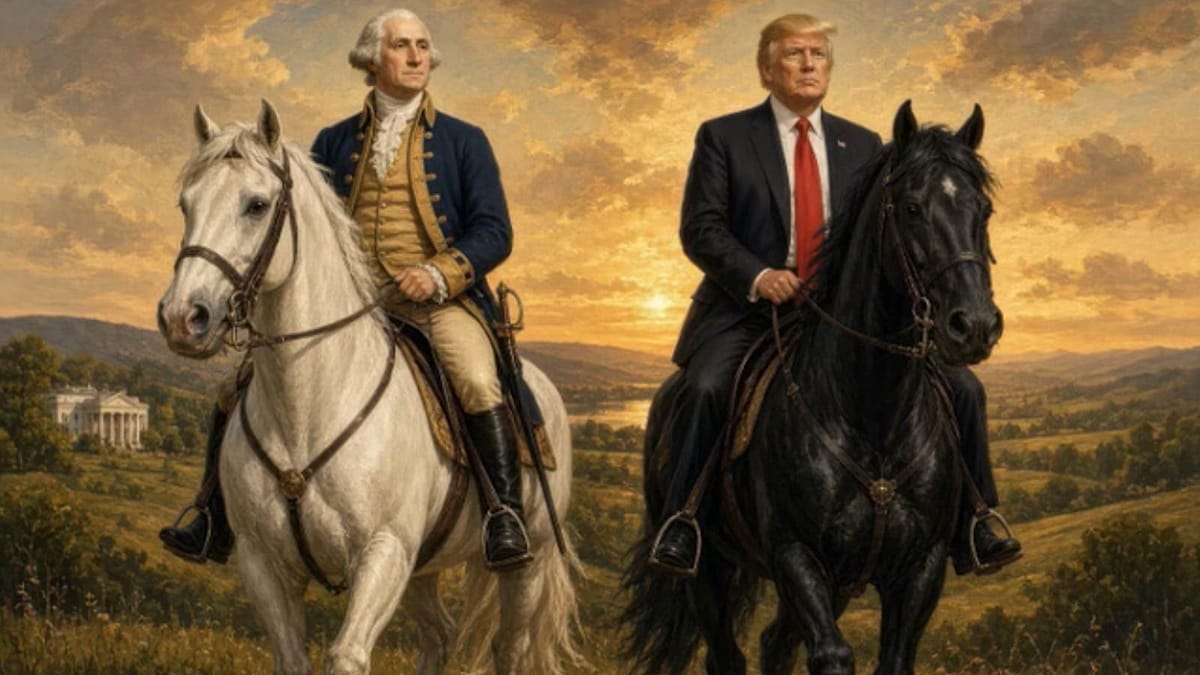
Donald Trump's social media feeds have become a canvas for AI-generated imagery, a tactic his team calls "memetic warfare." The latest creation, posted on Truth Social, depicts the former president on horseback alongside George Washington, the first US president. But the image has backfired, drawing attention to a symbolic misstep that resonates far beyond the digital realm.
In the picture, Washington rides a white horse, while Trump sits atop a black stallion. The contrast is stark, and the symbolism is hard to ignore. In Western art and literature, the black horse carries a heavy load of negative connotations. From Henry Fuseli's 1781 painting The Nightmare, where a dark horse embodies sleep paralysis and dread, to Carl Jung's concept of the "shadow self," the black horse often represents repressed fears, hidden desires, or darker aspects of the psyche.
The biblical reference is even more pointed. In the Book of Revelation, the Four Horsemen of the Apocalypse ride horses of different colors: white for pestilence, red for war, pale for death, and black for famine. The black horse specifically symbolizes scarcity and economic hardship. Given that Trump's image comes at a time when US households are grappling with soaring prices for gas, food, and other essentials—partly due to the ongoing conflict in the Middle East, now in its sixth month—the choice of a black horse feels inadvertently apt.
Social media users were quick to point out the irony. One X user quipped, "Does Trump know that bad guys ride the black horse?" Others drew parallels between the image and the current affordability crisis, calling it a "catastrophic self-own." The criticism highlights a recurring issue with Trump's AI-generated posts: they often miss the cultural and historical context, leading to unintended messages.
This isn't the first time Trump has appropriated Washington's image. Earlier, he shared a series of AI images showing himself giving Washington a tour of the White House's new ballroom. But the equestrian blunder has struck a chord, perhaps because it taps into deeper anxieties about leadership and national direction.
The timing is also notable. Trump's post comes amid a flurry of controversial moves, including his recent decision to switch from Air Force One over an alleged Iran threat, and his claims about the Strait of Hormuz, which have been disputed by Tehran. These actions, combined with the AI image, paint a picture of a leader who is both provocative and, at times, symbolically tone-deaf.
A black-and-white message
The weekend also saw Trump post a black-and-white image on Truth Social with the caption "We are going to win," which many interpreted as a hint at a potential 2028 presidential run. This comes despite the constitutional two-term limit, and it has reignited debates about his political ambitions. The image, reminiscent of the red 2028 caps he began selling last year, has been seen as another sign that Trump is considering a third term, a move that would be unprecedented and legally fraught.
For European observers, these developments are more than just transatlantic curiosities. Trump's policies and rhetoric have direct implications for Europe, from tariffs on European goods to his stance on international alliances. The AI image, while seemingly trivial, underscores a broader trend: the use of AI in political communication is growing, but it can easily backfire when cultural nuances are overlooked.
As the US heads into another election cycle, the intersection of AI, symbolism, and politics will likely become even more pronounced. For now, Trump's black horse serves as a reminder that in the age of memetic warfare, every image carries weight—sometimes more than intended.