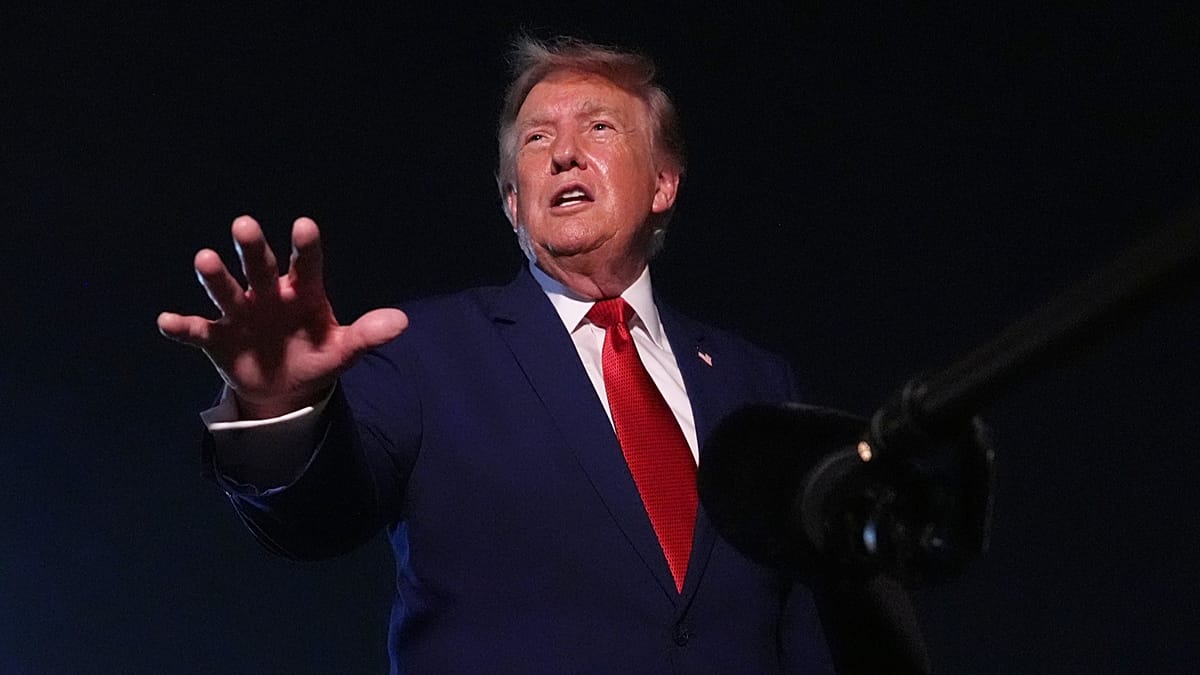
President Donald Trump has doubled down on his claim that the United States holds complete command over the Strait of Hormuz, vowing to retain that grip indefinitely. In a post on his Truth Social platform on Wednesday, he wrote: "The U.S.A. has total control over the Strait of Hormuz. I THINK WE WILL KEEP IT!" He added that the naval blockade is being described by "everyone" as "A WALL OF STEEL," and that "there is nothing Iran can do about it."
The strait, a narrow waterway between Iran and Oman, is a critical artery for global energy supplies and commodity shipping. Roughly a fifth of the world's oil passes through it, making its status a matter of acute concern for European economies and beyond. Trump's remarks came during a briefing with reporters late on Tuesday, where he asserted: "We have total control over the Hormuz Strait right now. They don't have control. We have total control. We own it."
Iran, however, maintains that it effectively controls much of the waterway and has threatened to impose a toll system on vessels transiting the strait. This is part of Tehran's response to the US-led military campaign that began on 28 February, which has included heavy bombing of Iranian military targets and the killing of a significant portion of the country's leadership. The stated goals of the offensive were to force Iran to abandon its nuclear programme and to bring about regime change.
A war of attrition
Despite the intensity of the initial strikes, Iran has shown resilience. It has launched missile attacks on US bases in the region, as well as on Israel and targets in US-allied Gulf states. Its most disruptive tactic has been to strike shipping in the Strait of Hormuz, effectively snarling the trade route and rattling global markets. The divergence between the IEA and OPEC on 2026 oil demand underscores the uncertainty caused by the prolonged closure.
With US congressional midterm elections looming in November, President Trump's domestic popularity has been slipping. He has consequently backed away from threats to escalate the war in pursuit of a decisive victory, leaving the conflict in a standoff. Instead, the administration appears to be shifting towards a strategy of economic strangulation. In an interview with Axios on Sunday, Trump described the approach as "low-keying," saying: "We are only semi-negotiating with them. We are just watching Iran with its huge inflation and the fact they have no money."
The blockade, which has effectively halted most commercial traffic through the strait, has had severe repercussions for global supply chains. European nations, heavily reliant on energy imports, have been particularly exposed. The stalled talks between Washington and Tehran have done little to ease concerns, with oil prices climbing as negotiations remain deadlocked.
Meanwhile, diplomatic efforts continue on the sidelines. Qatar has reported progress in Iran-Oman talks aimed at reopening the strait, though no breakthrough has been announced. Iran has likened the standoff to a game of chess, demanding US concessions before any de-escalation. The situation remains fluid, with the world watching to see whether the "wall of steel" holds or gives way to a negotiated settlement.