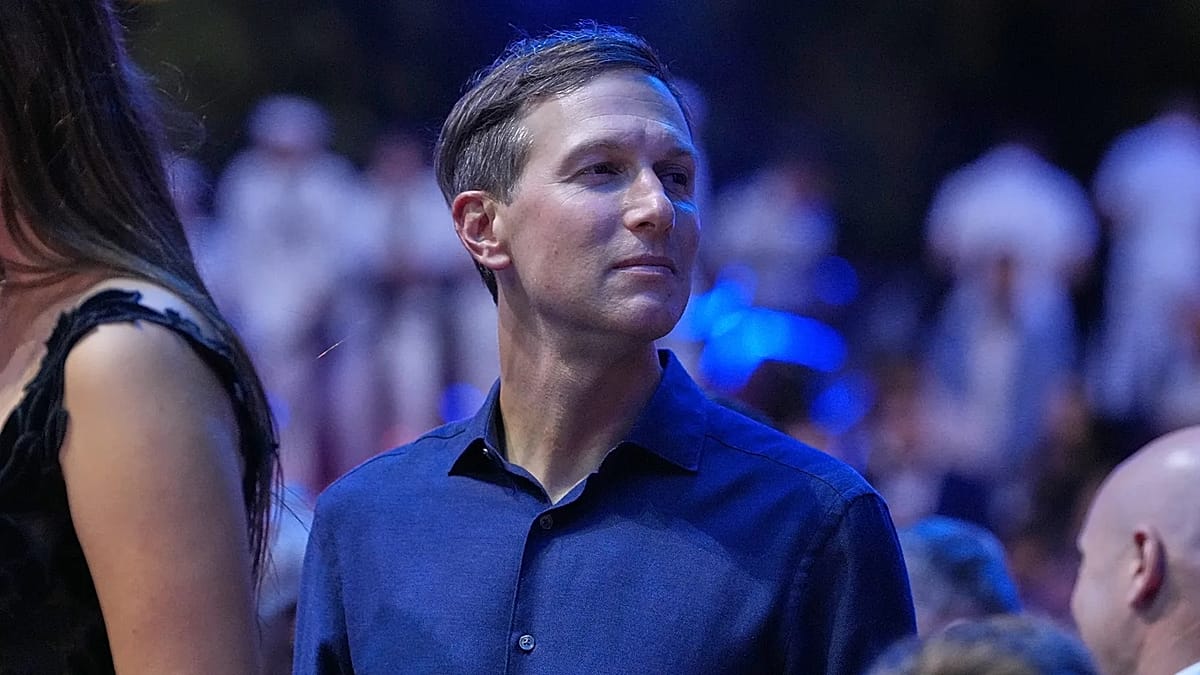
US special envoy Jared Kushner's shuttle diplomacy in the Middle East this week yielded no visible movement on Washington's proposed Gaza peace plan. After meetings with Israeli Prime Minister Benjamin Netanyahu and Hamas political chief Khalil al-Hayya, both sides remain entrenched on the core issue of disarmament.
The plan, unveiled by the Trump administration's Board of Peace in late July, envisions a full Israeli withdrawal from Gaza in exchange for Hamas laying down its weapons and ceding control of the territory. While Hamas has signaled acceptance, Netanyahu has conditioned any withdrawal on what he calls "genuine" disarmament.
Following Kushner's meeting with Netanyahu, a senior Israeli official told AFP that the two sides "agreed that no redeployment or reconstruction would take place in the Gaza Strip before Hamas is disarmed throughout Gaza." The official added that the first step toward demilitarisation would require Hamas to hand over its weapons for decommissioning under the supervision of an American general.
Netanyahu's office described the talks as "deep and constructive," stressing that both Israel and the Board of Peace were "determined" that disarmament and demilitarisation must be "prompt and completed before any reconstruction happens." The two sides also agreed to establish working groups—one focused on disarmament, the other on sanitation, clean water, and public health for Gazans.
Regional pressure mounts
The talks unfolded against a backdrop of growing regional frustration. On Sunday, foreign ministers from Turkey, Egypt, Indonesia, Jordan, Pakistan, Qatar, Saudi Arabia, and the United Arab Emirates issued a joint statement condemning Israel's rejection of the plan. They warned that "rejecting the Road Map constitutes an explicit refusal to proceed with the implementation of the Comprehensive Plan, and directly threatens to derail the extensive efforts exerted by US President Trump to bring an end to the war in Gaza and establish the conditions for lasting peace."
Kushner's visit came after earlier discussions with Hamas in Egypt, where the group's leadership had expressed conditional support. The lack of a breakthrough leaves the plan in limbo, with Netanyahu facing domestic political pressures ahead of Israel's October elections.
For European observers, the stalled talks carry significant implications. The EU has long advocated a two-state solution and has been a major donor to Palestinian humanitarian efforts. Any prolonged stalemate risks further destabilising a region already marked by deadly Israeli strikes in Lebanon and heightened tensions across the Eastern Mediterranean.
The impasse also complicates European efforts to engage with the broader Middle East, from migration flows to energy security. As the US pushes its own roadmap, European capitals watch closely, aware that a failure to resolve the Gaza conflict could spill over into European security interests.
Meanwhile, the humanitarian situation in Gaza remains dire. With reconstruction stalled, basic services are stretched, and the working group on public health is a small but tangible step. Yet without a political breakthrough, such measures may prove insufficient.
Kushner's departure without a deal underscores the deep divisions that remain. The coming weeks will test whether Washington can bridge the gap between Israel's security demands and Hamas's insistence on a full withdrawal. For now, the plan's future hangs in the balance.