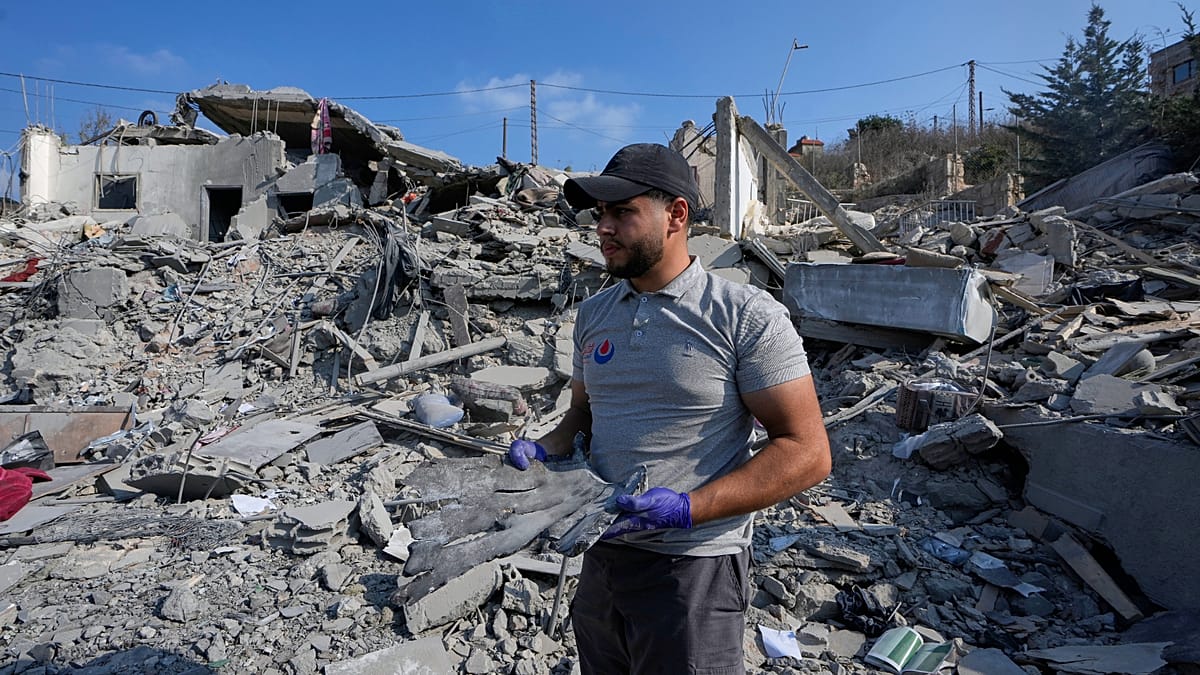
Lebanese President Joseph Aoun said on Saturday that Israeli airstrikes on southern Lebanon, which killed at least 11 people, including three children and two women, sent a "clear message" about the state of peace negotiations between the two countries. The strikes hit the villages of Ansar and Deir al-Zahrani, marking one of the deadliest incidents since a US-brokered framework agreement aimed at reducing hostilities was reached in June.
In a statement released by his office, Aoun said the attacks "send a clear message regarding the negotiation process and the US efforts aimed at implementing this agreement." He added that an entire family from Ansar had been killed in the strikes, underscoring the human toll of the escalation.
The Israeli military said the strikes were a response to an attack by the Iran-backed militant group Hezbollah on Israeli troops "in the Ali al-Taher Ridge, which is located in the security zone." Israel has maintained a so-called security zone in southern Lebanon since its ground invasion last year, which was launched after Hezbollah began firing rockets into Israel following the killing of former Iranian Supreme Leader Ali Khamenei.
Hezbollah vows retaliation
In a statement later on Saturday, Hezbollah warned that the latest Israeli attacks would "be met with an appropriate response." The group said, "The Israeli enemy must clearly understand that its acts of aggression, violations, and attempts to impose a fait accompli cannot continue." It also called on Lebanese authorities to "cease chasing after US-led negotiations," reflecting deep skepticism about the diplomatic track.
The escalation comes as the broader conflict between Israel, the US, and Iran continues to reverberate across the region. European capitals, particularly Paris and Berlin, have watched the situation with concern, as instability in the eastern Mediterranean has direct implications for migration flows, energy security, and the stability of EU partner states. The renewed anger in Greek ports over Israeli-linked vessels is a reminder of how the war is stirring tensions within Europe itself.
President Aoun's remarks suggest that Lebanon's leadership sees the strikes as a deliberate signal to influence the negotiation process, rather than a purely tactical military operation. His office's statement emphasized that the attacks undermine US efforts to implement the June agreement, which was supposed to pave the way for a durable ceasefire and the withdrawal of Israeli forces from Lebanese territory.
The June framework, brokered by Washington, was hailed as a breakthrough at the time, but its implementation has been fraught. Israel has insisted on maintaining its security zone to prevent Hezbollah from rebuilding its military infrastructure near the border. Lebanon, for its part, has called for full Israeli withdrawal and has accused Israel of repeated violations of the agreement.
The civilian death toll in Saturday's strikes has drawn condemnation from humanitarian groups. The United Nations Interim Force in Lebanon (UNIFIL) called for restraint and urged both sides to return to the ceasefire framework. The European Union, which has provided significant aid to Lebanon, has yet to issue an official statement, but diplomats in Brussels are known to be monitoring the situation closely.
For many Europeans, the conflict in southern Lebanon is not a distant crisis. The region is a key transit point for refugees and a source of instability that can spill over into the Mediterranean. The recent disruptions to France's nuclear capacity due to environmental factors are a separate issue, but they highlight how interconnected European security is with broader global events.
As the war between Israel and Hezbollah continues, the risk of a wider conflagration remains. Iran's involvement, through its proxy forces, adds a dangerous dimension. European leaders have repeatedly called for de-escalation, but their influence is limited. The United States remains the primary mediator, and President Aoun's comments suggest that Washington's efforts are now in jeopardy.
The coming days will be critical. Hezbollah's promised response could trigger another round of violence, further complicating the already fragile negotiation process. For Lebanon, a country already grappling with economic collapse and political paralysis, the prospect of renewed conflict is a devastating blow. For Europe, the stakes are equally high, as instability on the EU's southern flank has far-reaching consequences.