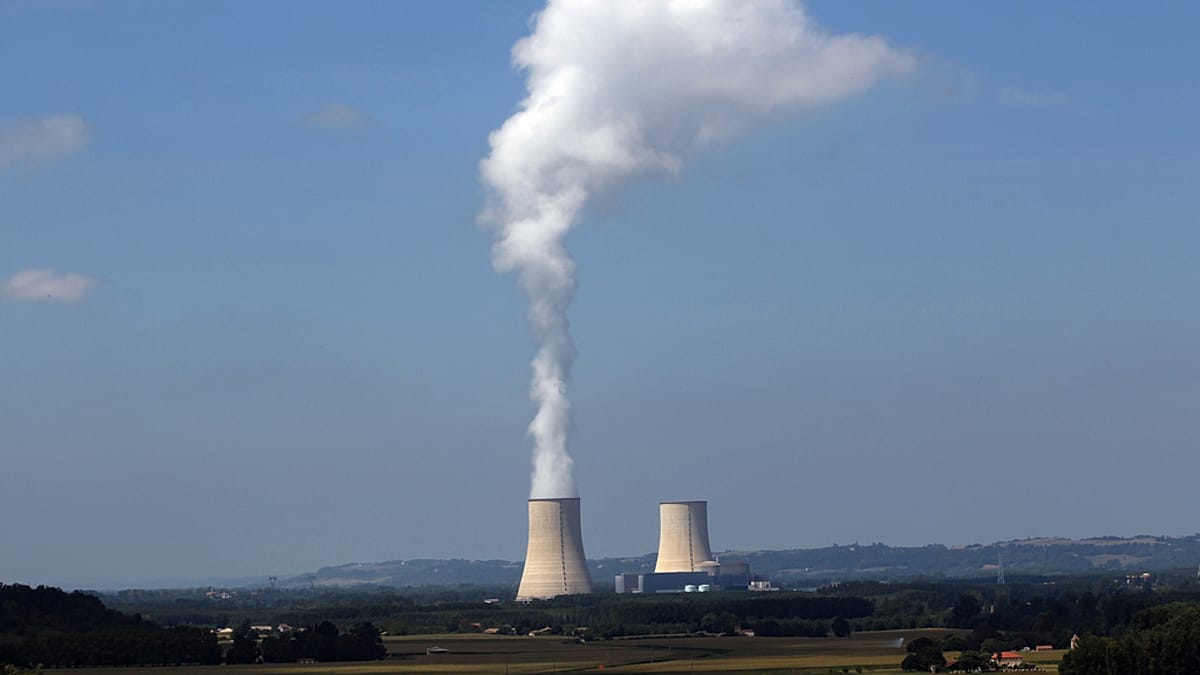
France's nuclear fleet, which supplies roughly 70% of the country's electricity, suffered its largest-ever outage from environmental causes on Wednesday. According to calculations based on data from energy group EDF, 20.4% of generating capacity was unavailable—a record for disruptions attributed to drought, extreme heat, and a jellyfish invasion.
Between 9:45 and 10:00 local time, EDF's reactors hit a new peak in unavailability for reasons classified as "environmental constraints" or "external environmental causes." In total, 13 of the 57 reactors were affected: eight were completely shut down (Bugey 3, Cattenom 1, Chooz 1 and 2, Golfech 2, and Gravelines 2, 3, and 4), while five operated at reduced power (Saint-Alban 2, Tricastin 1 and 4, and Gravelines 1 and 6).
Jellyfish clog cooling systems at Gravelines
A large share of the lost capacity came from the Gravelines plant in northern France, the largest nuclear facility in western Europe. Five of its six reactors were forced offline or down-rated after a mass of jellyfish blocked the seawater intake pumps used for cooling. An EDF spokeswoman said "several tonnes of jellyfish" surged into the pumping stations, clogging the filter drums.
Units 1 and 6 returned to full power by around 10 am on Wednesday, while reactor 5 was already in scheduled maintenance. Gravelines 2 was expected to reconnect to the grid at 11 pm that evening. The plant, which draws cooling water from the North Sea, faced the same problem almost exactly a year earlier.
Scientists point to overfishing, plastic pollution, and warmer waters linked to climate change as factors that have created favourable conditions for jellyfish proliferation. The earlier jellyfish incident at Gravelines had already highlighted the vulnerability of coastal nuclear infrastructure.
Heat and drought strain river-cooled reactors
Beyond Gravelines, shutdowns and output reductions at other reactors were tied to extreme heat and drought. When river levels drop and water temperatures rise, EDF must limit or halt production to protect the environment. The operator cannot discharge chemical or radioactive effluents, nor return cooling water at higher temperatures, under such conditions.
France has been grappling with repeated heatwaves and water restrictions across much of the territory. The current episode is part of a broader European pattern: heatwaves are expected to cost the EU billions in economic output this year.
Despite the scale of the outages, energy expert Nicolas Goldberg of Colombus Consulting told CNews that "there is enough leeway for this not to cause supply problems" in the short term. August typically sees lower electricity demand, and France remained a significant net exporter on Tuesday, following a record net export balance of 51 TWh in the first half of the year.
However, Goldberg warned that the longer-term outlook is more challenging. "Particularly if the lifespan of reactors is extended to 70 or 80 years, adapting them to climate change will be a real stress test over the next 20 to 30 years, in a warmer climate," he said.
France's nuclear regulator and EDF are already studying how to make reactors more resilient to higher temperatures and lower river flows. Options include upgrading cooling systems, increasing storage capacity, and adjusting operational protocols. But as this week's events show, the immediate risks are already materialising.
The outages come at a time when Europe is watching its energy security closely. While France's nuclear fleet has historically provided a stable baseload, its growing sensitivity to climate conditions adds a new layer of complexity to continental energy planning.