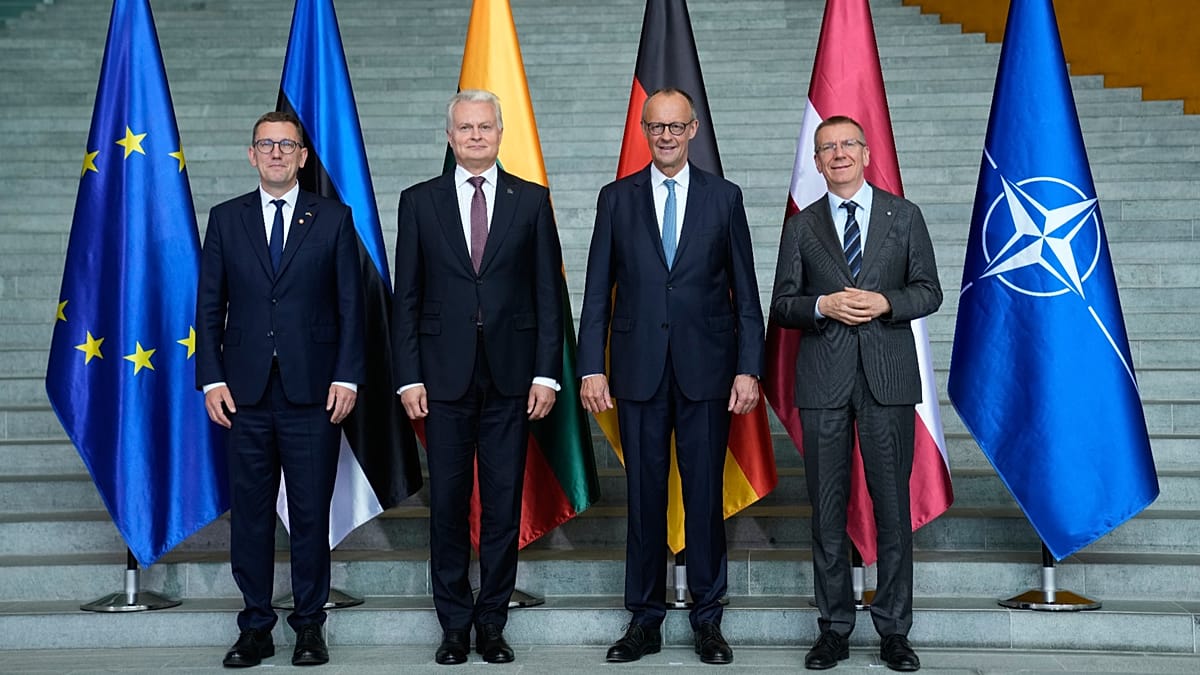
Days before the NATO summit in Ankara, German Chancellor Friedrich Merz welcomed the prime ministers of Estonia and Latvia, and the president of Lithuania to Berlin for a coordinated push on defence and deterrence. The meeting underscored a central message: the security of the Baltic states is inseparable from Germany's own.
Merz, speaking at a joint press conference, recalled a plaque on Vilnius Town Hall that reads: 'The security of Lithuania is our security. The defence of Vilnius is the defence of Berlin.' He first used that phrase last year at the formation ceremony of the 45th Armoured Brigade in Lithuania. 'The security of the Baltic states is also Germany's security,' he reiterated.
Preparations for the Ankara summit dominated the agenda. Merz said coordination with Estonia, Latvia, and Lithuania 'is close to our hearts and will remain so well beyond the NATO summit.' He added that the summit 'must be a success' by making NATO 'more European so that it can remain transatlantic.'
Three Priorities for Ankara
Latvian President Edgars Rinkēvičs outlined three priorities for the summit. First, translating the 5% defence spending target agreed in The Hague last year into real capabilities. 'Sometimes we see that this is not the issue of money, but buying the right equipment, the right armourment, and we see that we need to bolster the defence industry of each NATO member state,' he said.
Second, maintaining alliance unity behind Article 5 and all commitments, despite public and private disagreements. Third, ensuring continued support for Ukraine, including a common approach to tackling Russian and Belarusian hybrid threats and provocations.
Merz noted that Russia is constantly violating NATO airspace, carrying out hybrid attacks in cyberspace, and damaging undersea cables in the Baltic Sea. 'Moscow is testing how united and determined NATO is. We have been seeing where this Russian revisionism can lead for more than four years now in Ukraine,' he said. The Baltic states, he added, have 'long since met and exceeded' the 3.5% defence spending target agreed at last year's summit.
Rinkēvičs warned that if the Alliance fails to meet its targets, the Baltic states could 'have to pay more' in the event of a Russian attack. 'To a certain extent, defence spending is also a form of deterrence, and it is precisely this deterrence that we urgently need,' he said.
Estonian Prime Minister Kristen Michal stressed the need to turn commitments into concrete capabilities. 'We agreed to invest more in defence, now we must turn those commitments into capabilities. Estonia is already investing more than 5% of GDP in core defence; the other Baltic states and Poland are doing the same. We also need closer cooperation in the defence industries and more joint procurement. This is how we close capability gaps faster.'
Michal called Germany 'one of our closest allies and one of the key contributors to the security of the Baltic region,' highlighting the role of the German-Dutch Corps, which has taken over tactical command of Allied land forces in Estonia and Latvia, as well as Germany's contribution to NATO's Baltic Air Policing mission. He added that the EU could 'strengthen these efforts' by providing greater support for military mobility, the defence industry, critical capabilities, and the eastern border, which is 'in the EU's common interest.'
Lithuanian President Gitanas Nausėda pointed to the permanent deployment of Germany's 45th Armoured Brigade, due to be fully stationed in Lithuania by the end of 2027, describing it as a 'strengthening of our defence.' He noted that Lithuanian citizens welcome German soldiers on their streets, calling it 'the best proof and example of our solidarity and our friendship.'
Nausėda also argued that Europe must take greater responsibility for its own security. 'A stronger Europe, within a stronger NATO, should remain our common strategic objective.' Lithuania is on track to spend almost 7% of its GDP on defence and security this year, significantly exceeding the Hague commitment.
The meeting in Berlin comes amid broader debates about NATO's future, including reaffirming Article 5 and Ukraine's push for immediate air defence deliveries. The Baltic leaders made clear that the security of their region is the security of the entire Alliance.