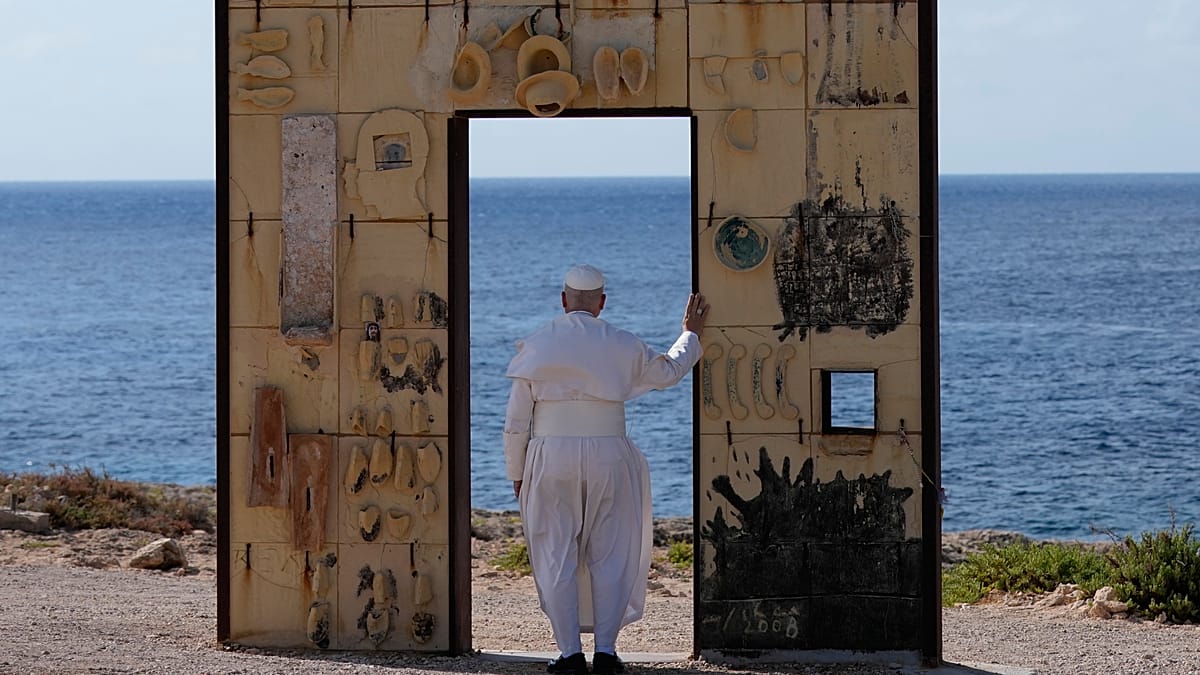
On the 250th anniversary of the United States, Pope Leo XIV chose to travel to Lampedusa, the Italian island that has become a stark emblem of the Mediterranean migration crisis. The visit, the first by a pontiff since Pope Francis in 2013, underscored the Vatican's enduring focus on the plight of those risking their lives to reach European shores.
Upon landing, the Pope proceeded directly to the Cemetery of the Nameless in Cala Pisana. There, he prayed at graves marked by crosses fashioned from the wood of wrecked migrant boats—a poignant reminder of the human cost of the journey. He then walked through the Porta d'Europa, a ceramic-and-iron sculpture overlooking the sea, where he met a migrant family and stood in silence, gazing at the horizon as a navy patrol vessel passed.
A child migrant handed the Pope a letter and a football. “Ten years ago my story began here in Lampedusa. I was alone and had lost everything, especially my mum,” the boy wrote. “They tell me I only stopped crying when they gave me a ball made out of paper; from that day the ball has stayed in my heart.”
A Plaque for Pope Francis and a Call for Action
At Molo Favarolo, where migrant boats are brought ashore, Pope Leo XIV unveiled a plaque renaming the quay Molo Francesco in honour of his predecessor. In a letter to the mayor, he wrote: “By deciding to name Molo Favaloro after Pope Francis you are giving a sign of the bond my predecessor forged with your community and with migrant brothers and sisters.”
During Mass at the ‘Arena’ sports ground, attended by some 4,000 people, the Pope delivered a pointed message to European leaders. “From this far-flung edge of Europe in the Mediterranean, the historic challenge that migration poses to European societies is all the clearer,” he said. “Europe has a unique potential, rooted in its history and its culture, and with it an equal measure of responsibility.”
He urged the continent to move beyond first-response measures and adopt a coherent, long-term strategy capable of “welcoming, protecting, promoting and integrating migrants.” The Pope stressed that this is a task not only for public institutions but for civil society and the Church. He also warned against indifference, recalling his recent remarks in Tenerife that people must not feel threatened by migration routes.
The visit comes as the European Union grapples with internal divisions over migration policy. The Pope’s call for a unified approach echoes debates in Brussels, where EU leaders like Ursula von der Leyen are balancing trade negotiations with humanitarian obligations. Meanwhile, the Mediterranean continues to claim lives: the most recent landing on Lampedusa occurred just hours before the Pope’s arrival, when the coastguard rescued 17 people, including five women and three children.
Pope Leo XIV’s journey to Lampedusa was not merely symbolic. It was a direct challenge to Europe to live up to its founding values. As he put it, “The act of Jesus breaking the bread and giving himself lends meaning and strength to our daily gestures of care and sharing. Yes, this is a place where gestures speak louder than words. But for gestures to be truly human, they need a heart.”
The island, which receives both migrants and holidaymakers, remains a microcosm of Europe’s broader dilemma. The Pope’s message was clear: the deaths at sea are not an inevitable tragedy but a failure to act collectively and humanely.