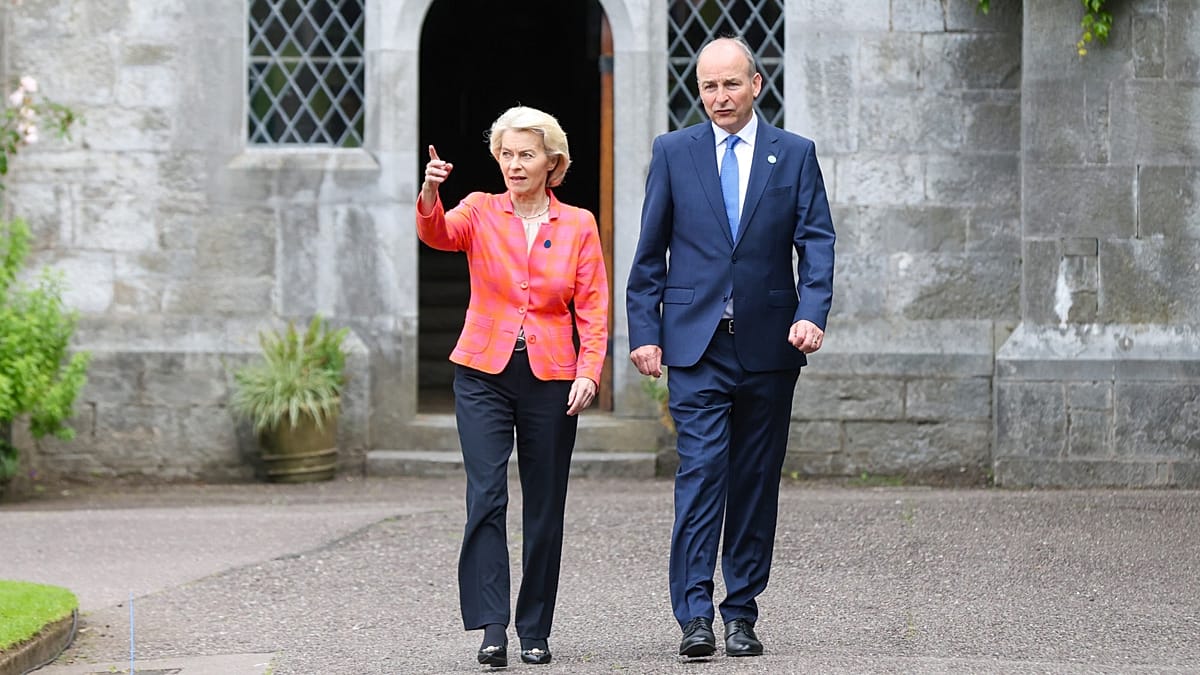
European Commission President Ursula von der Leyen has issued a clear warning to Beijing: if China does not deliver concrete changes to its trade practices by October, the European Union will retaliate. Speaking in Cork, Ireland, on Friday, von der Leyen said the bloc is ready to deploy a full range of trade defense tools if dialogue fails to produce results.
“Dialogue is essential, but the dialogue has to deliver,” von der Leyen stated. “Depending on how the response of the Chinese is, in the fall will then be our potential activity. We are basically prepared for everything, and we have all the instruments on the table, and we are thinking about other possibilities if necessary.”
The Commission president listed several persistent friction points: China’s glut of low-cost exports, stringent restrictions on European companies, and excessive use of state subsidies. “We don’t want to see [these practices] any more on our market,” she added, though she did not specify which measures would be targeted or how the October deadline would be enforced.
Her remarks come just days after EU leaders gave von der Leyen a mandate to adopt a tougher stance on China during a summit in Brussels. The 27 member states agreed that the Commission should pursue dialogue while simultaneously exploring new and existing trade instruments. This dual-track approach reflects growing unease in European capitals about the bloc’s trade imbalance with Beijing.
New Trade Instruments in the Pipeline
The EU already has the Anti-Coercion Instrument, which allows Brussels to retaliate with varying degrees of intensity. However, that tool has proven too cumbersome and divisive among member states and has never been used. To address this, von der Leyen’s services are now working on at least two additional instruments: one to diversify supply chains and reduce vulnerable dependencies, and another to ensure solidarity among member states in the event of Chinese reprisals—which are considered likely if the EU becomes more assertive.
Trade Commissioner Maroš Šefčovič met with his Chinese counterpart Wang Wentao earlier this week to discuss rebalancing bilateral trade. After the meeting, Šefčovič imposed an October deadline for “the first tangible results.” He acknowledged that “not everything will be fixed” by then but expressed confidence that there would be “sufficient time” to make a difference. “The trend is not sustainable, and the status quo is not an option,” Šefčovič said, describing the talks as “intensive, focused and constructive.”
The urgency is underscored by the numbers. Last year, the EU recorded a record €360 billion trade deficit with China—the first time every single one of the 27 member states posted a negative figure. This imbalance has fueled calls for action, particularly in sectors like automotive and manufacturing, where Chinese state-subsidized exports are undercutting European producers. For more on the automotive sector’s internal divisions, see EU Auto Sector Split Over Local Content Rules to Counter China.
Irish Prime Minister Micheál Martin, whose country holds the rotating EU Council presidency, echoed von der Leyen’s concerns while appearing alongside her in Cork. “Trade has to be conducted on a fair basis, and we all have to play by the same rules, and that is not always the case,” Martin said. He added that he hoped dialogue could “reach a landing zone between Europe and China,” noting the significant interdependence between the two economies. “Everybody needs everybody to some degree,” he concluded.
Keeping the 27 member states united will be a key challenge for von der Leyen. Views on China still diverge sharply among EU capitals, with some countries more reluctant to confront Beijing due to deep economic ties. The Commission is keen to maintain the momentum generated by the summit mandate, but it remains to be seen whether the bloc can sustain a unified front when push comes to shove. For context on the broader geopolitical stakes, see EU Faces Trade Conflict with China Unless Deal Reached by Autumn, EPP Chief Warns.
The October deadline is not an ultimatum but a benchmark. Šefčovič made clear that not all issues will be resolved by then, but the EU expects measurable progress. If Beijing fails to deliver, Brussels is prepared to escalate—using both existing tools and new ones still under development. The coming months will test whether the EU can translate its newfound assertiveness into concrete outcomes, or whether the bloc’s internal divisions will once again dilute its leverage.