A 29-year-old American tourist has died after being struck by lightning while hiking on Mount Etna in Sicily, as a severe thunderstorm swept across the volcano on Sunday evening. The man, whose identity has not yet been released, was hiking in the isolated Rocca Capra area, within the Valle del Bove, at around 1,400 metres above sea level.
Emergency services received a call shortly before 8 pm local time. A firefighter helicopter, designated Drago 142, was dispatched to the scene. Rescuers attempted to resuscitate the man before winching him aboard and flying him to Cannizzaro hospital in Catania. He arrived in cardiac arrest, and despite continued efforts, he was pronounced dead at around 9:30 pm. His body has been transferred to the hospital morgue.
According to preliminary information from authorities, the man is believed to have been hiking alone and may have been in an area closed to the public or subject to restrictions due to Etna's recent volcanic activity. An investigation is ongoing, and police have not yet traced any family members.
Etna remains highly active
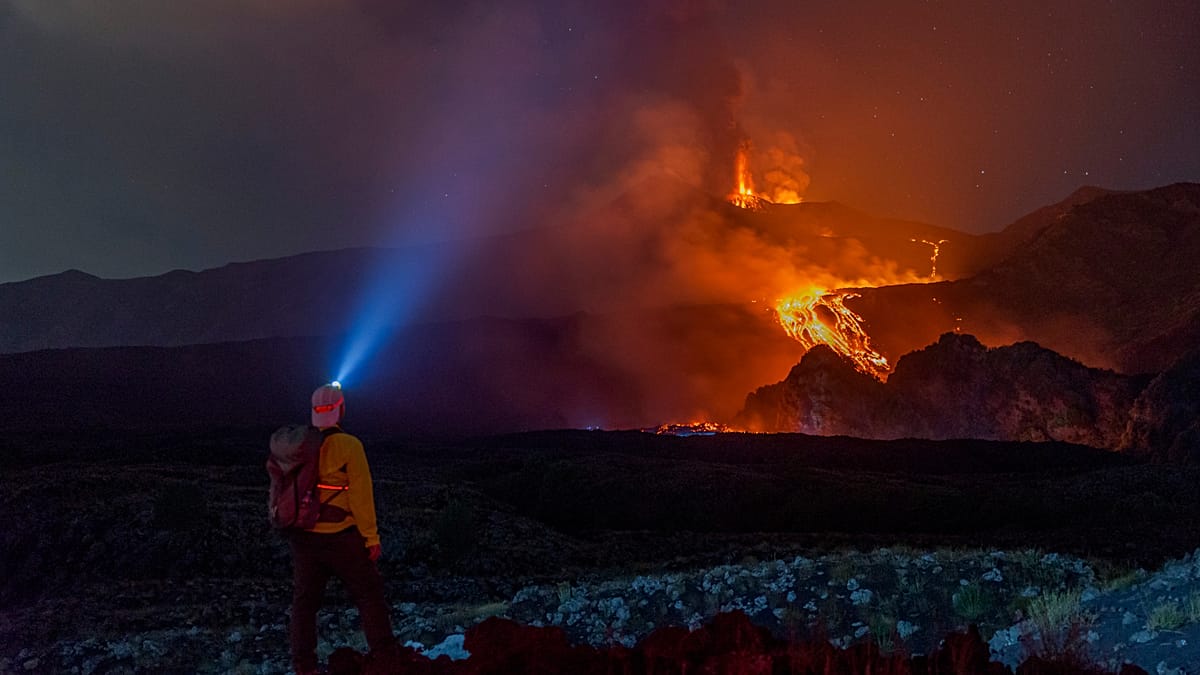
Mount Etna, one of Europe's most active volcanoes, continues to show intense eruptive activity. The National Institute of Geophysics and Volcanology (INGV) Etna Observatory reported the opening of a new lava vent in the Valle del Bove area after part of the eastern flank of the Rittmann summit cone collapsed. The new vent, at around 2,350 metres above sea level, produced a lava flow of about 500 metres, which has since halted and cooled.
Another vent at around 1,900 metres remains active, with lava continuing to flow down to about 1,600 metres. Explosive activity is also ongoing at Voragine, one of Etna's summit craters. The eruption plume has risen to around 6,000 metres above sea level and is drifting south-east. Volcanic tremors remain at high, steady levels, confirming that the volcano is still in an active phase. The INGV is closely monitoring the situation.
Ash disrupts flights at Catania
The volcanic activity continues to affect air traffic to and from Sicily. The presence of ash in the atmosphere has led authorities to extend the closure of sector B1 of the airspace and restrict arrivals at Catania-Fontanarossa airport. Until noon on Tuesday, no more than 10 flights per hour will be allowed to arrive, while departures are currently unrestricted. Passengers are advised to check the status of their flights with their airlines before travelling to the airport.
This is not the first time Etna's activity has caused severe disruption at Catania airport; in recent days, ash emissions had already led to cancellations. For more on the volcano's broader impact, see our explainer on Etna's eruptions.
Thunderstorms pose significant risk in mountains
The American tourist's death came as a 42-year-old man also died on Piz Starlex in South Tyrol, apparently struck by lightning during his descent. His body was located late in the evening by a drone at an altitude of around 2,600 metres.
Mountain rescue teams warn that thunderstorms are among the most serious dangers for hikers. Ridges, peaks, and rocky zones are particularly exposed, and hikers are advised to leave high ground and seek shelter as quickly as possible if they see lightning or hear thunder. This incident echoes other recent mountain-safety concerns across the Alps, such as crowding on Mont Blanc prompting new measures.
As Etna's activity continues, authorities urge visitors to respect closure zones and heed safety warnings. The volcano's beauty and power remain a draw for tourists, but the risks are real, especially during sudden weather changes.