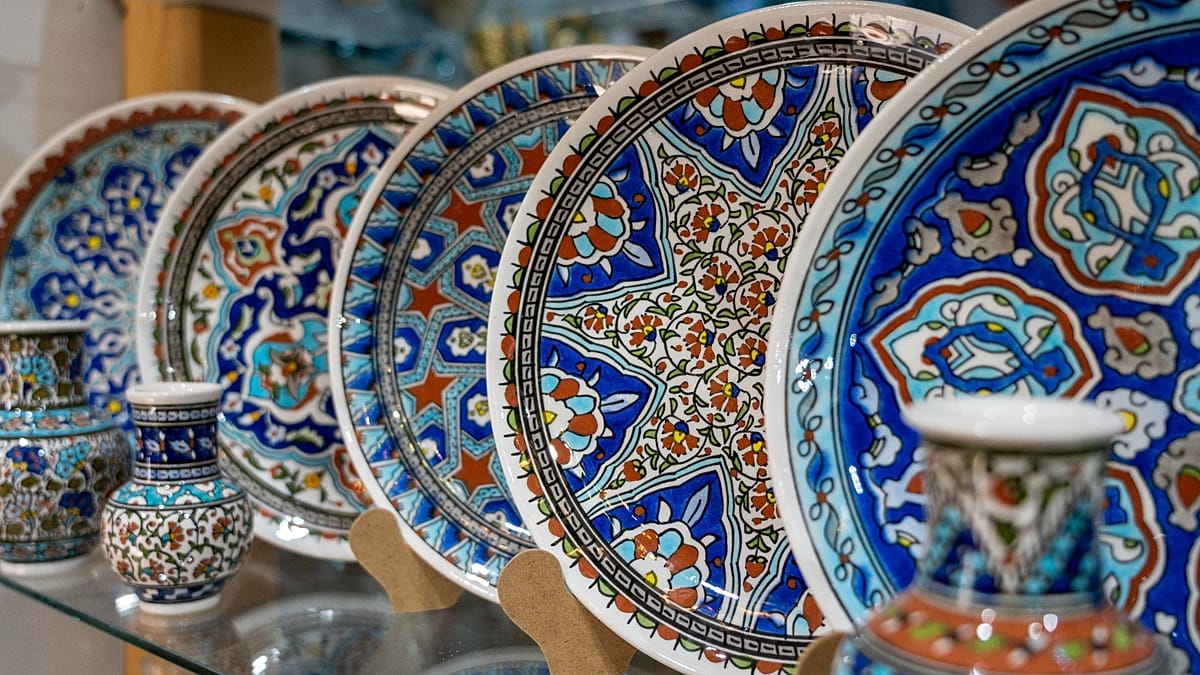
For centuries, Türkiye has been a crossroads of civilisations, and its artisanal traditions reflect that rich tapestry. The Silk Road, which wound through Anatolia for nearly 1,500 years, not only connected Asia and Europe but also nurtured a thriving local economy of handmade goods. Different regions became known for their specialities: silk from Bursa, carpets from Kayseri, ceramics from İznik. Today, many of these crafts endure, practised both for commerce and as living heritage.
Ceramics and pottery: from İznik to Kütahya
In the 15th century, inspired by Chinese porcelain, Turkish potters began moving beyond simple unglazed wares. The İznik region became famous for its glazed blue-and-white plates, vases, and tiles, while Kütahya earned renown for its exquisite 14th-century pottery. By the 16th century, designs grew more intricate, with vibrant greens and reds, and the craft became so significant that it required regulation.
These creations soon adorned iconic buildings such as the Süleymaniye and Blue Mosques in İstanbul, as well as the mausoleums of Süleyman I. Visitors today can see replicas in İznik's city centre and museum, where workshops are also offered. The originals are displayed in a dedicated museum in Kütahya.
Kilims: woven stories and symbols
Kilims, tightly woven traditional carpets made almost entirely from wool, have been part of Anatolian culture since ancient times. They remain a staple of daily life, used as prayer rugs and for decoration. The motifs are deeply symbolic: the elibelinde represents fertility, the boynuzlu (ram's horn) symbolises heroism, and earrings indicate a wish for marriage. Protective symbols against the evil eye are also common, and some weavers even incorporate amulets into their work.
Konya, south of Ankara, is known as the 'cradle of carpet weaving' and is an excellent starting point for exploring these textiles.
Silk: Bursa's enduring legacy
Silk was one of the most lucrative commodities on the Silk Road, and Türkiye soon developed its own sericulture. Bursa, once the first Ottoman capital and a UNESCO World Heritage site, became a major centre for silk trade and production. The 15th-century Koza Han market, whose name means 'the inn of the silk cocoon', was where raw cocoons were traded. It remains a bustling hub today, offering finished scarves and shawls alongside raw cocoons.
Coppersmithing: ancient metalwork in Gaziantep
Metalwork is among Türkiye's oldest crafts, with copper mined in Anatolia for over 7,000 years. The Seljuks were particularly influential in its evolution. Today, the dövme (hand-hammered) technique is still popular, with intricate designs etched into the surface using relief, openwork, or scraping. Turkish coffee pots (cezve) are common products, along with plates, pans, and decorative pieces. Gaziantep's Coppersmith's Bazaar is a vibrant place to see artisans at work.
These crafts are not just relics; they are part of Türkiye's living cultural identity. Many are listed on UNESCO's Intangible Cultural Heritage list, including ebru (paper marbling), tezhip (illumination), oya lacework, and sedef kakmacılığı (mother-of-pearl inlay). For travellers, visiting these cities offers a direct connection to centuries of tradition.
As Türkiye continues to balance modern development with its heritage, these artisanal practices remain a vital link to the past. Whether you're watching a potter in İznik, browsing kilims in Konya, or sipping coffee from a hand-hammered cezve in Gaziantep, the craftsmanship is unmistakable. For those interested in broader regional trends, travel patterns across Europe show a growing appetite for authentic cultural experiences.
While Türkiye's energy future is a topic of debate, as its solar ambitions clash with coal reliance, its artisanal heritage offers a different kind of sustainability—one rooted in skill, patience, and community. In an era of mass production, these crafts remind us of the value of the handmade.