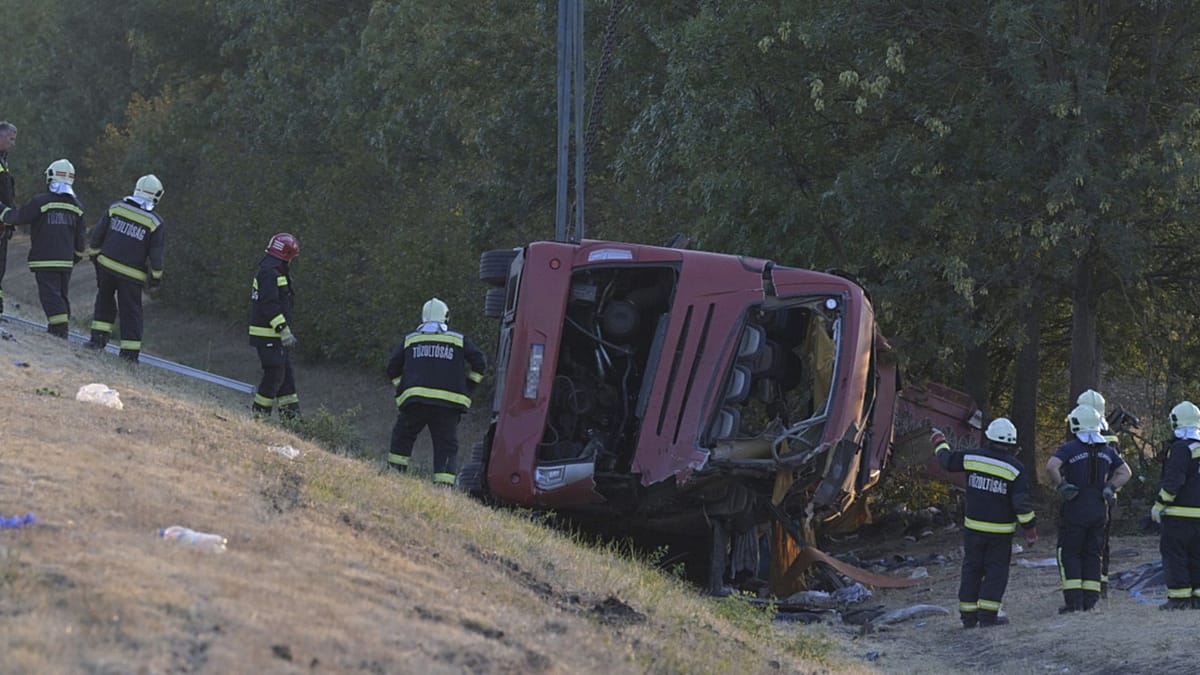
In the early hours of Sunday, a coach carrying Polish tourists overturned on the M3 motorway in northeastern Hungary, between the villages of Mezőkeresztes and Mezőnagymihály. Hungarian disaster management authorities confirmed that rescue teams, including firefighters, were dispatched to the scene and had to enter the overturned vehicle through its windows to reach passengers trapped inside.
By 3 a.m., the disaster management service reported that firefighters had pulled 35 people from the wreckage, while several passengers remained trapped beneath the coach. The operation continued for hours as emergency crews worked to free those pinned under the heavy vehicle.
Twelve confirmed dead, ten seriously injured
Hungarian Prime Minister Péter Magyar announced on social media that at least 12 people had lost their lives in the crash, with at least ten others suffering serious injuries. “12 people lost their lives and at least ten were seriously injured during the night, when a Polish coach overturned into a ditch on the M3 motorway,” he wrote.
Magyar extended his condolences to the families of the victims and wished the injured a swift recovery. He also thanked the rescue workers for their efforts, which continued through the night under difficult conditions.
The Polish foreign minister confirmed the disaster, stating that Polish authorities were in constant contact with their Hungarian counterparts. He noted that the details of the incident still needed to be fully established, including the exact circumstances that led to the coach leaving the motorway.
Polish President Karol Nawrocki also responded, saying, “I join in prayer and extend my deepest condolences to the families and loved ones of the victims.” His message was shared widely on social media as news of the tragedy spread.
The M3 motorway is a major route connecting Budapest with eastern Hungary and onward to Ukraine. The section where the crash occurred is a straight, well-maintained stretch, and the cause of the overturn is not yet known. Hungarian authorities have launched an investigation, with initial reports suggesting the coach may have hit a roadside barrier before tipping into a ditch.
This incident adds to a series of recent road accidents involving tourist coaches across Europe, raising questions about safety standards and driver fatigue on long-distance routes. The victims were part of a Polish tour group, though the exact itinerary and destination have not been disclosed.
Local emergency services, including ambulances and helicopters, were deployed to the scene. Hospitals in nearby towns, including Miskolc and Eger, were placed on alert to receive the injured. Some of the seriously wounded were airlifted to specialized trauma centers.
The Hungarian government has offered full support to the Polish embassy in Budapest, which is coordinating with families of the victims. A crisis hotline has been set up for relatives seeking information.
This tragedy comes as Hungary has been under scrutiny for its infrastructure spending, with recent reports highlighting efforts to bar corrupt firms from EU-funded tenders. While the crash is not directly linked to road quality, it underscores the importance of maintaining safe transport networks across the continent.
As Europe grapples with the human cost of travel, this incident serves as a somber reminder of the risks that remain on even the most familiar routes. The thoughts of many across the continent are with the victims and their families.