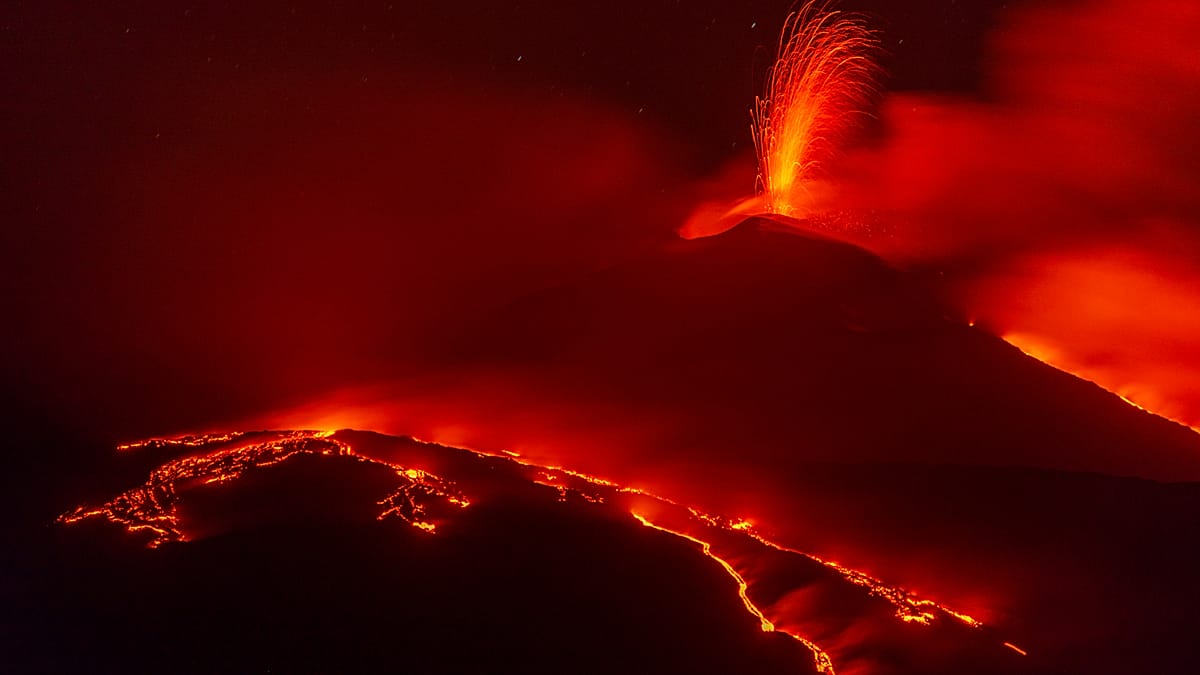
Mount Etna, Europe's most active volcano, has been putting on a spectacular display for over a week, with lava fountains and ash clouds drawing crowds to Sicily's eastern coast. The eruption, now in its seventh consecutive day, has caused significant disruption at Catania–Fontanarossa Airport, forcing dozens of flight cancellations and temporary suspensions of arrivals. Yet, despite the dramatic visuals, scientists stress that this is business as usual for the volcano.
Etna's constant activity
Etna erupts several times a year, sometimes multiple times a month, and has produced more than 70 paroxysmal eruptions in the past six years, according to Giorgio Costa, a PhD student at the University of Catania's Department of Biological, Geological and Environmental Sciences. These intense bursts can send lava fountains hundreds of metres into the air and ash clouds several kilometres high, but they typically last only a few hours.
“In reality, the volcano's activity is currently perfectly normal,” Costa told European Pulse. The recent eruption, which began in late July, is part of a pattern that has characterized Etna for decades.
Environmental impact: minimal on climate
Volcanic eruptions release a cocktail of gases and particles, including carbon dioxide, sulfur dioxide, and trace amounts of hydrogen sulfide, hydrogen chloride, and hydrogen fluoride. While sulfur dioxide can contribute to global cooling and carbon dioxide to warming, the scale is negligible compared to human activity. NASA estimates that human activities produce 100 times more carbon dioxide than all the planet's volcanic eruptions combined.
Costa also dismissed any link between climate change and volcanic activity. “There is no correlation between meteorological events, including climate change, and the Earth's volcanic or tectonic activity,” he said.
Ash: a local concern
The primary issue from Etna's eruptions is the fallout of pyroclastic material—ash and small lapilli (rock fragments 2 to 64 millimetres in size)—which can be carried by the wind and settle on surrounding slopes and towns. While these particles are not directly harmful to human health, fine ash can irritate the respiratory system if inhaled in large quantities. “Wearing a mask is recommended,” Costa advised.
For aviation, ash is a more serious hazard. When aircraft fly through ash clouds, particles can melt inside engines, damaging components and potentially causing power loss. This is why Catania Airport has been forced to close repeatedly, with hundreds of flights cancelled or diverted over the past week. The airport is currently shut until early Saturday, and disruptions are expected to continue as long as the eruption persists.
Fertile soil: a silver lining
Despite the immediate inconveniences, Etna's ash has a long-term beneficial effect. The mineral-rich ash acts as a natural fertiliser, improving soil drainage and water retention, which helps Sicilian farmers produce renowned wines, pistachios, and citrus fruits. Research from the Scripps Institution of Oceanography in San Diego found that volcanic ash can also revive microbial communities in degraded soil, enhancing nutrient cycling and plant growth. Plants grown in ash-rich soil developed larger root systems and produced more biomass.
Etna's frequent eruptions deposit fresh layers of ash, creating a cycle of destruction and renewal. Even when ash causes temporary problems, it eventually becomes part of the soil that sustains life and agriculture on the island. This dynamic is a reminder that natural disasters often have complex, multifaceted effects—both disruptive and regenerative.
As the eruption continues, authorities are monitoring the situation closely, balancing the needs of travellers and residents with the reality that Etna's fiery temperament is an integral part of Sicily's landscape and identity.