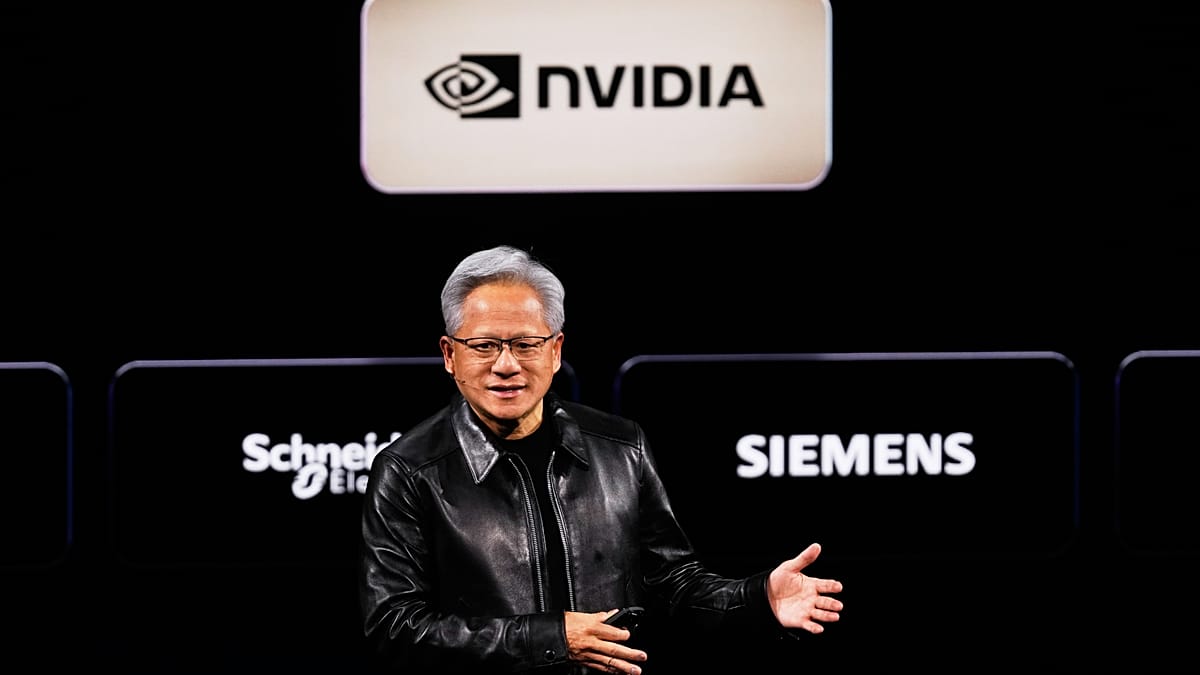
LISBON — The resignation of Jensen Huang as chief executive of Nvidia has sent ripples through the global technology sector, prompting economists to question the resilience of an industry increasingly dependent on a handful of dominant players. Speaking at Web Summit in Lisbon, investor and financial commentator Adam Kobeissi described Huang's departure as “a significant loss for the industry as a whole” and “a critical mistake,” arguing that more time should have been taken to investigate the circumstances surrounding his exit.
Huang stepped down on Thursday after reports of an affair with an alleged Chinese spy and a company employee, a dramatic fall for the man who had become the public face of the artificial intelligence revolution. The news has already weighed on Nvidia's share price, and the board's handling of the matter has drawn scrutiny.
A debate over the company's future
On a panel moderated by Euronews, Kobeissi and James Galbraith, a professor at the Lyndon B. Johnson School of Public Affairs at the University of Texas at Austin, offered contrasting views on the long-term impact. Galbraith argued that Nvidia's importance would ensure its continuity, stating: “The nature of large, successful corporations is that they are built to survive their founders or any mortal human who happens to be in charge.” If the company is as strong as its reputation suggests, he added, the effects of the transition may not be long-lasting.
Kobeissi, however, warned that Nvidia's troubles are unlikely to remain contained. “AI is the biggest revolution in history,” he said, but the sector's dependence on a few key players makes it “hard to say” whether any issue involving Nvidia can be treated in isolation. This concentration of power, he suggested, could have implications for the industry's next major milestones.
The debate comes at a time when the AI sector is already facing headwinds. The US AI Safety Centre is without a permanent leader, and the White House has been tightening its grip on AI policy. Kobeissi noted that private debt markets are becoming “a little tapped out” as a source of capital, and the next couple of quarters will be full of uncertainty, from the outcome of the US midterm elections to policy shifts and other economic pressures.
Despite the turmoil, Kobeissi said he expects Anthropic, a leading AI research company, to proceed with its public offering, possibly as soon as next week. “The notion that you can wait for uncertainty to dissipate in the AI world right now is kind of questionable,” he remarked, suggesting that investors may need to accept a degree of volatility.
For Europe, the developments at Nvidia carry particular weight. The continent is home to several AI research hubs and startups that rely on Nvidia's chips, and any disruption in supply or confidence could have knock-on effects. European policymakers have also been pushing for greater strategic autonomy in technology, and the current situation may reinforce calls for more diversified sources of AI hardware and software.
As the story continues to unfold, the question remains whether Nvidia can maintain its dominance without its charismatic founder at the helm. Galbraith's view that corporations are built to outlast their leaders offers some reassurance, but Kobeissi's warnings about the fragility of the AI boom serve as a reminder that the sector's future is far from certain.