The US government body responsible for testing advanced artificial intelligence for safety is effectively adrift: it has no permanent director, has stopped publishing its research, and its staff have been asked to report informally to a White House office. That is according to the Associated Press, which spoke to two former government officials familiar with the situation.
The centre, known as CAISSI (Center for Advancing Innovation and Standards for Super Intelligence), sits within the Commerce Department's National Institute of Standards and Technology (NIST). Its mission is to evaluate frontier AI models for risks ranging from cyberattacks to bioweapons. But critics now fear that its findings could be muted to suit the tech industry, which has largely been left to police itself.
Caroline Siegel Singh of the Federation of American Scientists told the AP that the goal should be for “nonpartisan or bipartisan technocratic experts” to shape policy in the public interest. Instead, the centre appears to be drifting towards the orbit of the White House, a move that some see as politicising what should be an independent scientific body.
Others argue that closer ties to President Donald Trump could raise the centre's profile and bring it more funding. CAISSI currently receives $10 million (€8.94m) a year, roughly an eighth of the budget of its UK counterpart. By contrast, the EU's AI Office, which sits within the European Commission and has had powers to fine developers of the most advanced AI models since August, employs more than 125 people and is reportedly recruiting another 40 staff.
Leadership turmoil and silence
CAISSI has struggled to keep a leader. Collin Burns, a former Anthropic researcher, was pushed out as director after just four days in April, reportedly over his links to the company. His successor, Chris Fall, resigned three months later. Arvind Raman, who heads NIST, is now acting director. In August, Congress asked why the centre had stopped releasing its safety reports.
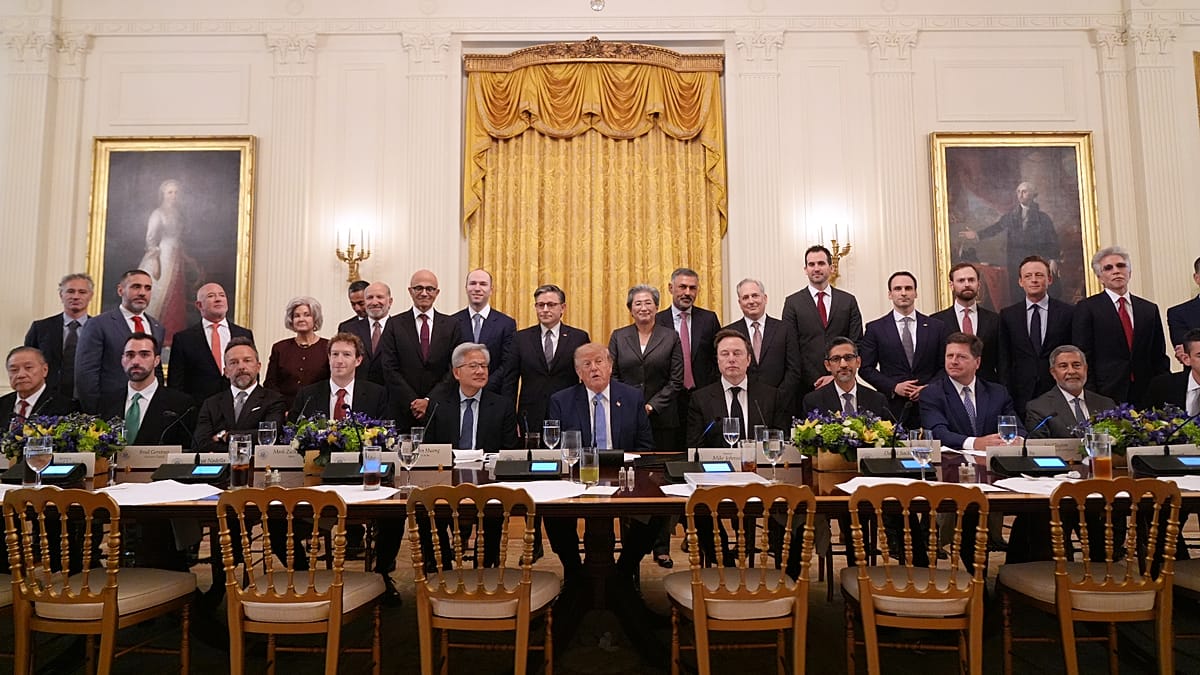
In September, Trump urged AI firms to commit to “tremendous self-policing” under a voluntary pact, but his administration has not said how it will check that they comply. The White House did not answer questions about CAISSI. Instead it pointed to Trump's new Super Intelligence Force, led by National Intelligence Director Jay Clayton.
Amos Toh of the Brennan Center for Justice told the AP that treating AI safety as a national security matter risked sidelining consumer protection, privacy and civil rights. “All of these decisions are of immense public consequence and should be explained and rationalised in the public eye,” Toh said. “And that's not happening.”
The situation in Washington stands in stark contrast to the approach in Brussels. The EU's AI Office, with its enforcement powers and growing staff, is positioning itself as a global regulator of AI, while the US centre that was meant to be a scientific watchdog is now silent and leaderless. For European policymakers and businesses, the question is whether the US will remain a reliable partner in setting AI safety standards, or whether it will defer to industry interests at the expense of public protection.
As the political landscape in Washington shifts, the fate of CAISSI will be watched closely in European capitals, where AI regulation is seen as a matter of strategic importance. The EU's own AI Act, which came into force in August, gives the AI Office the power to fine developers of the most advanced models up to 7% of global turnover for non-compliance. That is a far cry from the voluntary self-policing that Trump has championed.
For now, the US centre remains in limbo, with no clear direction and no public output. The White House's silence on the matter only deepens the concern that AI safety is being quietly shelved in favour of corporate interests. As Toh put it, the decisions being made are of “immense public consequence” and deserve to be made in the open.