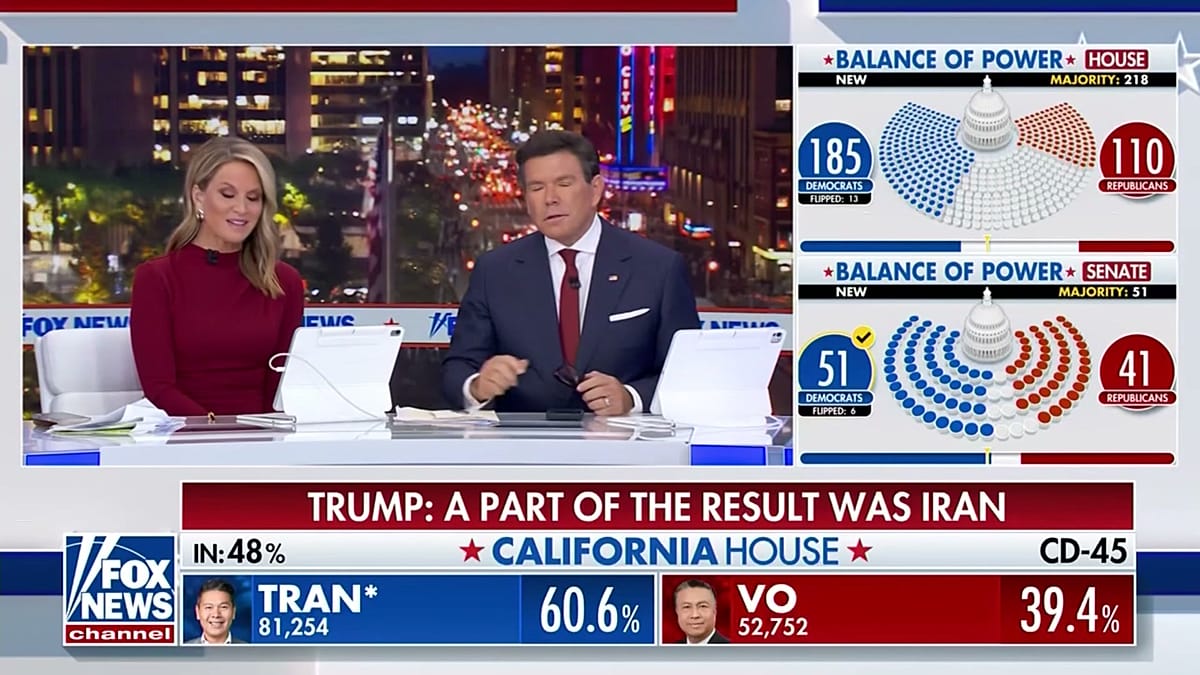
The Democratic Party has swept to victory in both chambers of the US Congress, handing President Donald Trump the most significant electoral rebuke of his political career. With votes still being counted early on Wednesday morning, the Democrats had secured 220 seats in the House of Representatives, a gain of 25, while in the Senate they flipped seven Republican seats, including in Texas, Ohio, Kansas and Maine.
The result was widely interpreted as a verdict on the president's economic stewardship. Polls conducted on election day suggested that roughly two-thirds of voters believed his tariff policies had damaged the American economy. Trump, for his part, said he would accept the outcome but insisted it was not a personal defeat. He quickly signalled his intention to block Democratic legislation, posting an image of a red cap emblazoned with the word “VETO”.
For European policymakers and investors, the immediate question is what this new political landscape means for the continent. The answer, according to analysts, is less straightforward than it might appear.
Tariff threat remains, despite Democratic control
One of the most pressing concerns for European exporters has been the threat of new US tariffs. The midterm result does little to remove that risk. Trump's tariff authority no longer depends on Congress. After the Supreme Court struck down his emergency tariffs in February, the administration shifted them under Section 301 of US trade law, which allows the president to act unilaterally.
Democrats can hold hearings and slow the confirmation of presidential nominees, but they cannot easily strip away that power. James Smith, a developed markets economist at Dutch bank ING, noted before the vote that trade, like foreign policy, is an area where the president can act without legislative approval. He did not rule out new tariffs aimed at Europe, which he said would have significant implications for US inflation and for the Federal Reserve's policy path.
In a divided Washington, Trump may even be more inclined to use his unilateral trade powers, since he faces little chance of passing broader legislation. That leaves European businesses in a familiar state of uncertainty.
Ukraine aid: intent is not commitment
On Ukraine, the Democratic victory offers some hope. The party will now chair Senate committees and control the confirmation process for senior administration officials. Many Democrats have expressed strong support for additional military and financial assistance to Kyiv.
But the practical reality is more complicated. Over the past two years, the White House has repeatedly withheld funds that Congress had already approved, allowing them to expire at the end of the fiscal year. Nevada Joan Lee, a policy fellow at the European Council on Foreign Relations, warned in a commentary last month that a Democratic Congress could authorise new money for Ukraine, yet the president might simply refuse to spend it.
Her advice to European governments is clear: treat earmarked funds as an expression of intent, not a firm commitment. European capitals should plan their own support accordingly, rather than relying on promises from Washington that may never materialise.
Markets take the result in stride
Financial markets reacted calmly to the news. The euro strengthened by 0.4% against the dollar, trading at $1.1232 by 07:00 CET, while gold climbed 2% to $4,011 an ounce, back above the symbolic $4,000 level. Silver rose 3.4% to $51.49. Stock futures were modestly lower on both sides of the Atlantic, with S&P 500 futures down 0.3% and Euro Stoxx 50 futures off about 0.5%.
Government bonds rallied, with the 10-year Treasury yield falling 2.9 basis points to 4.94%. Germany's 10-year Bund yield had closed on Tuesday at 3.33%, before the results came in. Bitcoin was little changed at around $77,700, and Brent crude traded near $104 a barrel.
Historically, markets have tended to welcome divided government, because it reduces the likelihood of major legislative surprises. Luca Bindelli, head of investment strategy at Swiss private bank Lombard Odier, pointed out that in the three months following past midterm elections, 10-year Treasury yields have typically fallen by 20 to 25 basis points.
Diego Barnuevo, a market analyst at payments company Ebury, said a Democratic Congress could restrain Trump's expansionary fiscal agenda, which would be mildly positive for the US deficit outlook. But Ed Yardeni, president of Yardeni Research, sounded a note of caution. He warned that the coming fight over the debt ceiling could push borrowing costs higher, rather than lower, if the two parties engage in a prolonged standoff. Barnuevo expects the debt limit to become binding at some point in 2027.
Euro's fate tied to the Fed and domestic woes
Currency strategists doubt that the midterm result will have a lasting impact on the dollar. Francesco Pesole, FX strategist at ING, and his colleagues argued that the greenback continues to respond primarily to the Federal Reserve's policy trajectory, which is unlikely to be directly affected by the election outcome.
The euro, meanwhile, faces its own challenges. Energy prices remain elevated, largely due to the ongoing conflict with Iran, and ING expects eurozone inflation to stay around 4%. Investors are also demanding a higher risk premium to hold French government bonds, reflecting persistent fiscal and political concerns in Paris.
For Europe, the midterm result is a reminder that Washington's political shifts can have profound consequences, but they do not automatically translate into a more predictable transatlantic relationship. The continent will need to continue hedging its bets, both on trade and on security.