Public broadcasters in the Czech Republic faced widespread disruption on Tuesday as staff walked out and thousands took to the streets in protest against a government proposal to overhaul media funding. The action, described as unprecedented in the country's post-1989 history, reflects deep unease over the ruling coalition's plans to shift financing from household licence fees to direct state budget allocations.
The plan, championed by Prime Minister Andrej Babiš, would cut public radio and television budgets by roughly 15 percent, according to government estimates. Officials argue the change is necessary to reduce costs and insist it will not affect editorial independence. Babiš dismissed the protests on Monday, saying "nobody wants to control public media, let alone nationalise them" and that "none of what the people are protesting against... is true."
But critics see the move as a power grab. They point to similar funding overhauls in Hungary under former Prime Minister Viktor Orbán and in Slovakia under Robert Fico, where state budgets were used to bring broadcasters under political sway. In the Czech case, the three-party nationalist coalition led by Babiš has already pushed the bill through its first reading in a controversial overnight parliamentary session last month.
Strike and rallies
Czech Television and Czech Radio reduced their output to archived programmes and shortened news bulletins on Tuesday. Michal Kubal, chief news editor at Czech Television, said the strike was a first for the country's public service media. Viewers saw an on-screen message: "We are doing everything we can to ensure that we can continue to provide a public service in its full scope and quality in the future."
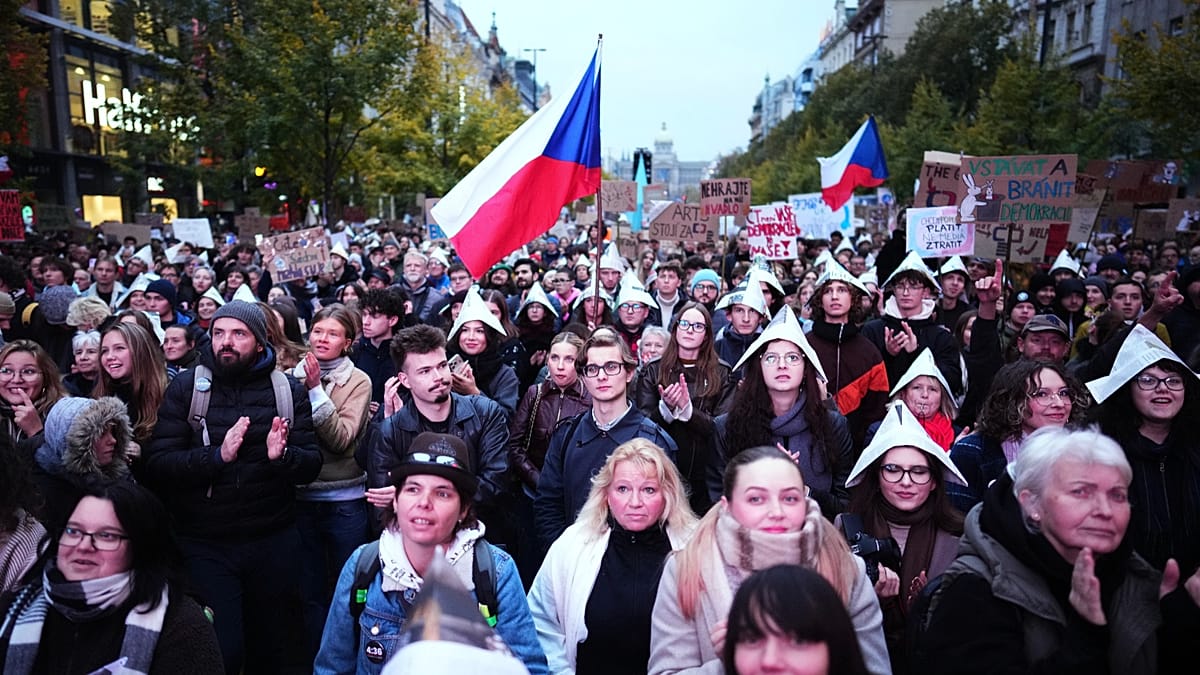
Staff marched from the broadcasters' headquarters to a central square in Prague, where they were joined by university students and other demonstrators. Many wore triangular paper hats resembling a popular animated character from Czech TV that has become a symbol of the protest. Similar rallies took place in other cities across the country.
The action has drawn support from labour unions, university deans, churches, artists, athletes, and international media organisations. In a joint statement, the European Federation of Journalists, Reporters Without Borders, and other groups warned that "such a funding model opens the door to political pressure and threatens editorial independence."
Under the proposed system, public radio and television would receive money directly from the state budget instead of the current licence fee paid by households and businesses. The reduction in funding could lead to staff layoffs, reduced production, and programme cancellations, according to broadcasters.
The protest comes amid broader concerns about media freedom in Central Europe. In neighbouring Slovakia, similar changes have been accompanied by pressure on journalists, while Hungary's media landscape has been heavily criticised by international watchdogs. The Czech Republic has long been seen as a relative outlier in the region, with a robust public broadcaster, but activists fear that could change.
Babiš's coalition has defended the bill as a modernisation, arguing that licence fees are outdated and that state funding would be more efficient. However, opponents counter that the real aim is to bring the media under government control, pointing to the speed with which the bill is being pushed through parliament.
The strike is set to continue until the government agrees to withdraw the proposal, though no talks have been scheduled. The bill still faces two more readings in the lower house and must pass the Senate, where the coalition lacks a majority, before it can become law.
For now, Czech viewers and listeners are experiencing a pared-down service, a visible reminder of the standoff between the government and the country's public media. The outcome will be closely watched across Europe, where similar battles over media independence are playing out in several member states.