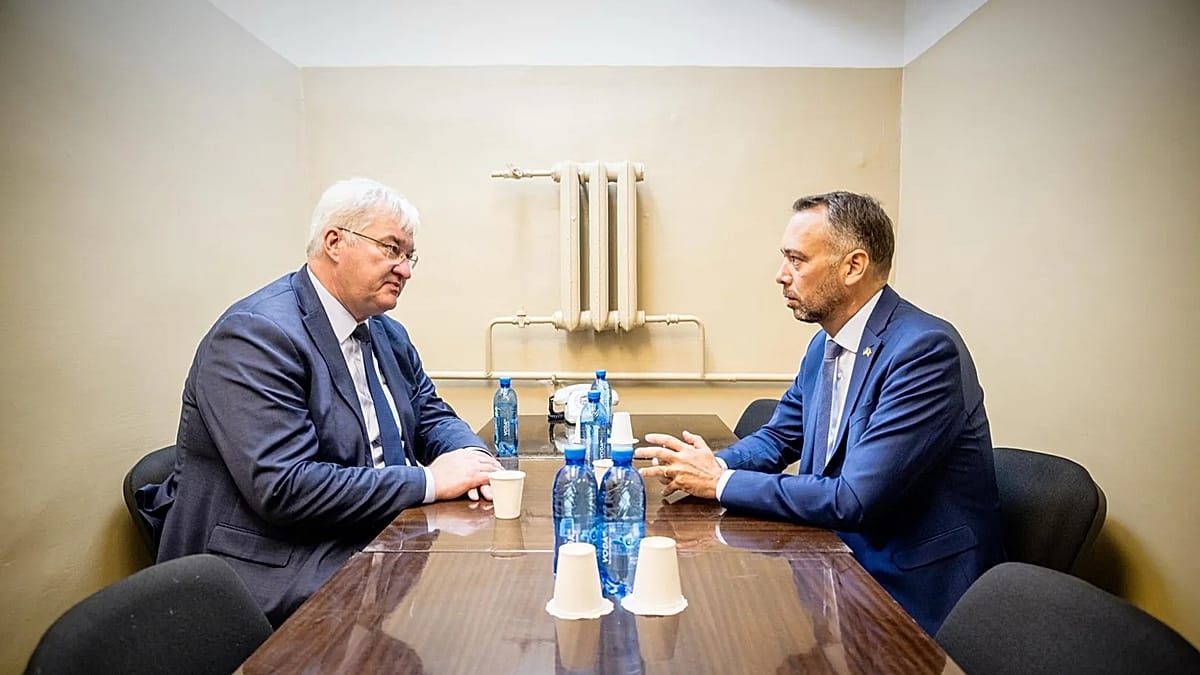
KYIV — The steady wail of air raid sirens has become a grim constant in the Ukrainian capital. On Tuesday, that reality intruded directly into diplomacy: Belgian Foreign Minister Maxime Prevot and his Ukrainian counterpart, Andrii Sybiha, were forced to move their meeting into a bomb shelter beneath the Ukrainian foreign ministry as Russian drones circled overhead.
Sybiha documented the encounter on X, posting photographs of the two ministers seated in a cramped, windowless room. “Due to Russian drones attacking our capital, we held our talks underground in the @MFA_Ukraine bomb shelter—a daily reality for millions of Ukrainians, shared by our Belgian guests today,” he wrote.
The shelter meeting underscores the persistent threat facing Kyiv, which has been a regular target of Russian missile and drone barrages since Moscow’s full-scale invasion began in February 2022. According to a local air-alert tracker, at least eight alerts had sounded in the city by Tuesday afternoon, with one still active at the time of writing.
Solidarity and support
Despite the circumstances, the two ministers covered substantial ground. Sybiha expressed Ukraine’s solidarity with Belgium over the devastating wildfires that have scorched the country’s High Fens region in recent days, offering Ukrainian assistance if needed. The blazes, which have forced evacuations and destroyed large swaths of protected moorland, have been a major challenge for Belgian emergency services.
On the war itself, Sybiha briefed Prevot on the latest frontline developments and thanked Belgium for its sustained backing, which he said now exceeds €4.6 billion. He singled out the more than €1 billion in military aid delivered this year, both bilaterally and through NATO’s Prioritised Ukraine Requirements List (PURL) initiative, which facilitates the purchase of US-made equipment and munitions for Ukraine. As of June 2026, allies had committed over $6 billion through that mechanism, according to NATO.
Belgium has also contributed to training Ukrainian troops, including F-16 pilots and technicians. In June, Defence Minister Theo Francken told reporters in Brussels that Belgium would “step up” its support, with seven F-16 fighter jets slated for delivery to Ukraine in 2026. He added that he would propose sending all of Belgium’s F-16s to Ukraine in the coming years, once the country receives its own F-35s.
The meeting came as Russian forces continued their deadly strikes on Ukrainian territory. In the Kharkiv region, a missile attack on the village of Pechenihy killed at least 10 people and wounded 18 others, according to Oleh Syniehubov, head of the Kharkiv Regional Military Administration. He said the strike, which used two Banderol cruise missiles, also damaged ten houses, multiple cars, and shops.
The ongoing attacks have heightened concerns about Ukraine’s air defence capabilities and the resilience of its civilian population. As European allies weigh further military aid, the image of two foreign ministers huddled in a shelter has become a stark symbol of the war’s daily toll.
For Belgium, the visit also highlighted the broader European dimension of the conflict. Brussels has been a vocal supporter of Kyiv, and its commitment to F-16 deliveries marks a significant step in the coalition of nations providing advanced fighter jets to Ukraine. The timing of the meeting, however, also drew attention to the fragility of diplomatic engagement in a country under constant threat.
As the sirens eventually fell silent, the ministers emerged to continue their discussions, but the message was clear: for Ukrainians, the war is never far away, and even the most routine diplomatic encounters must adapt to the realities of conflict.