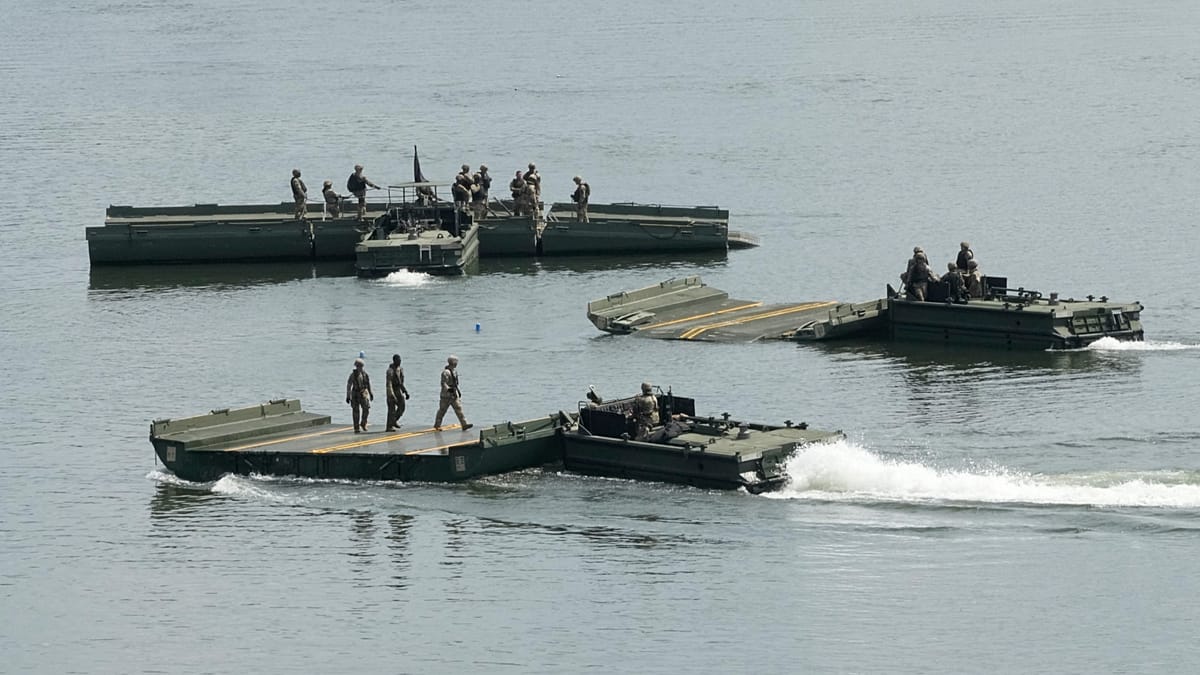
South Korean President Lee Jae Myung on Tuesday sought to reassure a nervous public after US President Donald Trump's surprise decision to scale back joint military exercises. Speaking at a cabinet meeting in Seoul, Lee insisted that a robust alliance with Washington remains the cornerstone of national security, even as the move left many in the country questioning America's commitment.
"National security will be further strengthened when the alliance is solid," Lee said, adding that "when we build up our strengths, our value and importance as an ally will further grow." His comments came a day after Trump announced on social media that the US would "substantially reduce" the annual Ulchi Freedom Shield drills, which began on Monday and involve tens of thousands of troops from both countries.
The exact scope of the reduction remains unclear. Both the South Korean and US militaries had earlier said this year's exercises would be comparable in scale to previous ones and would incorporate lessons from recent conflicts, including North Korea's experiences on the Russia-Ukraine front. They also stressed the drills are defensive in nature. Pyongyang, however, condemned the exercises as provocative and vowed to respond with "a new level of a deterrent."
Tokyo backs trilateral cooperation
Japan's defence minister, Shinjiro Koizumi, echoed Lee's sentiments during a visit to Canberra on Tuesday. "As Japan faces the most severe and complicated security environment in the post-war era, the cooperation among Japan, the United States and South Korea is critical to the peace and stability of the region," he told reporters.
Trump's decision, which he justified by citing his "good relationship" with North Korean leader Kim Jong Un and South Korea's refusal to join the US war against Iran, appears to have been made without prior consultation with Seoul. This has deepened concerns about the reliability of an alliance forged during the Korean War, which ended in 1953 with an armistice rather than a peace treaty.
The US maintains about 28,500 troops in South Korea, a legacy of that conflict. For many South Koreans, the US "nuclear umbrella" is a vital deterrent against a nuclear-armed North Korea. Any weakening of that commitment could have profound security implications.
Confidence in Washington has already been eroded by Trump's tariff policies and last year's immigration raid in Georgia that led to the detention of hundreds of South Korean workers. The conservative daily Hankook Ilbo wrote in an editorial that Trump's announcement "reveals the stark reality of a faltering Korea-US alliance, fuelling public anxiety," adding that "it's absurd that the US appears to treat North Korea more respectfully than its ally South Korea."
Uncertain prospects for Kim-Trump reengagement
Trump, who met Kim three times during his first term, insisted on Monday that his personal ties with the North Korean leader have made the situation "much safer." "Kim Jong Un has always treated me with great respect," Trump said. "I understand him. He understands me."
But Kim has avoided any talks with the US or South Korea since his earlier diplomacy with Trump collapsed in 2019. Experts say Kim is unlikely to return to negotiations unless he is offered significantly larger concessions. In recent years, he has expanded his nuclear arsenal and deepened ties with Russia, which has bolstered his military and diplomatic standing.
Lee's office expressed hope that a "friendly relationship" between Trump and Kim could lead to "meaningful dialogue" to promote peace on the Korean Peninsula. That stance drew criticism from conservatives, with Park Chung-kwon, a spokesperson for the main opposition People Power Party, warning that "South Korea's security bulwark is being shaken to its very foundations."
For Europe, the developments carry broader implications. The US alliance system in Asia is a pillar of global stability, and any erosion could have knock-on effects for European security, particularly as Washington's attention is increasingly drawn to the Indo-Pacific. The situation also echoes European concerns about the reliability of US commitments under Trump, as seen in his drone tariffs on Europe and his approach to other alliances.
As the Ulchi Freedom Shield exercises continue, the focus will be on how the reduction is implemented and whether it signals a broader shift in US policy. For now, both Seoul and Tokyo are trying to project confidence, but the uncertainty is palpable.