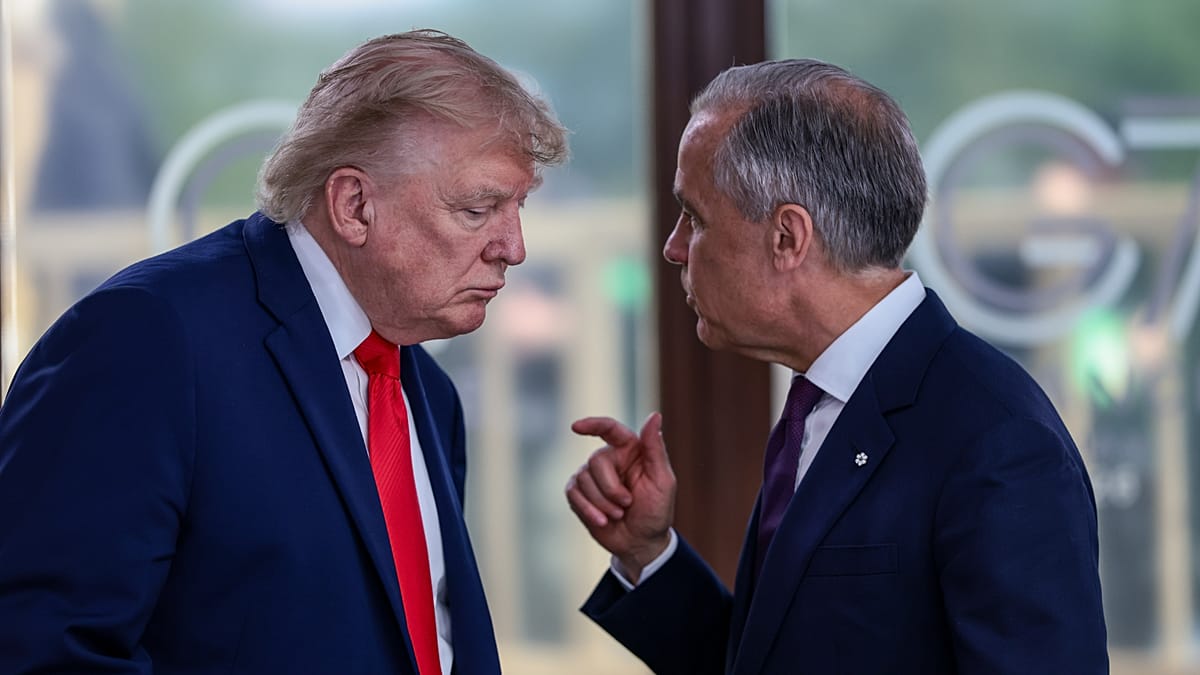
With just hours to go before a midnight deadline, Washington and Ottawa are locked in intense negotiations to prevent a new wave of US tariffs on Canadian products. The threatened 50% duties, set to hit roughly $20 billion (€17.2bn) of goods, would affect everything from hockey sticks to tongue depressors, and could reshape the economic relationship between the two neighbours.
Canadian Prime Minister Mark Carney described the talks as "very intense and delicate" in a Monday press conference, while declining to provide specifics. Carney and US President Donald Trump spoke by phone on Monday afternoon, underscoring the urgency of the situation. The two countries have a long history of trade disputes over softwood lumber and dairy, but they have also remained steadfast allies, with a 5,525-mile border that is largely undefended and sees nearly 330,000 people and $2 billion (€1.72bn) in goods cross daily.
A dramatic shift in US policy
Trump's hard-line approach marks a significant departure from previous US administrations. He has used tariffs to encourage manufacturing to return to the US and has repeatedly floated the idea of Canada becoming "the 51st state." That rhetoric has not gone down well in Canada, where a petition to oust US Ambassador Pete Hoekstra, a Trump ally, has gathered nearly 218,000 signatures since 21 July, accusing him of normalising annexation talk.
Both sides appear to be seeking an exit ramp. Nearly 72% of Canada's goods exports went to the US last year, making the stakes particularly high for Ottawa. Analysts suggest that Washington may be reluctant to impose steep new tariffs, which are initially paid by US importers and then passed on to consumers, so close to the November midterm elections when voters are already frustrated with high living costs.
"I don't think either side really wants these tariffs to come into effect," said Ryan Majerus, a former US trade official and partner at King & Spalding. "There's a pretty strong push on both sides to find an off ramp here."
The US is pressing Canada to purchase more American military hardware, including F-35 fighter jets, to join Trump's "Golden Dome" missile-defence system, and to provide greater access to critical minerals that would reduce US reliance on China. Canada, in turn, is seeking relief from existing US tariffs on steel, aluminium, and softwood lumber, which Washington claims are unfairly subsidised.
Depression-era law as leverage
Trump has reached back to the 1930 Tariff Act, a law infamous for worsening the Great Depression, to justify the 50% levies under Section 338. This provision, never before used, allows a US president to impose tariffs of up to 50% on nations deemed to discriminate against US businesses, with no investigation required and no expiration date.
Trump alleges discrimination against American autos, alcohol, and cheese, and remains angry that Canada, along with China, retaliated against his earlier tariffs. The threat also bolsters US leverage as the North American trade pact, the US-Mexico-Canada Agreement, is being renegotiated. "You can't renegotiate it with a massive trade war going on," noted Christopher Gundermann of the Center for Strategic and International Studies.
However, domestic political pressure could constrain Carney. Political scientist Daniel Béland of McGill University cautioned that Canada "cannot look like it is simply caving," warning that one-sided concessions risk a fierce backlash and signal weakness to future pressure.
Canada's trade minister, Dominic LeBlanc, met US Trade Representative Jamieson Greer on Monday and said only that "the work is continuing." As the clock ticks down, the outcome remains uncertain, but the implications extend beyond North America. European allies are watching closely, as a trade war between the US and Canada could have ripple effects on global supply chains and transatlantic relations. For more on how US trade policy is affecting Europe, see the impact of drone tariffs on Europe.
Meanwhile, Canada's broader economic strategy, including its $70bn clean energy plan, could be affected by the outcome of these talks. The midnight deadline looms, and with it, the future of North American trade relations.