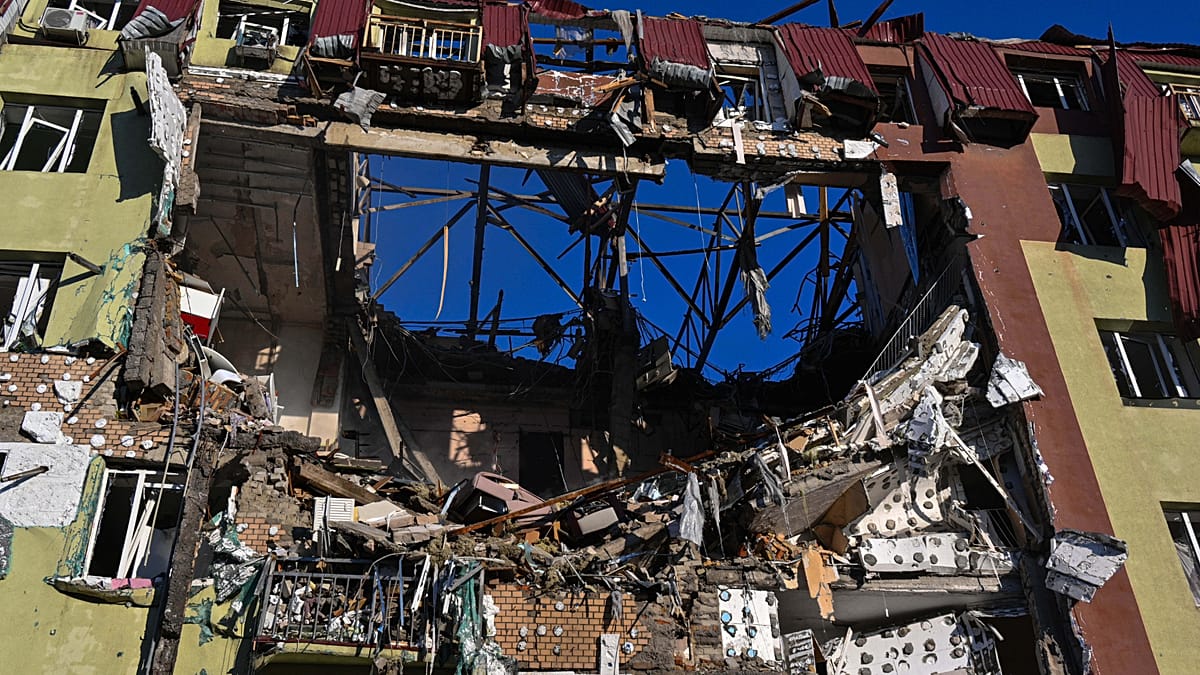
In the early hours of Thursday, Russian forces launched a large-scale aerial assault on Ukraine, mixing cruise missiles, Shahed-type drones, and a relatively new addition to their arsenal: the Banderol. Ukraine's Air Force reported intercepting the munitions during the barrage, but the weapon's growing presence signals a deliberate shift in Moscow's strategy—one that targets not just physical infrastructure but the economic calculus of Ukraine's air defense.
The Banderol, also designated S8000, is a small jet-powered loitering munition that blurs the line between a cruise missile and an attack drone. First recorded in Ukrainian skies in spring 2025, it has since become a recurring feature of Russian strikes. Its appeal lies in its cost: while a conventional cruise missile like the Kh-101 can cost around €685,000 to produce, the Banderol is estimated at between €42,500 and €127,500, depending on components. That places it in the same price bracket as the Iranian-designed Shahed, but the two weapons present very different challenges for defenders.
Shahed drones, slow and relatively simple, can increasingly be countered by inexpensive interceptor drones. The Banderol, however, flies at over 500 km/h and requires more capable short- and mid-range air defense systems—the same systems needed to stop cruise missiles. This forces Ukraine to expend scarce, high-value interceptors on a weapon that costs a fraction of the missile it mimics. The imbalance is deliberate: Russia can produce and launch Banderols in volume, while Kyiv must decide whether to use a €1 million Patriot interceptor or risk letting a €50,000 munition through.
A weapon designed to stretch defenses
The Banderol's launch method compounds the problem. Unlike cruise missiles fired from strategic bombers—whose takeoff can be detected and give Ukrainian forces advance warning—the Banderol is primarily launched from Orion reconnaissance drones, also manufactured by Russia's Kronshtadt JSC. It has also been integrated into Mi-28 helicopters. This reduces the tactical warning time and complicates interception planning.
With a range of up to 500 km, the Banderol is being used extensively against the Odesa region, launched from positions in Russian-occupied Crimea. Vladyslav Vlasiuk, Ukraine's presidential envoy for sanctions policy, has said the weapon is involved in around 80% of Russian attacks on Odesa's infrastructure. The munition carries a 114 kg fragmentation warhead with up to 50 kg of explosives—substantially less than the 400–500 kg payloads of Kh-101 or Iskander-K missiles. But its destructive power is secondary to its strategic purpose.
By forcing Ukraine to commit its most capable air defenses to intercept a cheap, relatively low-yield weapon, Russia aims to deplete the very systems that protect against its more powerful cruise missiles. This is a classic attrition strategy, and it is already straining Ukrainian resources. The recent missile barrage on Kyiv that killed nine people underscores the persistent threat, even as Ukraine's air defenses have proven effective in many engagements.
The Banderol relies on satellite navigation for guidance, making it vulnerable to electronic warfare, but it also carries an autonomous navigation system as a backup. This redundancy complicates jamming efforts and adds another layer of difficulty for Ukrainian defenders.
The weapon's emergence also highlights a broader concern: Russia's continued ability to source foreign technology for its weapons industry despite Western sanctions and export controls. The Banderol's components, like those of other Russian systems, appear to include parts from multiple countries, raising questions about the effectiveness of the restrictions imposed since the full-scale invasion began.
For Ukraine, the immediate challenge is adapting to a new threat that is cheaper to produce than to counter. The UK's recent pledge of unwavering support is welcome, but the long-term solution may require developing more cost-effective interception methods, such as the use of interceptor drones against faster targets, or enhancing electronic warfare capabilities to disrupt the Banderol's guidance systems.
As Russia continues to refine its tactics, the Banderol represents a worrying evolution in aerial warfare—one where the economics of defense are as critical as the technology itself. For Kyiv, every intercepted Banderol is a small victory, but the cumulative cost is mounting. The pressure on Russia's own resources may eventually limit its production, but for now, the Banderol remains a cheap and effective tool in Moscow's campaign to wear down Ukraine's defenses.