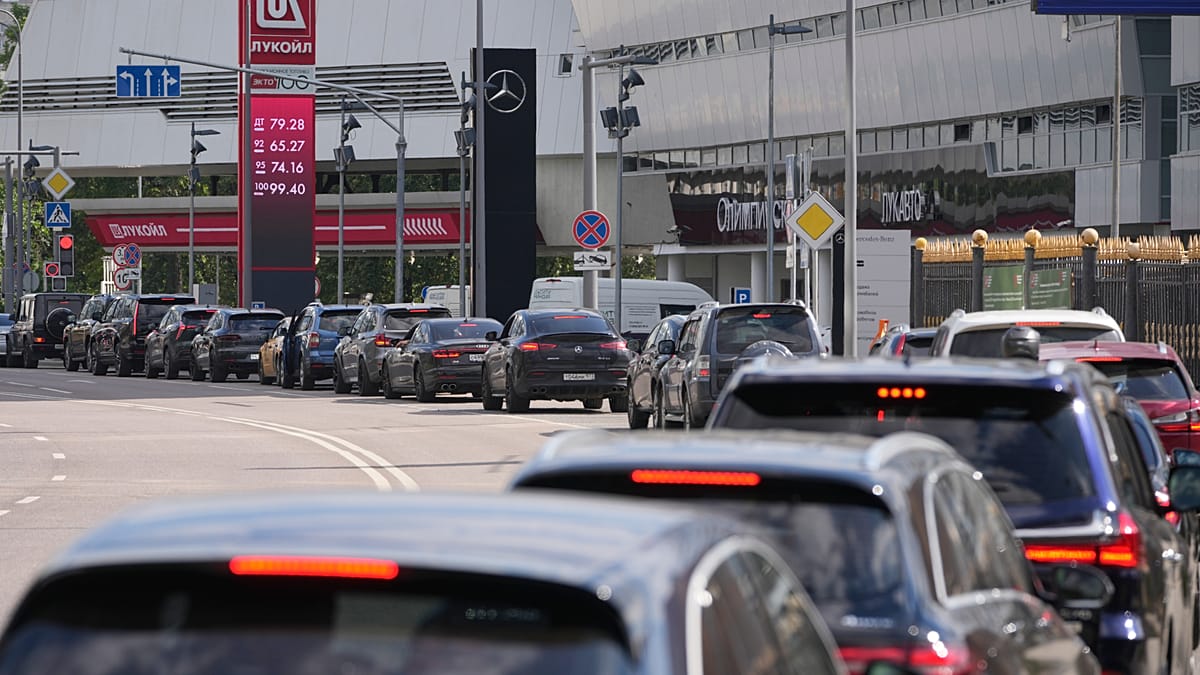
Russia's fuel crisis has reached a critical point, with petrol available at fewer than three in ten filling stations nationwide on Wednesday. The monitoring app Gdebenz reported availability at just 28% of stations, down from 41% a week earlier, as queues formed at pumps in Moscow for the first time.
Fuel restrictions are now widespread. According to Benzinmap, which tracks rationing measures, nearly all regions have imposed limits on volumes per customer, QR-based rationing, or odd-even number plate schemes. In Moscow, Gazprom Neft stations capped petrol at 40 litres per fill-up, while Tatneft limited petrol to 50 litres and diesel to 60. By Wednesday, the Yandex Fuel service showed AI-92 petrol available at only one in ten stations in the capital.
Ukrainian drone campaign takes its toll
The shortages are a direct consequence of Kyiv's sustained drone campaign against Russian oil infrastructure, aimed at weakening Moscow's war machine. By early July, every major refinery in Russia had been struck at least once. In the first two weeks of August alone, nearly a dozen more facilities were hit, including Yaroslavnefteorgsintez in Yaroslavl, two refineries in Bashkortostan, and export infrastructure at the port of Ust-Luga.
Russian Forbes calculated that damaged refineries now account for 54% of total national refining capacity. Daily petrol output fell to between 75,000 and 80,000 tonnes in July, against summer demand of 115,000 to 120,000 tonnes—a daily deficit of roughly 35%.
President Vladimir Putin acknowledged the shortage at the end of July, describing it as "non-critical," and repeated the phrase on Wednesday. "There are no critical consequences from such attacks, there have been none and there cannot be any. But they do, of course, cause us damage; that is obvious, we understand it, we see it and we know it," he said.
Imports fail to plug the gap
Despite being one of the world's largest oil exporters, Russia has been forced to import fuel. In July, Moscow banned petrol and diesel exports to protect domestic supply. It has been importing by rail from Belarus—shipments surged 25-fold year on year between January and July—as well as from Kazakhstan and, for the first time, Morocco, when a Lukoil-supplied cargo of approximately 30,000 tonnes of AI-92 was loaded at Tangier and shipped to Murmansk.
However, much of the imported fuel has not reached consumers. According to Russian industry sources cited by the portal InfoTEK, large volumes of Indian and Moroccan petrol are stuck at Murmansk because suppliers want between 110,000 and 130,000 roubles per tonne, while the state regulator demands a price below 78,000 roubles.
A further supply gap is expected in September when Belarus's Novopolotsk refinery undergoes scheduled maintenance. Belarus supplied a record 212,000 tonnes of petrol and 162,000 tonnes of diesel to Russia in July. It now processes Russian crude on a tolling basis and is Moscow's most important external fuel source. Both of Belarus's refineries—Novopolotsk and Mozyr—have a combined export capacity of roughly 2 million tonnes per year, a fraction of what Russia needs.
Price rises and crackdowns
Retail petrol prices rose 7.4% in the first half of 2026 to an average of 70 roubles per litre, and diesel by more than 12%, according to official data. Residents in some regions say prices have exceeded 100 roubles per litre (€1.02). The Kremlin has ordered the Federal Antimonopoly Service to tighten price controls; the agency said on Wednesday it had opened 41 cases against oil companies for violations.
The crisis has forced Russia to reintroduce fuel grades that it banned in the 2010s. On 5 August, the government authorised the production, import, and sale of Euro-2, Euro-3, and Euro-4 petrol for almost a year. High-sulphur fuel below the Euro-5 standard can degrade modern engines and produces significantly higher levels of air pollutants. Trading in the lower grades started on the St Petersburg exchange on Tuesday.
Meanwhile, authorities are prosecuting people who have complained publicly about the shortages. In Volgograd, five residents were detained after they recorded a video message to the head of the Russian Investigative Committee, Alexander Bastrykin, complaining that officials filled up without restrictions while ordinary drivers faced rationing.
The fuel crisis is a stark reminder of how the war in Ukraine is reverberating across Russia's economy. As the drone campaign continues, the Kremlin's ability to maintain domestic stability may be tested further. For more on the broader impact of the conflict, see Russians withdrawing billions amid fears of asset seizures, and Russian trawlers suspected of spying on Europe's undersea infrastructure.