Anyone hoping to profit from the robotics revolution—whether in factories, warehouses, or homes—quickly hits an awkward reality: the start-ups at the centre of the frenzy are not listed on any stock exchange. Their shares are reserved for venture capitalists and wealthy insiders, leaving ordinary investors to choose from a handful of indirect and often expensive alternatives.
What is available, as European Pulse has found, is a carmaker betting its future on robots, industrial conglomerates where robotics is just one division, and a new breed of listed funds that charge hefty fees for a slice of private companies. Each option carries its own risks, and none offers a clean bet on the sector's purest players.
Tesla: a robot bet wrapped in a car company
Tesla is the most prominent route for retail investors. Elon Musk has repeatedly claimed that about 80% of the company's future value will come from Optimus, its humanoid robot, with robotaxis adding another robotics angle. Yet buying Tesla today still means buying a carmaker first. In the second quarter of this year, automotive sales generated $20.5 billion (€18.1bn) of the company's $28.2 billion (€24.9bn) revenue—almost 75%—while Optimus has yet to record a single sale.
Speaking at the World Economic Forum in Davos in January, Musk predicted that "by the end of next year, we'll be selling humanoid robots to the public." Tesla has since begun assembling Optimus at its Fremont plant in California, but Musk has cautioned that "production will be extremely slow at first, as everything is new. This is not like making a car."
Dan Coatsworth, head of markets at UK investment platform AJ Bell, told European Pulse that many Tesla investors are buying the stock for Musk's entrepreneurial vision. "The vehicle sales keep the lights on and help to fund the more adventurous ideas, including robotics," he said. But that ambition does not come cheap. "European car manufacturers typically trade on less than 10 times forward earnings. In contrast, Tesla trades on 165 times forward earnings. That suggests a lot of the 'blue sky' element is factored into the shares, and investors are having to pay up for it."
Most robots are not humanoids
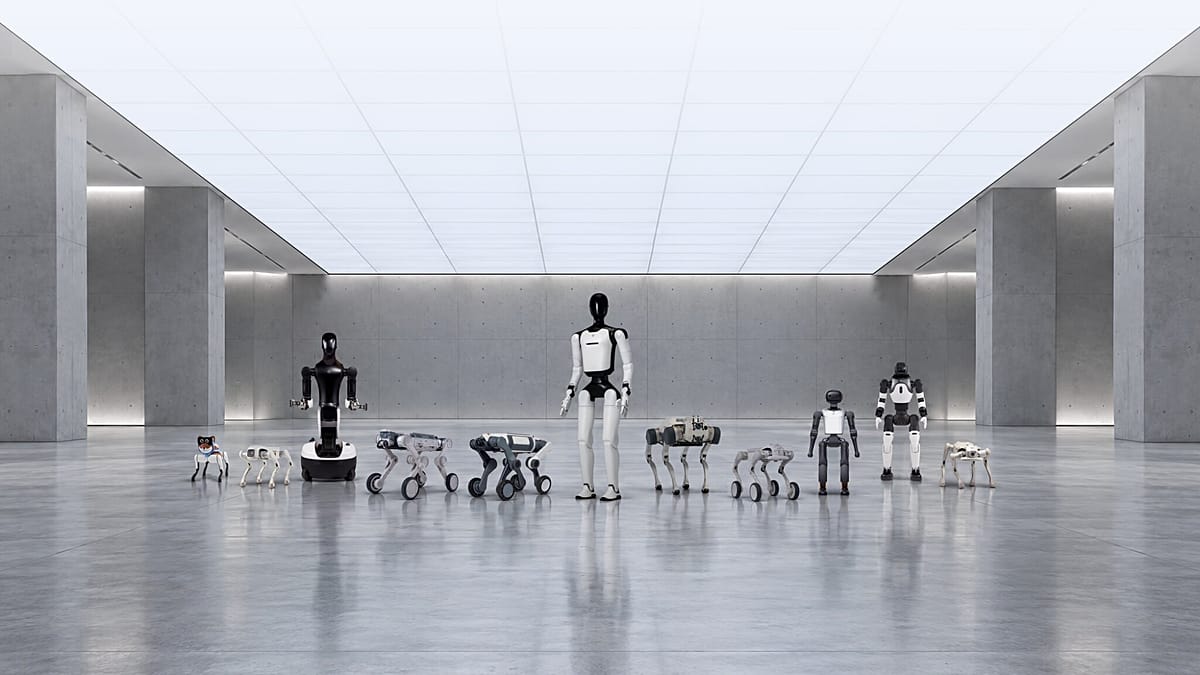
Humanoids also attract attention out of proportion to their market share. According to the International Federation of Robotics (IFR), only about 7,000 humanoid robots were sold worldwide last year for industrial and professional use, compared with 603,000 industrial robots installed globally. The industrial leaders rarely offer a clean bet either. Robots accounted for 44% of sales at Japan's Fanuc in the year to March, but only between 7% and 10% of revenue at Swiss-Swedish group ABB over the last two years. ABB, which had planned to spin off its robotics arm, instead agreed to sell it to Japan's SoftBank for $5.4 billion (€4.7bn). Germany's KUKA left the stock market in 2022 after Chinese appliance maker Midea took full control. Siemens, meanwhile, makes the software and controllers that run automated factories, not the robots themselves.
A listed fund of private robot makers
None of these options offers a direct stake in the start-ups themselves, and that is the gap RoboStrategy aims to fill. The fund, which began trading on the Nasdaq in May under the ticker BOT, holds stakes in private robotics companies and has publicly traded shares, so anyone with a brokerage account can own a slice of its investments. Well-known robotics start-ups such as Figure AI, Dyna Robotics, and Apptronik each made up close to a fifth of its net assets in June.
The fund is run by Andrew Kang, co-founder of crypto investment firm Mechanism Capital, who wrote on X in May that when he first looked at robotics two years earlier, "most venture capitalists I consulted with recommended not to invest in the space." Sentiment has turned fast since then. Robotics start-ups had raised $18.8 billion (€16.6bn) by mid-June this year, more than in the record-breaking year of 2025, according to data platform Crunchbase.
Vehicles like RoboStrategy exist because companies now stay private far longer. The median US tech company that listed in 2025 was 12 years old, against only four back in 1999, according to University of Florida professor Jay Ritter, known as "Mr. IPO" for his decades of research into initial public offerings. In the US, stakes in private companies are largely reserved for wealthy "accredited" investors. Paul Atkins, chair of the US Securities and Exchange Commission, said in March that this kind of exposure "should not be reserved for those who satisfy a certain wealth threshold or are deemed to be sufficiently sophisticated."
However, access does come at a price, even for these new funds. RoboStrategy's shares opened at $27.34 on Friday, about 2.4 times the fund's net asset value of $11.35 per share at the end of August. The shares hit a peak of $59 back in May. "It's a scarcity premium which can happen with a hot investment area," Coatsworth explained. "Investors might feel it is worth paying a premium to invest in RoboStrategy if it means getting early exposure to companies that could be tomorrow's market champions."
That premium can shrink fast. For instance, buyers in early July paid almost four times the value of the underlying assets and have since lost about a quarter of their money, even though net asset value per share rose by 27% over roughly the same period. Investors also pay a 2.5% annual management fee, with total yearly expenses of almost 4%, and the fund's private stakes are valued on estimates rather than market prices.
For European investors, the robotics boom is a global story with local implications. As Germany's role in supplying components shows, the continent is not just a bystander. But the investment options remain limited, and the risks are real. As Coatsworth put it, "Investors need to be aware that they are paying a premium for scarcity, and that premium can evaporate quickly."