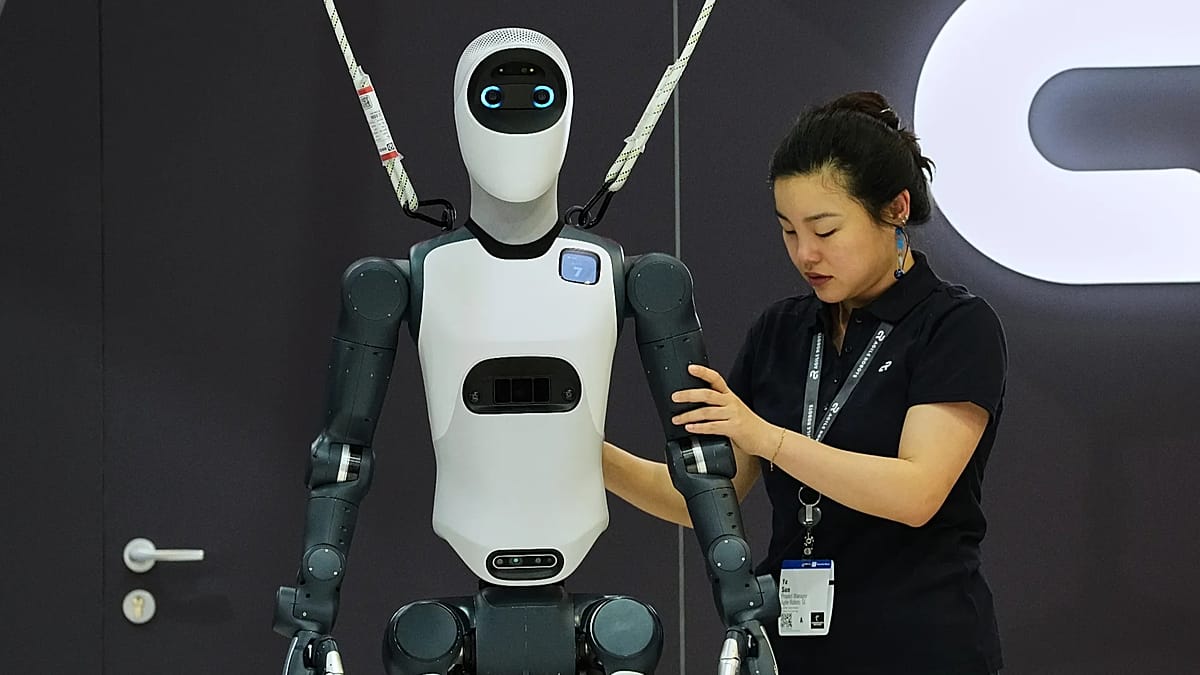
Humanoid robots look like a software story: artificial intelligence, cameras, sensor fusion, machine learning. Look under the casing and it is something far more familiar to Europe — motors, gearboxes, bearings, grippers and precision sensors, the bread and butter of the German and wider European automotive supply base for decades.
That distinction matters because Europe has so far been almost invisible in finished humanoid machines. According to data from the research firm Smart Analytics Global (SAG), around 19,100 humanoid robots were delivered worldwide in the first half of 2026, and 97 percent of them came from China. Agibot, based in the greater Shanghai area, alone shipped 8,400 units. American contenders such as Tesla, Figure AI and Agility Robotics are trailing. For the full year, researchers expect roughly 60,000 shipments, rising to half a million by 2030.
A supplier strategy instead of a robot strategy
The question now being asked in German engineering circles is whether Europe needs to build the robot at all in order to profit from it. A specialist paper from the Fraunhofer Institute for Manufacturing Engineering and Automation IPA, produced with the consultancy P3, argues that the component business is the more realistic prize — and one that plays directly to existing European strengths.
"In principle, the potential along the German and European supply chain is very large," says Vincent Bezold, who heads IPA's Automated Manufacturing Systems segment and authored the report. IPA puts the component market at roughly 30 billion dollars by 2030.
The mechanical arithmetic is straightforward. A conventional industrial robot arm manages with about seven joints. A humanoid needs more than 40, and every joint bundles a motor, a gearbox, a bearing and sensors. German firms including Schaeffler, Bosch, Schunk, Wittenstein and Neugart already make these parts at scale. In August, Herzogenaurach-based Schaeffler unveiled a strain wave gearbox developed specifically for humanoids, designed to transmit motion precisely and powerfully in the smallest possible installation space.
Durability is Europe's opening
Chinese manufacturers produce comparable components, but the Fraunhofer analysis and independent robotics researchers point to a persistent gap in service life. Sebastian Reitelshöfer, who leads robotics research at the University of Erlangen–Nuremberg, is blunt about the showcase machines that draw crowds in Beijing. "They don't happen to run a half marathon as a PR stunt by chance. They do it because they wouldn't withstand a full marathon," he told the ARD-Finanzredaktion. Some components in those flagship models, he says, last only "one or two weeks" under heavy load.
European designs inherited from the automotive world are built to far longer duty cycles — a genuine competitive advantage as humanoids move from demonstration to deployment. The near-term commercial targets are manufacturing, logistics and warehousing, where tasks are clearly defined and productivity can be measured and optimised. SAG notes that the leap from "robots that can put on a show" to "robots that can work reliably" has not yet been made.
That gap is also visible in the wider automation market, where the global robot fleet has passed five million units while humanoid hype has cooled.
The localisation trap
None of this guarantees Europe a share. Bezold warns that supply chains tend to form around the original equipment manufacturers. "As a large proportion of humanoids currently comes from China, corresponding supplier structures are likely to form there as well, just as they did in Germany around the automotive industry," he says. Chinese robot makers have every incentive to source locally, and Beijing is backing the sector heavily to accelerate deployment.
European suppliers also face pressure on the input side, with EU automakers' supply chains already competing for chips and metals against AI-driven demand. Trade policy adds another layer of uncertainty, as Brussels presses China on export quotas in negotiations that could reshape access to critical inputs.
The strategic conclusion from the Fraunhofer work is not that Europe should abandon finished humanoids, but that it should stop treating the component trade as a consolation prize. Germany's Mittelstand and its tier-one suppliers already hold the precision manufacturing, testing and quality-control expertise that humanoid makers will need as volumes scale. Whether that translates into contracts depends on how quickly European firms position themselves with Chinese, American and emerging European robot builders — and on whether policymakers treat robotics components as a strategic industry rather than a legacy one.