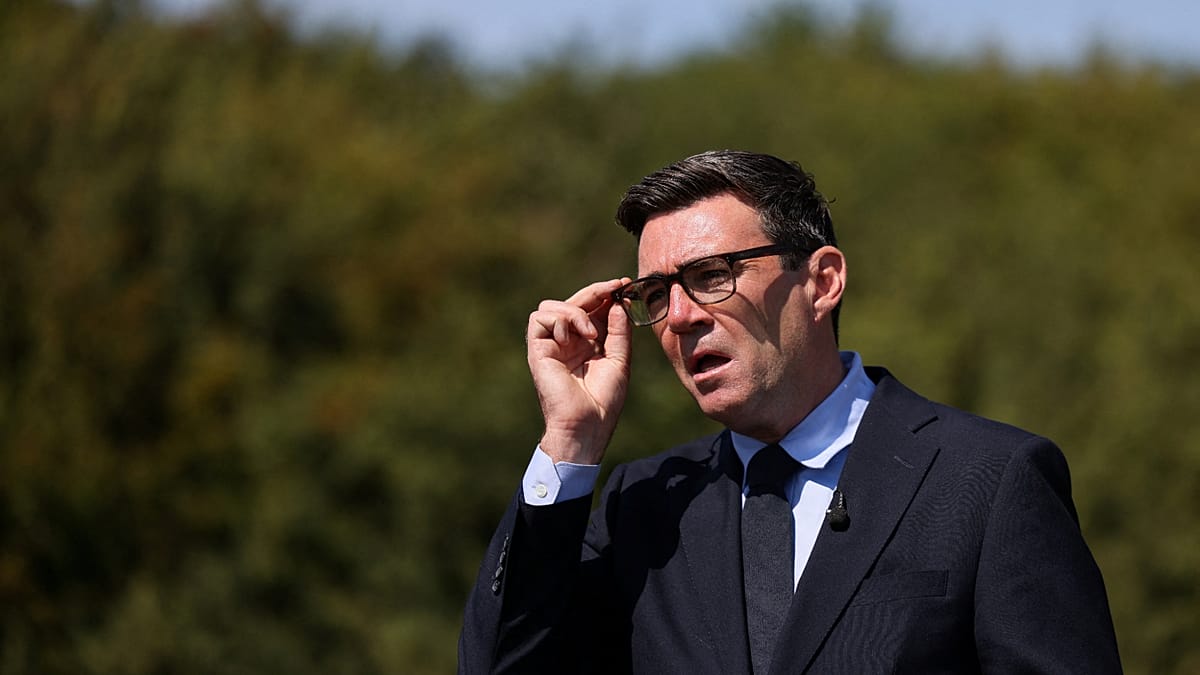
British Prime Minister Andy Burnham has reaffirmed the United Kingdom's steadfast commitment to Ukraine, vowing to maintain full support despite Moscow's warnings of retaliation. Speaking during a visit to Wolverhampton on Tuesday, Burnham responded to a statement from the Russian Embassy in London that had threatened 'consequences' for the UK's involvement in the conflict.
'This is the UK doing what it has long said it would do, which is to support Ukraine 100% against this illegal war led by Vladimir Putin,' Burnham said. He added that Britain was not a 'fair-weather' friend and would 'be there in Ukraine's hour of need.'
The Russian Embassy's statement, issued on Monday, accused Westminster of 'deliberately opting for an escalation of the Ukraine crisis' and of acting as an 'accomplice and co-perpetrator' in Ukrainian attacks. The warning came after reports that UK-made drones had been used in Ukrainian strikes on Russian soil.
Ukraine's long-range campaign
Ukraine has intensified what it calls its 'long-range sanctions' on Russia in recent months, targeting energy infrastructure and logistics facilities to cripple Moscow's economy and degrade its military capabilities. Over the weekend, Ukrainian President Volodymyr Zelenskyy confirmed strikes on an oil facility in Ust-Luga, near the Estonian border, and on Russia's Progress rocket and space centre, a key facility for manufacturing and operating space launch vehicles.
The General Staff of the Armed Forces of Ukraine stated that launch vehicles produced at the Progress centre are used to 'place Russian military, reconnaissance, and communications spacecraft into orbit.' These strikes are part of a broader strategy to disrupt Russian supply chains and command structures.
This escalation comes amid a wider European security landscape where drone warfare is becoming increasingly prominent. Germany, for instance, recently opened a drone security hub in Saxony-Anhalt to address growing aerial threats, reflecting the continent's heightened focus on unmanned systems.
Deadly Russian strikes on Kharkiv
Meanwhile, Russian missile strikes on the village of Pechenihy in the northeastern Kharkiv region killed at least 10 people and injured 18 others on Tuesday, according to local authorities. Oleh Syniehubov, head of the Kharkiv Regional Military Administration, said the attack damaged 10 houses, multiple cars, and shops.
The strikes underscore the ongoing human cost of the war, even as Ukraine pursues its long-range campaign. The UK's continued backing is part of a broader European effort to support Kyiv, though the continent remains divided on how far to go in providing offensive capabilities.
Burnham's remarks signal that London is prepared to weather Russian threats, maintaining a stance that has been consistent since the start of the full-scale invasion. 'We are providing support so that Ukraine can defend itself,' he said, reiterating that the UK's commitment is not conditional on the shifting tides of the conflict.
As the war enters another phase, with both sides trading long-range strikes, the UK's role remains a point of contention with Moscow. The Russian Embassy's warning is unlikely to deter London, which has positioned itself as one of Ukraine's most vocal allies in Europe.