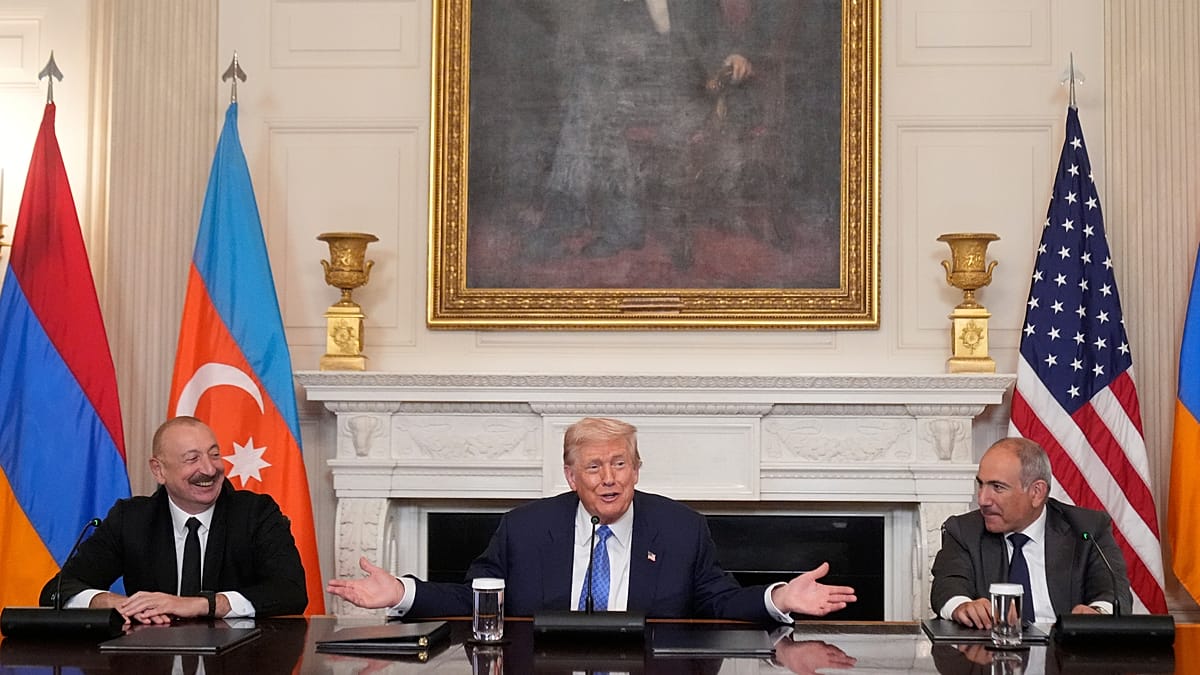
Armenian Prime Minister Nikol Pashinyan has officially launched the construction phase of the Trump Route for International Peace and Prosperity (TRIPP), a US-backed transit corridor that will link mainland Azerbaijan with its Nakhchivan exclave through Armenian territory. The announcement marks a significant milestone in the fragile normalisation process between Yerevan and Baku, a year after the two countries signed a joint declaration in Washington.
In a televised address, Pashinyan called the launch “a truly historic event in the modern history of the Republic of Armenia,” describing TRIPP as the largest economic project in the country since its independence. He stressed that the initiative would not only connect Azerbaijan with Nakhchivan but also enhance Armenia’s own connectivity, both domestically and internationally, by adding momentum to the Trans-Caspian trade route and the broader West-East corridor.
The project is to be implemented jointly by the governments of Armenia, the United States, and Azerbaijan, with a stated commitment to respecting the sovereignty, territorial integrity, and jurisdiction of all participating states. According to Pashinyan, TRIPP will give Yerevan access to new foreign markets and attract investment to the southern Syunik province, while also contributing to regional security by encouraging stability among neighbours.
Live footage broadcast after the speech showed preparatory work beginning at several sites in the Meghri area of Syunik, as confirmed by Governor Robert Ghukasyan. Major construction is expected to follow once the initial groundwork is complete.
A multi-modal corridor with energy and rail components
Beyond road transport, TRIPP is designed to include electricity transit, with plans to connect the power grids of Armenia, Azerbaijan, and Turkey. This would mark a major geopolitical shift in a region where energy infrastructure has long been a point of tension. A railway link is also a core element, with an agreed completion date of 2028.
The project is part of the wider Middle Corridor, an emerging trade route linking China, Southeast Asia, and Central Asia with European markets via the Caspian Sea, the South Caucasus, and the Black Sea. Azerbaijan, Georgia, and Kazakhstan are already cooperating to develop this network, which offers an alternative to traditional supply chains disrupted by conflicts in the Middle East. European companies are increasingly exploring investment opportunities along this route, which could reduce dependence on existing chokepoints.
In a video address marking the kickoff, US President Donald Trump congratulated Pashinyan and announced the establishment of the TRIPP Development Company. “This partnership between the United States and Armenia will create new trade routes for the flow of goods, energy, and travel throughout the region,” Trump said, adding that Washington is “committed to ensuring it is a great, great success.”
The bilateral framework, ratified by Armenia’s parliament in October and signed by President Vahagn Khachaturyan, gives the United States a 74% stake in the joint operating company, with Armenia holding the remaining 26%. The agreement allows Armenia’s share to rise to 49% if the partnership is extended. Armenian officials have emphasised that Yerevan retains full control over legislation, customs, and administration along the route.
Trump also thanked Azerbaijani President Ilham Aliyev for his cooperation and invited Pashinyan to visit the White House in 2027. In a statement on X, Aliyev expressed gratitude for Trump’s remarks, signalling Baku’s support for the project.
The TRIPP initiative stems from the 8 August 2025 joint declaration signed in Washington, where Aliyev and Pashinyan, in the presence of Trump, launched the two countries’ peace agreement. Restoring unhindered transport links between mainland Azerbaijan and Nakhchivan has been a central pillar of the normalisation process, and TRIPP is the key component of that effort.
The project is moving forward in a complex geopolitical environment, with Iran and Russia closely monitoring developments. Both TRIPP and the wider Middle Corridor face challenges tied to the durability of the peace process, including Armenia’s adoption of its peace treaty and the broader stability of the region. As the corridor gains traction, it could reshape trade and energy flows between Asia and Europe, with significant political and economic implications for the continent.