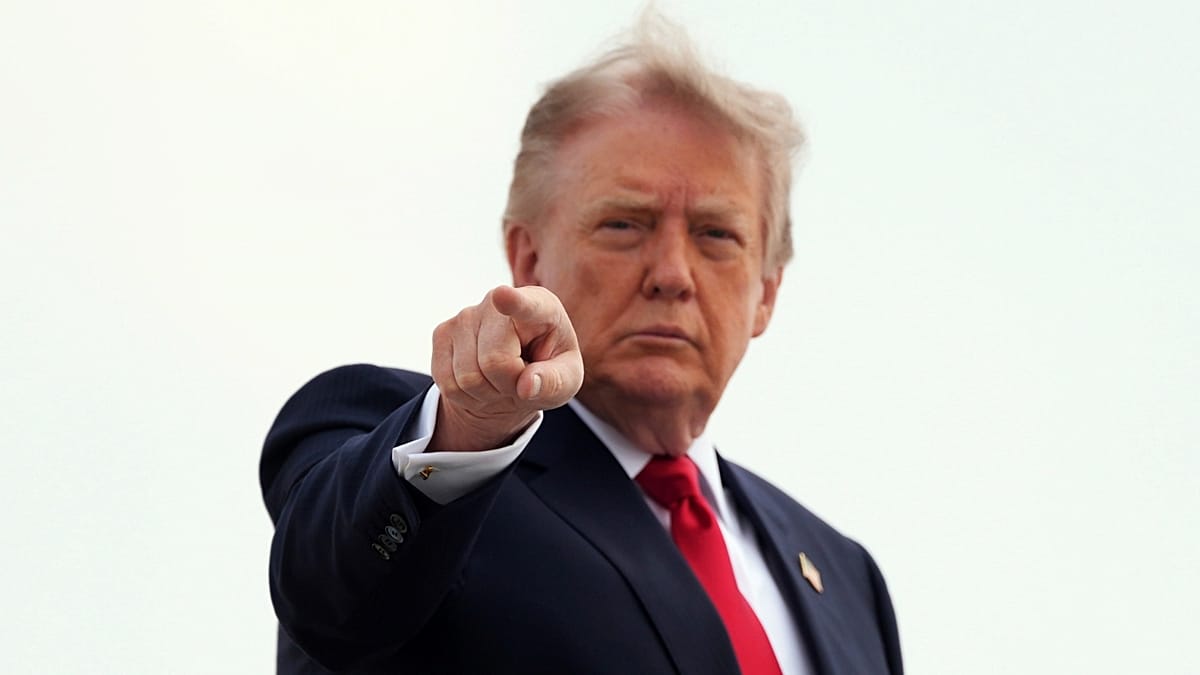
For the past year and a half, European governments have pressed Washington to use its financial muscle to squeeze Moscow. But a draft bill now moving through the US Senate could turn that appeal into a double-edged sword, handing President Donald Trump a fresh legal basis to slap punishing tariffs on friends and rivals alike.
The legislation, originally sponsored by Republican Senator Lindsey Graham and Democratic Senator Richard Blumenthal, was designed to force Trump's hand on Russia. Both were staunch supporters of Ukraine, and the bill was meant to close loopholes that have allowed the Kremlin to keep earning from fossil fuel exports. Yet the text, as written, contains a provision that goes far beyond Russia: it would grant the White House authority to impose duties of up to 100% on goods imported from any country deemed a major buyer of Russian oil and gas, or one that facilitates sanctions evasion.
Graham's sudden death last month gave the stalled project new momentum, with senators seeking to honour his legacy by pushing it into law. Ukrainian President Volodymyr Zelenskyy attended the funeral in Washington, where he lobbied for the bill's passage. "This bill is very important," Zelenskyy said, flanked by senators. "It's also a big signal to Europe, a big signal to Ukraine, a big support of our people."
The bill's core sanctions are broad: it would prohibit financial transactions with Russian banks, target state officials, oligarchs, and the so-called "shadow fleet" of tankers used to evade price caps. But the most contentious element is Section 113, which empowers the president to apply tariffs of up to 100% on all goods from any country that is among the five largest importers of Russian oil or gas, or among the five countries deemed to be facilitating sanctions circumvention. The determination of which countries qualify is left entirely to the executive.
Promoters insist the secondary tariffs are aimed at China and India, whose continued purchases of Russian crude have helped sustain Kremlin revenues. But experts warn the vague wording and weak congressional oversight could give Trump a powerful tool to pursue his broader trade agenda, potentially targeting European allies.
"The bill was deliberately structured around tariffs rather than sanctions to appeal to President Trump and improve its political prospects," said Maria Shagina, a senior fellow at the International Institute for Strategic Studies (IISS). "In practice, however, tariffs are more likely to serve the administration's broader trade and domestic political agenda than to exert sustained economic pressure on Russia. As a result, the bill may ultimately expand presidential trade powers more than it strengthens the sanctions regime."
The timing is precarious for EU-US trade relations. The European Commission's recent decision to fine Google €890 million over alleged anti-competitive practices drew Trump's ire, prompting him to threaten "a substantial TARIFF" on the EU. That dispute has cast doubt on the durability of the Turnberry agreement, which had capped US tariffs at 15%.
Trump's interest in the Graham-Blumenthal bill has grown since the Supreme Court struck down his earlier use of the International Emergency Economic Powers Act (IEEPA) to impose "reciprocal" tariffs. His administration has since relied on Section 301 of the 1974 Trade Act, alleging that trading partners, including the EU, have failed to address forced labour practices—a claim Brussels firmly rejects. That interpretation is already under legal review, setting a precedent for how Trump might use the new bill if it becomes law.
The EU remains one of the top buyers of Russian liquefied natural gas (LNG). Imports surged in the first half of this year, reaching nearly 10 million metric tons, ahead of a permanent ban scheduled for January 2027. Pipeline gas continues to flow, albeit at reduced levels. The bill includes a clause to exempt countries that have taken "significant steps" to reduce purchases of Russian gas, which appears designed to shield European allies. But that determination is left to the executive's discretion, meaning the White House could use the recent import surge—or any other tangential figure—as grounds to hit the EU.
The provision targeting countries that "facilitate" sanctions evasion is even more open-ended, speaking broadly about "transactions, activities or services" that circumvent or help others to circumvent. Greece, Cyprus, and Malta play a significant role in the global trade of Russian oil, which they do lawfully under the existing price cap regime. Yet they could find themselves in the crosshairs if the White House chooses to interpret their activities as facilitation.
European leaders have long urged Washington to maintain a united front against Moscow. But this bill, if enacted, could fracture that unity, turning a sanctions measure into a lever for Trump's protectionist instincts. As Shagina notes, the bill may ultimately do more to expand presidential trade powers than to strengthen the sanctions regime. For Europe, the risk is that a tool meant to pressure Russia becomes a weapon against its own economic interests.
The bill still faces an uncertain path in the House, which has adjourned for summer recess. But its momentum, combined with Trump's renewed interest, makes it a live threat. European policymakers would be wise to watch its progress closely and prepare for the possibility that the next tariff battle begins not in Brussels, but in Washington.