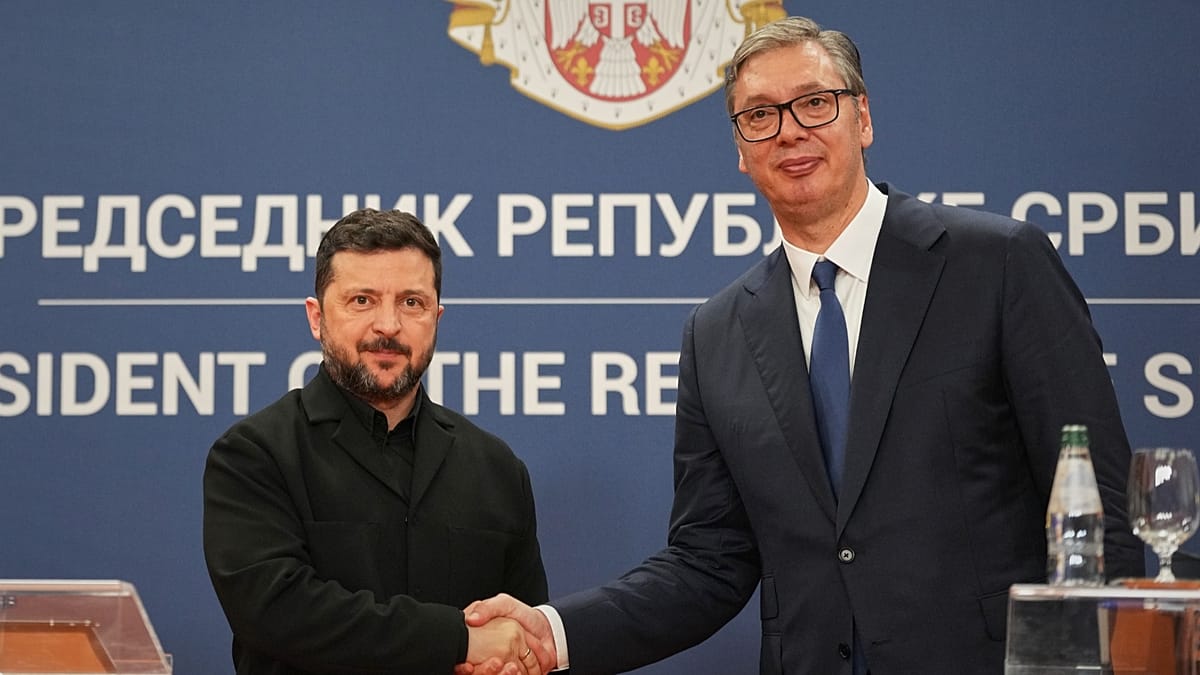
Belgrade rolled out the red carpet for Volodymyr Zelenskyy this weekend, as Serbia's president sought to project a pro-European course without severing ties to Moscow. The Ukrainian leader arrived in the Serbian capital on Friday for his first official visit since taking office in 2019, receiving full honours at the Serbia Palace on Saturday before talks with President Aleksandar Vučić.
The visit comes at a moment of renewed intensity in Russia's war against Ukraine, with overnight strikes on Kyiv killing at least three people, including a child. Zelenskyy used the joint press conference to appeal for more air defence support, noting that supplies from partners had declined compared to last year.
A signal to Brussels and the Kremlin
For Vučić, the carefully choreographed welcome was as much about audience as substance. Serbia has long walked a tightrope between its EU accession bid and deep historical, energy, and cultural links to Russia. By hosting Zelenskyy with full pomp, Belgrade is signalling to Brussels that it takes European integration seriously, while also reminding Moscow that its patience has limits.
"If you ask me, and as a political veteran, I can tell you that I'm not sure about it, and I'm very much afraid that we'll have another difficult winter," Vučić said, expressing doubt that the war would end soon. "But I just hope, without any real facts behind these hopes, that this will end tomorrow."
Serbia remains one of the few European countries that has refused to impose sanctions on Russia following the full-scale invasion. It continues to rely almost entirely on Russian gas and oil, a dependency that constrains its foreign policy options. Yet Belgrade has provided direct financial and humanitarian aid to Ukraine, stopping short of military assistance.
Zelenskyy acknowledged the limits of Serbia's position but stressed the importance of solidarity. "There was another missile strike last night—ballistic missiles targeting our infrastructure. There were also attack drones. In particular, reactive Shahed drones were again targeting our energy facilities and railways," he said.
The Ukrainian president also addressed the question of Western military support, saying agreements exist but deliveries remain insufficient. "Who has ballistic missiles and systems? The manufacturer. That's the United States of America, first and foremost. Can they help? We're working on this. Will they provide us with missiles every month? Yes, we have agreements in place. But are these missiles enough? No," he said.
His comments come amid reports of dwindling US stockpiles, which President Donald Trump has denied, and as Kyiv pushes European allies to step up their contributions. The recent Ukrainian strikes on Russian refineries have shown Kyiv's capacity to hit back, but air defence remains a critical gap.
Beyond the geopolitics, the two leaders oversaw the signing of a memorandum of understanding between Serbia's agriculture ministry and Ukraine's ambassador. Vučić said a free trade agreement would follow soon, calling it of "utmost importance for our country and Ukraine."
The visit also carries domestic resonance. Serbia's EU membership talks have stalled over issues including the normalisation of relations with Kosovo, and Vučić faces pressure from nationalist factions at home. Hosting Zelenskyy allows him to present himself as a statesman engaged with Europe, even as he maintains a pragmatic line with Moscow.
For Ukraine, every diplomatic engagement matters as it seeks to sustain international attention and support. Serbia's willingness to receive Zelenskyy—despite its historical ties to Russia—is a notable diplomatic win, even if it does not translate into military aid or sanctions.
The broader European picture remains fraught. As the war grinds on, countries like Serbia are being forced to choose sides more explicitly. Vučić's balancing act may be growing harder to sustain, but for now, Belgrade is sending a clear message: it wants to be seen as part of Europe's future.