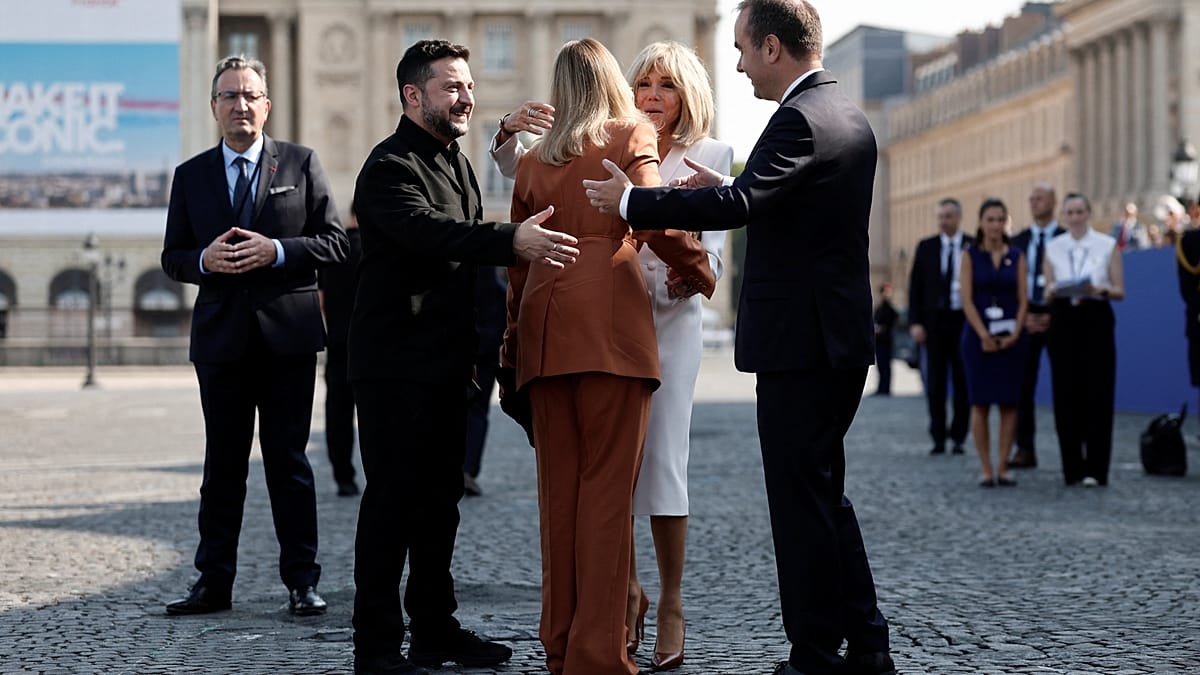
Ukrainian President Volodymyr Zelenskyy joined French President Emmanuel Macron and a host of European leaders in Paris on Friday for the annual Bastille Day military parade, which this year carried a distinctly Ukraine-focused message. The event, held on the Champs-Élysées, served as a display of military solidarity with Kyiv as the war against Russia enters its second year.
The parade featured troops from several European countries, including Germany, Poland, and the United Kingdom, alongside French forces. Armored vehicles, fighter jets, and helicopters rolled and flew past the reviewing stand, where Zelenskyy stood alongside Macron, German Chancellor Olaf Scholz, and other dignitaries. The inclusion of Ukrainian soldiers marching in formation was a symbolic gesture of Europe's commitment to Ukraine's defense.
In his remarks before the parade, Macron reiterated France's unwavering support for Ukraine, stating that the country's fight for sovereignty is also a fight for European security. "Ukraine's resistance is our resistance," Macron said, according to reports from the Élysée Palace. "We stand with them until victory."
Zelenskyy, who arrived in Paris earlier this week for a series of diplomatic meetings, used the occasion to thank European allies for their continued military and financial aid. "This parade shows that Europe is united and strong," Zelenskyy said in a brief statement. "We are grateful for every piece of equipment, every euro, and every gesture of solidarity."
A Show of Force and Unity
The Bastille Day parade, traditionally a celebration of French national pride and military prowess, was this year reframed as a demonstration of European collective defense. The event came just days after a coalition of willing nations gathered in Paris to coordinate further support for Ukraine, including pledges of advanced weaponry and training programs.
Among the military hardware on display were French Leclerc tanks, German Leopard 2 tanks, and American-made M142 HIMARS rocket systems, all of which have been supplied to Ukraine. The flyover included French Rafale jets and a contingent of NATO surveillance aircraft, underscoring the alliance's role in monitoring Russian activity.
The parade also highlighted the broader European security context. With Sweden and Finland now NATO members, and Hungary recently joining the European Prosecutor's Office—a move that could open probes into corruption under Viktor Orbán—the continent's defense architecture is shifting. The presence of leaders from the Baltic states and Poland, which have been among Ukraine's strongest backers, signaled that the war remains a top priority for the EU's eastern flank.
For Paris, hosting Zelenskyy on such a symbolic day was a deliberate political statement. Macron has faced criticism from some quarters for his earlier attempts to maintain dialogue with Moscow, but the Bastille Day parade offered a clear visual rebuttal: France is firmly in Ukraine's corner. The event also served as a counterpoint to recent tensions with Hungary and Slovakia over their more cautious stances on arming Kyiv.
Zelenskyy's visit to Paris followed a series of diplomatic engagements across Europe, including stops in Berlin, London, and Rome. The Ukrainian leader has been pressing for faster delivery of F-16 fighter jets and long-range missiles, as well as a clear path to NATO membership. While the parade was a moment of unity, the underlying negotiations remain complex. European leaders are grappling with how to sustain military aid without depleting their own arsenals, and how to balance support for Ukraine with domestic economic pressures.
The Bastille Day parade also took place against the backdrop of a heatwave that has forced early closures of Paris landmarks and raised concerns about climate resilience. But on the Champs-Élysées, the focus was squarely on the war. As the last military vehicles rumbled past, the crowd—many waving Ukrainian flags alongside the French tricolor—applauded. For a few hours, the divisions that sometimes mark European politics gave way to a display of common purpose.
Zelenskyy's participation in Bastille Day is likely to be remembered as one of the most striking images of the war so far: a wartime leader, in a foreign capital, standing shoulder to shoulder with allies on a day that celebrates national sovereignty. It was a reminder that for Ukraine, sovereignty is not a given—it is a daily battle.