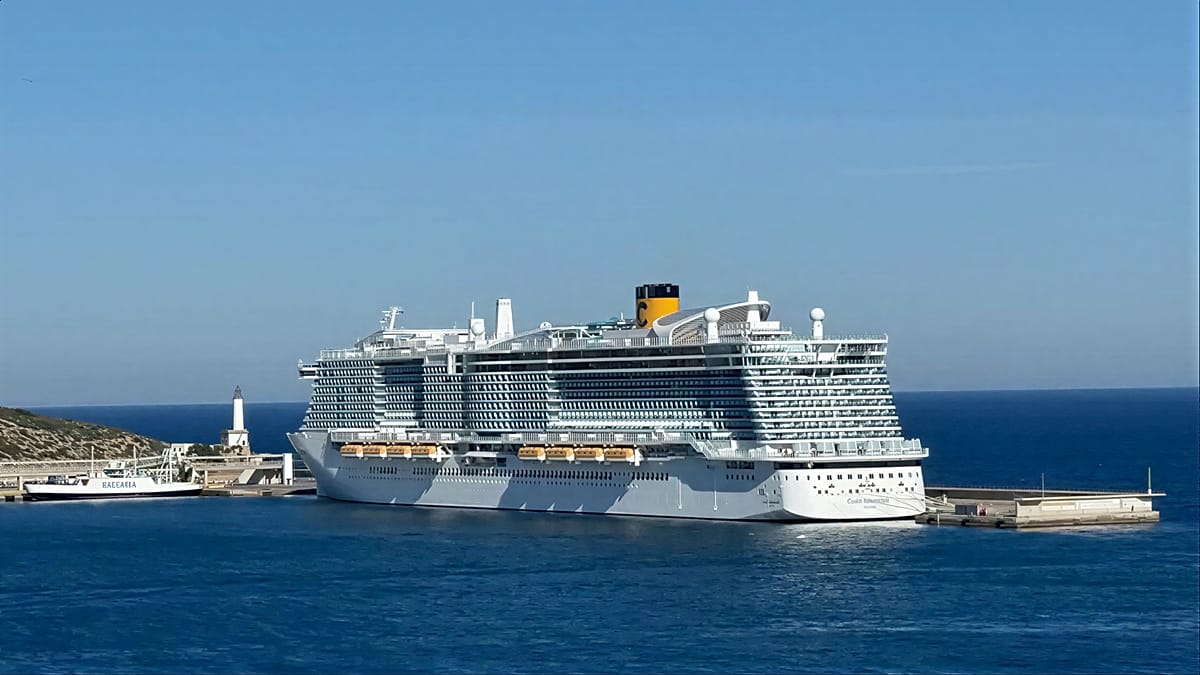
From the port of Barcelona, the Costa Smeralda rises like a steel cliff: 20 decks, 2,600 cabins, and a length of nearly 340 metres. At 200,000 tonnes, it is one of the largest cruise ships in the world, and for many passengers, the sheer scale is the first surprise. Yolanda, a 51-year-old first-time cruiser, had packed seasickness tablets, but the ship’s stabilisers made the rolling barely perceptible throughout the voyage.
An Italian Floating City
Boarding is swift, and the Italian identity is immediate. Every piece of furniture, lighting, and fabric is made in Italy. Each deck is named after a city—Rome, Venice, Capri, Palermo, Genoa, Milan, Naples, Trieste—and decorated in colours and patterns that evoke its namesake. The central atrium, called the Colosseum, hosts the best shows, while the stern features the Piazza di Spagna, a three-level staircase that can hold 1,800 people for open-air parties.
On the upper deck, a glass-floor balcony makes you feel as if you are flying over the sea, offering a panoramic view of Barcelona shrinking as the ship departs. The seven-day itinerary includes Ibiza, Palermo, Rome (via Civitavecchia), Savona, and Marseille. Our journey lasted five days, ending at Civitavecchia, the gateway to the Eternal City.
“We’re delighted because everything we could possibly want is here,” said a group of retired Spanish women. Of the more than 5,000 passengers, only 390 were Spanish; the majority were Italian, followed by French. “We also have groups coming from China, Japan and even Russia. Their numbers are growing all the time,” added Zarella from Guest Relations.
Entertainment Around the Clock
The ship is designed for non-stop enjoyment. Shows range from pop and hip-hop dance performances to acrobatics, video games, themed parties, and a talent contest called The Voice of the Sea. The Sanremo theatre transforms into a nightclub at night, while the Quelli della Notte jazz club offers live music for a different mood. Families dance together, and children find their own fun in the AcquaPark, a water park suspended over the Mediterranean with slides offering sea views.
Gastronomy is central. Daily menus feature dishes inspired by the ports of call, with a strong emphasis on Italian cuisine. The Teppanyaki restaurant combines Japanese food with a chef’s show—juggling spatulas and leading singalongs that the whole room joins.
Sport, Relaxation, and Shore Excursions
For active passengers, the gym offers personal trainers, and there is a football pitch on the upper deck. Four pools and the AcquaPark cater to all ages. Those seeking calm can retreat to the spa, which includes a thalassotherapy pool, snow and salt rooms, a hammam, and various massages.
At sea, the ship organises “Sea Destinations”—stargazing or sunset-watching off the bay of Ibiza with music and shows. On land, “Land Experiences” take passengers to northern Ibiza’s Can Marçà caves, Palermo’s catacombs, or the city of Rome itself. This combination of sailing, leisure, and discovery explains why cruises remain popular despite occasional image crises. The Costa Smeralda brings together children, young adults, and retirees in an experience designed for all ages.
Yolanda, who boarded anxious about seasickness, ended the voyage with a smile. She never felt ill, enjoyed every stopover, the shows, and the Italian and international cuisine. She returned home with a phone full of photos and, she admitted with a laugh, a few extra kilos.