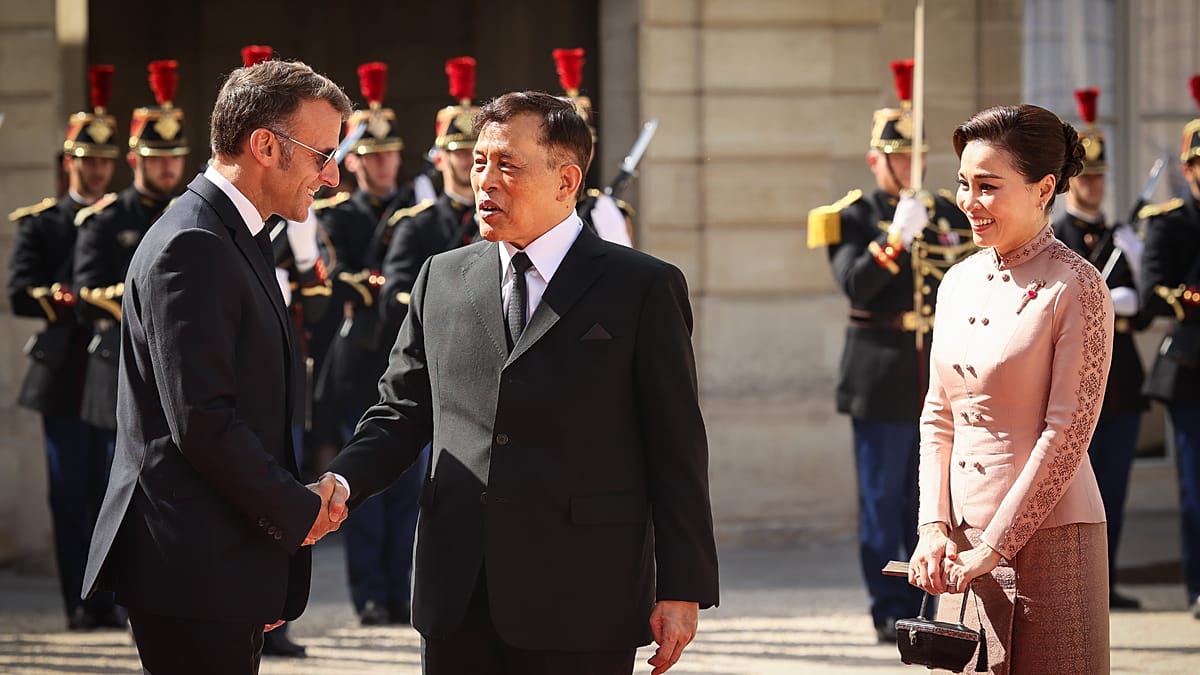
An AI-generated image falsely depicting French President Emmanuel Macron kneeling before Thailand's King Maha Vajiralongkorn has circulated widely on Thai social media, prompting a denial from Bangkok's foreign ministry. The fabricated scene, which shows Macron presenting France's highest state honours while on one knee, spread rapidly after the Thai monarch's first state visit to France since 1960.
The visit, which marked 170 years of diplomatic relations between France and Thailand, included a state dinner at the Élysée Palace. During the event, Macron awarded the 73-year-old king the Grand Cross of the Legion of Honour — France's highest decoration — and Queen Suthida received the Grand Cross of the National Order of Merit, according to Thai media reports.
Shortly after the ceremony, an AI-generated image appeared online purporting to show Macron kneeling before the king as he presented the award. One Thai-language Facebook post featuring the image garnered more than 40,000 reactions and 2,000 shares. According to COFACT, a Thai fact-checking organisation, the post was shared nearly 400 times within its first hour online. It was also amplified by a page with over two million followers that regularly publishes pro-military and nationalist commentary.
Many comments in Thai expressed admiration for the French leader. One user called him "so charming" and said he had "completely won over Thai hearts with this." Another described him as a "true leader."
Official Denial and Visual Inconsistencies
Thailand's Ministry of Foreign Affairs quickly refuted the claim. "There is no evidence of any image showing Emmanuel Macron kneeling to present a royal decoration," a ministry official told AFP. Official photographs released by the ministry show Macron standing while presenting the award.
The image also contains visual inconsistencies. Comparing the clothing worn by the figure resembling Queen Suthida with photographs taken during the visit reveals a different outfit. Furthermore, Euronews' fact-checking team, The Cube, ran the image through OpenAI's verification tool, which found it contained a SynthID watermark and was "generated using OpenAI tools."
This is not the first time AI-generated imagery of Thailand's royal family has gone viral. In June, images claiming to show Thai Princess Sirivannavari crying after the death of the king's eldest daughter, Princess Bha, gained widespread sympathy online.
The incident highlights the growing challenge of deepfakes and AI-generated disinformation in Europe and beyond. As brands and public figures grapple with viral moments in the social media age, the need for robust fact-checking mechanisms becomes ever more pressing. The French presidency has not commented on the image, but the episode underscores how easily manipulated visuals can shape public perception across borders.