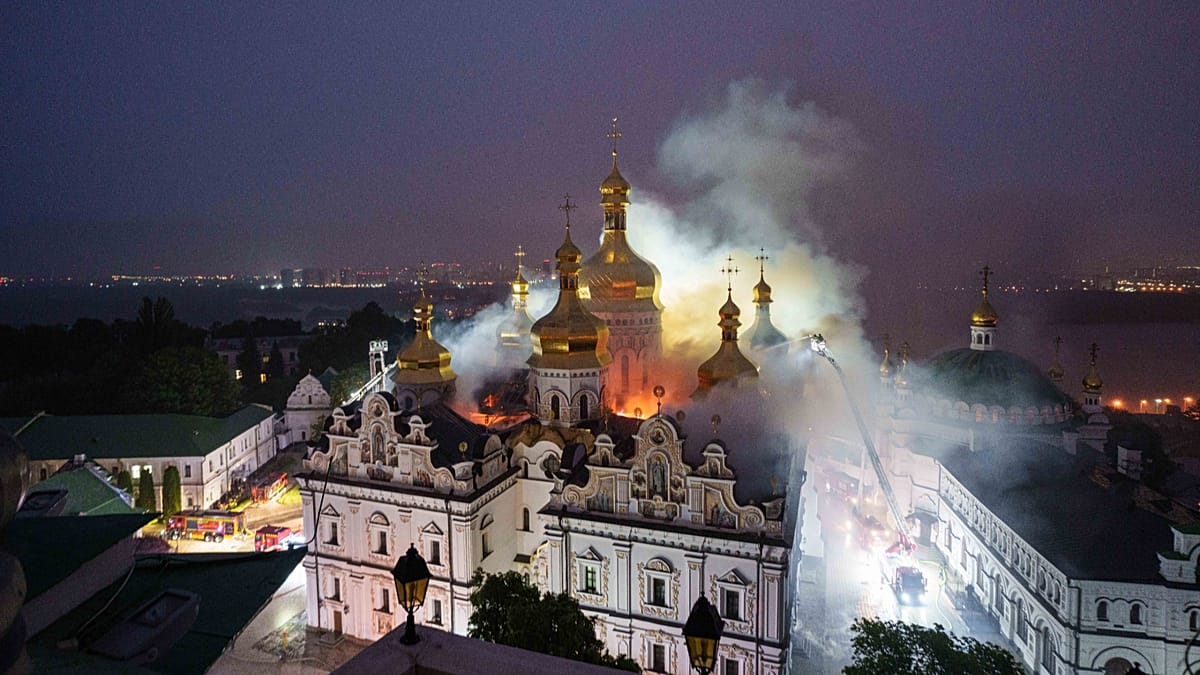
In the aftermath of a Russian drone and missile barrage that struck Kyiv on the night of 14–15 June, pro-Kremlin social media accounts began circulating fabricated images to suggest the attack on one of Ukraine's most sacred Orthodox Christian sites was staged. The posts, shared in German, Greek, and other languages, claimed that photographers were seen setting up equipment on nearby rooftops before the strike hit the Kyiv-Pechersk Lavra monastery complex, a UNESCO World Heritage site.
The images, which were analysed by Euronews' fact-checking team The Cube, were found to contain digital watermarks from OpenAI's SynthID system, confirming they were generated by artificial intelligence. The visuals also showed the cathedral's roof as green, whereas verified photographs of the complex show it is brown, with only some adjacent buildings having green roofs. No evidence has emerged to support the claim that Ukrainian photographers had prior knowledge of the attack or that the strike was staged.
Disinformation in the Shadow of War
This incident is part of a broader pattern of disinformation surrounding Russia's war in Ukraine. The attack on the Pechersk Lavra, which dates back to the 11th century, killed five people and damaged both the monastery and the Oleksandr Dovzhenko Film Studios. Ukrainian Prime Minister Yulia Svyrydenko shared a video showing the Dormition Cathedral in flames. Russian authorities, in turn, blamed Ukraine, alleging that a US-made Patriot missile caused the damage—a claim for which no evidence has been provided.
Ukrainian President Volodymyr Zelenskyy described the strike as “one of Russia’s most serious crimes against Christian culture to date.” Foreign Minister Andrii Sybiha announced that Ukraine would initiate procedures within UNESCO and other international mechanisms to demand a response from what he called “Russian terrorists.” The Security Service of Ukraine (SBU) confirmed that the attack was carried out by a Geran-2 unmanned aerial vehicle, a type of Iranian-designed drone used extensively by Russian forces.
The use of AI-generated imagery to fuel false narratives is a growing concern. Earlier this year, a similar fabricated image falsely showed French President Emmanuel Macron kneeling before the King of Thailand, highlighting how synthetic media can be weaponised to undermine trust in institutions and events. In this case, the fake images were shared on X, Facebook, and TikTok, accumulating over 11,000 views across platforms.
Ukraine has repeatedly urged its allies to accelerate air defence deliveries to protect its cities from such attacks. The EU recently announced new sanctions on Russian drone manufacturers in response to deadly strikes on Kyiv. Meanwhile, the human toll continues to mount: overnight strikes on the capital have killed eight and wounded dozens more, as Zelenskyy warns of an imminent Russian assault.
The disinformation campaign around the Pechersk Lavra strike serves as a reminder that the information war is as relentless as the kinetic one. As European nations grapple with the consequences of Russia's aggression, the need for robust fact-checking and media literacy has never been more urgent.