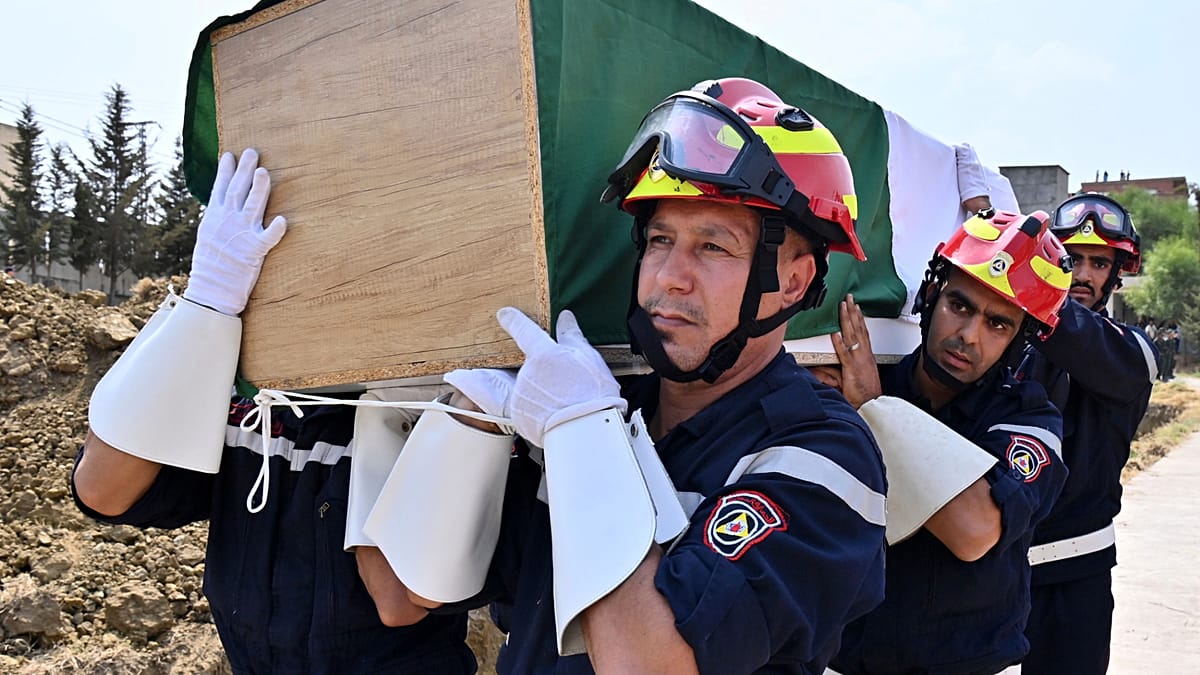
Algeria is in mourning after wildfires tore through the country's northeastern provinces, killing at least 12 people and injuring dozens. In response, President Abdelmadjid Tebboune has announced plans to amend the criminal code to allow the death penalty for arson, a move that would end a moratorium on capital punishment observed since 1993.
The announcement came as the government declared three days of national mourning. In a statement, Tebboune described the loss of life as “a great tragedy,” while officials maintained the official death toll from Wednesday.
Deadly fires across the Kabylie region
Interior Minister Saïd Sayoud confirmed five fatalities in Jijel province, four in Béjaïa, and three in Tizi Ouzou. He added that 54 people were receiving hospital treatment for burns, six of whom remain in critical condition. Algeria's civil protection agency reported on Thursday morning that 46 fires remained active out of 193 recorded over the previous 24 hours. Unverified videos shared online overnight depicted sweeping blazes trapping residents in their homes.
The national gendarmerie announced that three major highways linking eastern regions were closed due to forest fires raging near Béjaïa, Jijel and Sétif. The fires have also destroyed large areas of forest and farmland, with local authorities warning that the full extent of the damage is not yet known.
While summer forest fires occur regularly in northern Algeria, more frequent droughts and extreme heat have been adding to their intensity. In July 2023, fires swept through thousands of hectares of forest and farmland near Béjaïa, destroying hundreds of homes and leaving more than 30 people dead. Authorities recorded nearly 2,000 fires nationwide in July this year alone.
The decision to seek the death penalty for arsonists has drawn mixed reactions. Human rights groups have criticised the move, arguing that it violates Algeria's international commitments and that the moratorium on executions, in place for three decades, should be maintained. Others, however, have welcomed the measure as a necessary deterrent against those who deliberately start fires.
Tebboune has ordered that the amendment to the Criminal Code be completed by 15 September. The move would require parliamentary approval, and it remains unclear whether the measure will be applied retroactively to those already arrested in connection with the current fires.
The fires have also reignited a broader debate about climate change and forest management in the Mediterranean region. Across the sea, southern European countries such as Spain and Greece have faced similar challenges, with record heatwaves and drought conditions increasing the risk of wildfires. In Spain, heat-related deaths hit a record high this year, underscoring the regional impact of rising temperatures.
As Algeria mourns, the focus remains on containing the remaining fires and supporting the affected communities. The government has deployed additional firefighting resources, including aircraft and ground crews, to the hardest-hit areas. Local residents have also formed volunteer brigades to help battle the blazes, reflecting a spirit of solidarity in the face of disaster.
The coming weeks will be critical as authorities investigate the causes of the fires and implement the president's directive. The decision to pursue the death penalty for arsonists marks a significant shift in Algeria's legal landscape, with implications that extend beyond the current crisis.