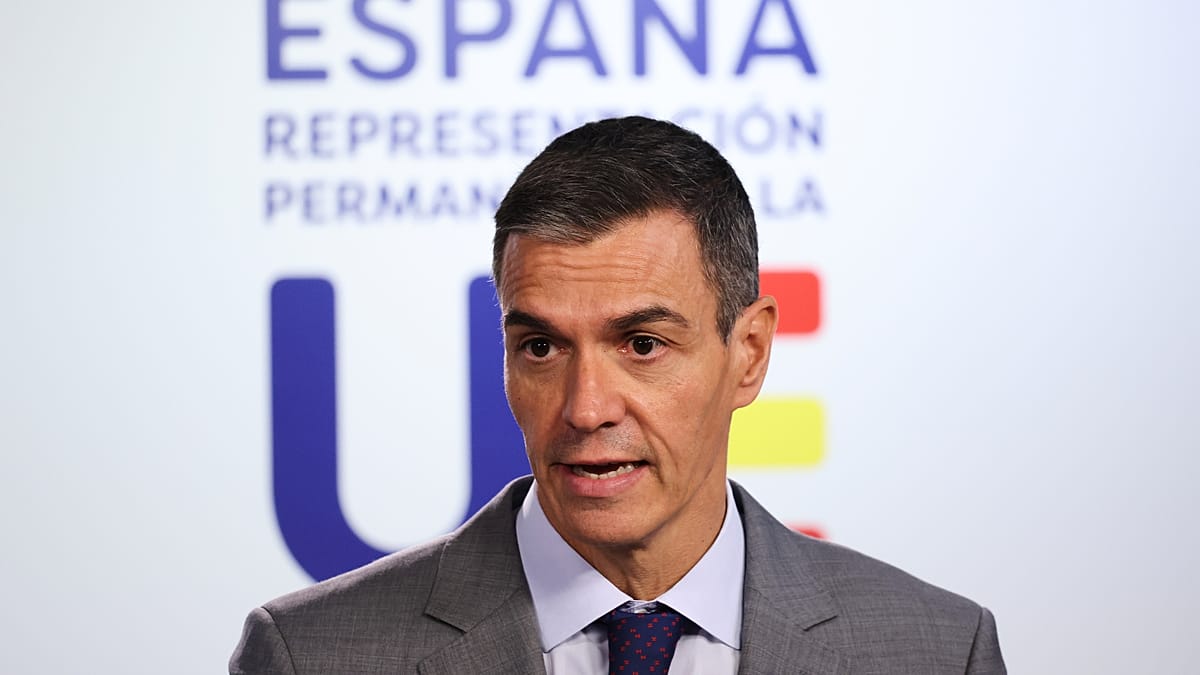
Spanish Prime Minister Pedro Sánchez used a European Council summit in Brussels to push back against a wave of criticism from fellow EU leaders over his government's migration policy, insisting that the data supports his approach. "If you look at the facts, at the figures — which is kind of always what happens with the far right — it's like night and day," he said on Friday. "What is being said has nothing to do with reality... one thing is the blah, blah, blah and another is reality."
Sánchez was responding to pointed remarks from Czech Prime Minister Andrej Babiš, Danish Prime Minister Mette Frederiksen, and Austrian Chancellor Christian Stocker, who have all questioned Spain's migration management, particularly its extraordinary plan to regularise hundreds of thousands of undocumented migrants. The Spanish leader drew a clear line between his policy disagreements with Frederiksen and the tone of Babiš's comments, which he likened to the rhetoric of Spain's far-right Vox party.
"With the Danish prime minister we have disagreements, but indeed, it has nothing to do with what the prime minister of the Czech Republic said, which, by the way, sounds very much like what the far-right Vox says in Spain," Sánchez said. Babiš had accused some European leaders of being willing to "replace the population" to stay in power and warned that his country could tighten border controls to prevent migrants from arriving from other EU states. Stocker described Spain's regularisation plan as a "bad signal" with potential consequences for the whole bloc, while Frederiksen has asked the European Commission to examine the implications of Madrid's measures.
Spain's record under scrutiny
In defending his government, Sánchez pointed to concrete results: interceptions in the Atlantic, returns, and refusals of entry at airports. He rejected claims that Spain is a hub for secondary movements of migrants within the EU. "The reality, the data show that Spain is pursuing a very responsible policy in the fight against irregular migration, in managing regular migration flows and in cooperation with transit and origin countries," he said.
He also stressed the importance of maintaining a progressive government in Spain, arguing that "because Europe indeed needs a contrast of opinions and political positions," and urged his European partners to continue implementing the migration and asylum pact. The pact, secured under the Spanish presidency of the EU Council, is "working," he added, calling Spain "a model pupil" in the fight against irregular immigration.
The exchange comes amid broader tensions over migration policy across the continent. Denmark has formally asked the EU to review Spain's regularisation plan, which would affect up to 600,000 people. The move has drawn support from several member states but also sharp criticism from human rights groups and from Madrid.
Von der Leyen calls for unity
European Commission President Ursula von der Leyen used the summit to stress the need for full implementation of the EU migration and asylum pact and stronger cooperation between member states. She noted that irregular crossings of the EU's external borders have fallen by more than 56% over the past two years. Von der Leyen outlined three priorities: fully implementing the pact, strengthening the management and protection of external borders, and improving preparedness for potential border crises.
She also announced that the Commission will propose strengthening Frontex, the EU's border agency, to expand its capacity to support member states when needed. "To succeed, it is necessary to continue acting together," she said, acknowledging that more work remains. Her remarks came as leaders remained divided over how to manage migration and tackle irregular arrivals.
Denmark, Poland, and Italy pushed for changes to the summit conclusions, including an indirect reference to Spain's regularisation plan. Spain and France opposed the proposed amendments. A revised draft seen by Euronews urged member states to avoid "measures that may create incentives for illegal migration," but the broader wording was ultimately rejected in favour of a shorter, less forceful version. The proposal, jointly backed by the three countries, was seen as an implicit criticism of Spain's left-wing government.
French President Emmanuel Macron, speaking after the summit, said that "ideological divisions" between EU member states over migration were making them "ineffective." He expressed support for Spain over the Ceuta crisis, which he described as a "humanitarian tragedy," and noted that France had not signed a letter sent to Brussels by 22 EU countries. "We have had a bad debate," Macron said. "My assessment is that when we politicise this debate at the table, we create divisions. And when we are divided and fall back on national solutions, we become ineffective."
The summit's outcome on migration was a compromise, with leaders agreeing on a general call for continued implementation of the pact but avoiding any direct reference to Spain's regularisation plan. The episode highlights the deep fault lines that remain within the EU on migration, even as the bloc's executive pushes for a common approach. The summit also ended with a budget deadlock and an unresolved funding gap for Ukraine, adding to the sense of a bloc struggling to find consensus on multiple fronts.
For Sánchez, the confrontation in Brussels is unlikely to be the last. With a snap election looming in Spain, migration has become a domestic political battleground, and the prime minister's critics at home and abroad are unlikely to let the issue rest. Spain's foreign minister has warned that the election is a fight over fundamental rights, and migration policy is set to remain a central theme.