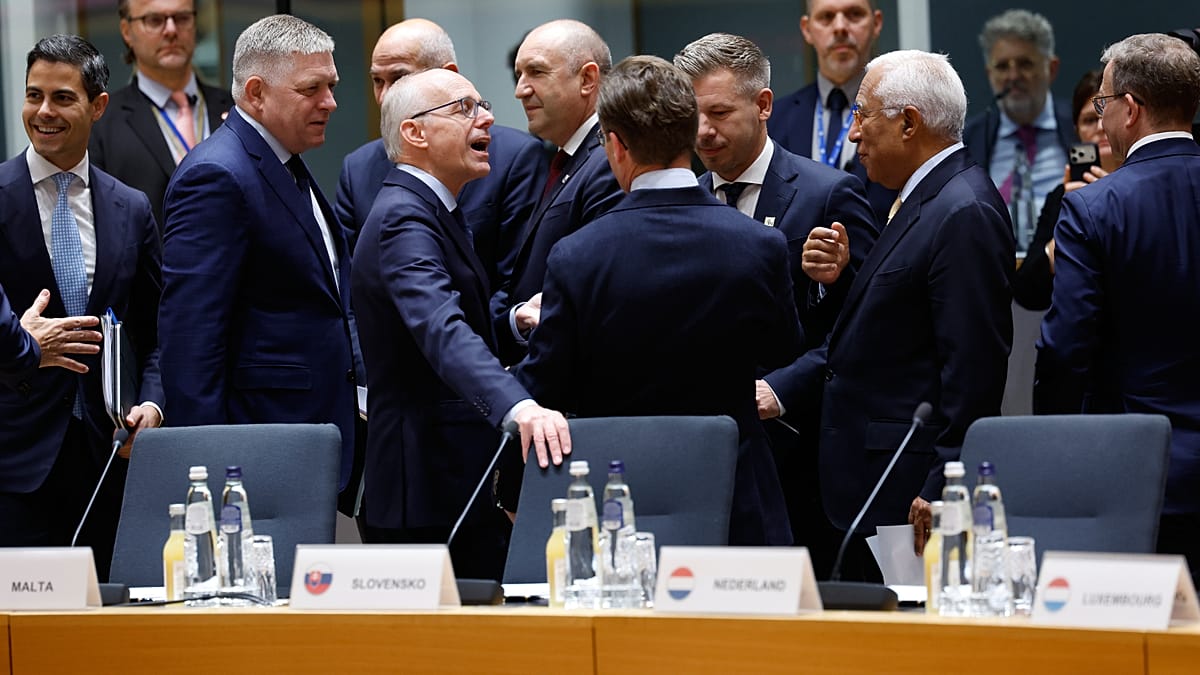
European Union leaders wrapped up a two-day summit in Brussels on Friday with the bloc's long-term budget still unresolved, a fresh €70bn funding request from Ukraine on the table, and open disagreements over migration and energy policy. The meeting also produced a renewed push for new trade defence tools aimed at countering Chinese competition.
Ukraine: a show of unity, but a funding gap
The summit's second day was overshadowed by the heated exchange between Ukrainian President Volodymyr Zelenskyy and US President Donald Trump. European leaders rallied behind Zelenskyy, reaffirming their commitment to maintain sanctions on Russia as long as its full-scale invasion continues. They also condemned the diesel deal Trump struck with Russian President Vladimir Putin, though Bulgarian Prime Minister Rosen Zhelyazkov broke ranks to voice support for it.
Zelenskyy used his address to request an additional €70bn in financial and military aid for 2026, a figure that would cover the gap left by the bloc's previous assumption that a €90bn loan would stretch through 2027. The request caught many in Brussels off guard, and leaders tasked the European Commission with drafting a proposal to meet Kyiv's needs.
Finding that money will be difficult. Rising borrowing costs make joint debt unattractive, while the idea of using immobilised Russian assets remains politically sensitive. Bilateral contributions risk placing the burden on a few wealthy member states, a scenario that has already drawn resistance.
Zelenskyy struck a defiant tone in response to Trump's criticism, saying: "I defend the interests of Ukraine and the Ukrainian people exclusively. We were attacked, occupied, and our people were killed. It is only logical that we have the right to defend ourselves." He added: "We will keep living, fighting, and most importantly, living with dignity."
Budget: no deal, and no urgency
On Thursday, leaders debated the next Multiannual Financial Framework (MFF) at length, but as expected, made little progress. The "frugal" net contributors and the southern and eastern "Friends of Cohesion" remain entrenched in their positions. The negotiating box tabled by the Irish presidency, which proposed cutting €141bn from the overall budget, is now officially dead.
European Council President António Costa will take over the talks. He is expected to present a new compromise in the coming weeks, possibly before the special summit he has called for 26 November, just days before the Spanish elections. Costa is likely to focus on keeping national contributions low, reworking the package of EU-wide taxes, and restoring flexibility instruments that the Irish presidency had cut.
Yet there is a worrying sign: leaders on both sides now openly say they feel no pressure to close a deal by the end of the year. Seasoned negotiators know that deadlines force concessions. If December passes without an agreement, the talks could slip into an electoral season that may reshape Europe's political landscape. As one Irish MEP has suggested, a deal by Christmas is still possible, but it will require genuine compromise.
Migration: a fragile truce and a hard-line push
Migration once again proved one of the most contentious files. After the shouting match in June between Spain's Pedro Sánchez and Italy's Giorgia Meloni and Denmark's Mette Frederiksen, this summit saw a small step towards easing the border dispute between Rome and Madrid. Italy extended its temporary border controls by a week to align with Spain's, which expire on 22 October, and the two interior ministers are due to agree on replacement measures by then.
But while Meloni opened the summit in a conciliatory tone, Frederiksen did not spare Sánchez over his plan to regularise the status of 600,000 migrants. "I have asked the European Commission to examine what happens when a country does almost the exact opposite of what the rest of us are doing," she said, referring to Spain without naming it.
Meloni, Frederiksen, and Dutch Prime Minister Rob Jetten hosted an informal breakfast with 17 other leaders to explore "innovative solutions" on migration. Support is growing for emergency measures that would allow asylum applications to be suspended during crises. The hard-line camp pushed to include language in the summit conclusions calling for avoiding "measures that could create incentives for illegal migration," but the final text only urges the Commission to coordinate with member states "on all types of instrumentalisation."
China: a new trade defence toolbox
On "macroeconomic imbalances," the EU's euphemism for China, leaders held their course despite the recent deal between the Commission and Beijing to curb hybrid car imports. Over lunch on Thursday, they pressed the Commission to prepare a toolbox of new trade defence instruments, including safeguards with quotas and tariffs, to shield the chemicals and machinery industries from Chinese competition.
With a trade deficit of about €360bn with Beijing, China looms large. Chemicals and machinery are among the sectors hardest hit by cheap Chinese imports, and leaders singled them out as the next industries needing urgent protection after the hybrid car quotas. The push reflects a growing consensus that the EU must be more assertive in defending its industrial base.
The summit also touched on energy, with leaders calling for a joint response to price surges, as reported earlier. But no concrete decisions were made, and the issue is likely to return at the next meeting.
As the bloc heads into a period of political transition, with elections in Spain and a new Commission taking shape, the unresolved issues from this summit will only grow more pressing. The coming weeks will test whether the EU can turn its rhetoric into action on Ukraine, budget, and migration.