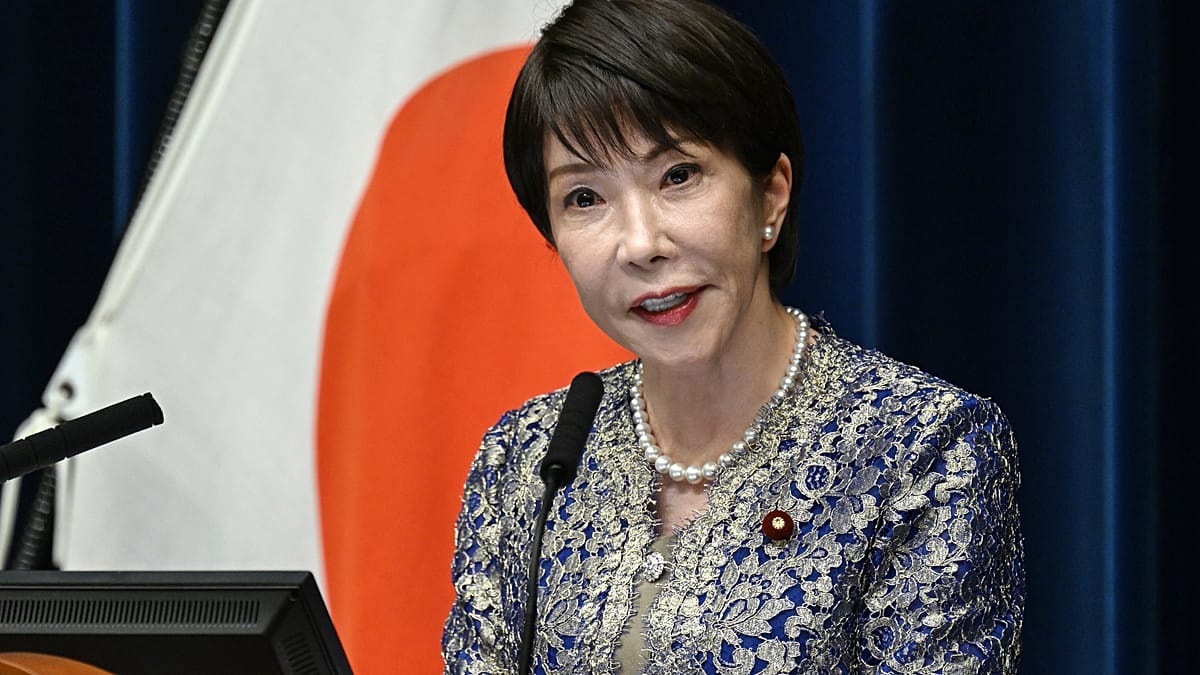
Japan's first female prime minister, Sanae Takaichi, has ignited a fresh debate on gender roles and the demands of high office after revealing that household chores and personal grooming add three to four hours to her daily routine compared with her male predecessors.
Speaking in the Diet on Wednesday, Takaichi detailed her morning schedule, which begins with a bath, breakfast preparation, cleaning, and applying makeup before she starts her official duties. “In the morning, I take a bath, prepare breakfast, clean up afterwards, and then do my makeup. When you add all that up, I feel I may be spending an extra three or four hours compared with a male prime minister,” she said.
The remarks have resonated far beyond Tokyo, touching on a theme familiar to working women across Europe and elsewhere: the invisible labour that still falls disproportionately on women, even at the highest levels of power. In Brussels, Strasbourg, and national capitals, female leaders have long spoken about the double shift of public office and private responsibility, but Takaichi's frank admission is a rare public acknowledgment from a sitting head of government.
A question of support and expectations
Takaichi also revealed that her staff initially struggled to accommodate the time she needed to prepare for television appearances, a logistical challenge that her male counterparts likely never faced. The disclosure underscores how institutional structures are still designed around male norms, a point that resonates with women in politics and business across the EU, where similar complaints have been raised by figures such as former Finnish Prime Minister Sanna Marin and European Commission President Ursula von der Leyen.
In Japan, the reaction has been mixed. Some commentators have praised Takaichi for her honesty, while others have questioned why a prime minister with access to official residences and support staff would choose to do her own housework. The debate has also highlighted the persistent gender gap in Japan, which ranks poorly on global equality indices, and the challenges facing women in leadership roles across Asia and Europe alike.
For European readers, the story offers a lens into the broader conversation about work-life balance and the gendered division of domestic labour. In countries like Germany, France, and the Nordic states, policies such as shared parental leave and subsidised childcare have sought to address these imbalances, but cultural expectations remain stubbornly entrenched. Takaichi's comments are a reminder that even the most powerful women are not immune to the daily grind of domestic responsibilities.
The prime minister's remarks also come at a time when Japan is grappling with demographic decline and a shrinking workforce, issues that have prompted calls for greater female participation in the economy. Her candid admission may serve as a catalyst for renewed discussion on how to support women in public life, a conversation that echoes in Brussels and beyond.
As Takaichi continues to navigate the demands of her office, her words have struck a chord with many who see in her experience a reflection of their own struggles. Whether it leads to tangible change in Japan or simply sparks a wider conversation, her statement has already achieved something rare in politics: a moment of genuine, unvarnished honesty about the realities of leadership.