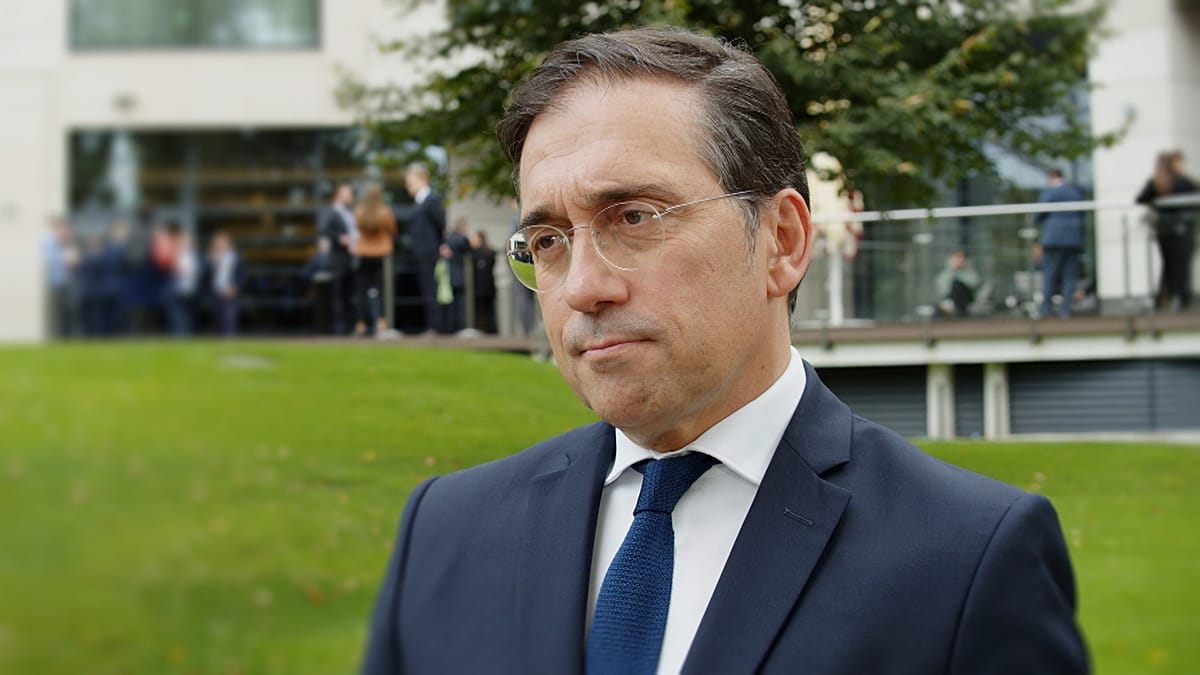
WARSAW — Spain's foreign minister has framed the country's upcoming snap election as a decisive contest over fundamental rights, warning that a right-wing victory could roll back protections that many Europeans take for granted.
In an interview with Euronews on the sidelines of the Warsaw Security Forum, José Manuel Albares said the 29 November vote offers a clear choice between a 'progressive majority' and political forces that 'want to remove fundamental rights' from Spanish citizens. His remarks come as Prime Minister Pedro Sánchez kicks off his re-election campaign with a focus on housing and social policy, a strategy that has already drawn sharp reactions from the opposition.
Albares did not name specific parties, but his comments reflect the deep polarization in Spanish politics ahead of the election. The conservative People's Party (PP) and the far-right Vox have both pledged to reverse several progressive laws passed under the current coalition government, including those on gender violence, euthanasia, and historical memory.
The minister also pointed to external meddling in the electoral process, saying that 'they want to divide and weaken Europeans.' He did not provide evidence, but his warning echoes concerns raised by other EU officials about disinformation campaigns and cyberattacks targeting elections across the bloc. Spain's intelligence services have been on alert for such interference since the 2019 general election.
Frozen Russian assets: a new push
On the eve of an EU leaders' summit in Brussels, Albares reiterated Madrid's support for using the profits from frozen Russian assets to finance Ukraine's reconstruction and military needs. Brussels shelved the idea in 2025 amid legal and financial concerns, but Spain believes the time is right to revisit it.
'We have to be creative and bold,' Albares said. 'The Russian state must pay for the destruction it has caused. Using these assets is not only a matter of justice, but also of strategic necessity.'
The proposal has gained traction among several EU member states, though it remains controversial. Some governments worry about the precedent it could set for international investors, while others argue that the funds—estimated at over €200 billion—are essential to sustain Ukraine's defence and rebuild its infrastructure. The debate is likely to feature prominently at the summit, where leaders will also discuss the bloc's long-term security commitments.
Albares's stance aligns with the EU ministers' pushback against any easing of sanctions on Russia, a position that has gained urgency following recent diplomatic manoeuvres by Washington.
Warsaw Security Forum: a platform for unity
The Warsaw Security Forum, where Albares spoke, has become a key venue for European and NATO officials to coordinate responses to shared threats. This year's agenda focused on hybrid warfare, energy security, and the war in Ukraine.
Albares used the platform to stress the importance of European unity, a theme that resonates in Poland, which has been a staunch ally of Ukraine and a vocal critic of Russian aggression. He also touched on the need to strengthen the EU's external borders and to counter disinformation, issues that are particularly sensitive in the run-up to the Spanish election.
The minister's comments come amid heightened security alerts across Europe. Polish authorities recently warned of a possible attack on Prime Minister Donald Tusk and the defence minister, underscoring the volatile security environment. Albares expressed solidarity with Poland, saying that 'threats to one member state are threats to all.'
Spain's position on Russian assets is part of a broader push by some EU countries to maintain pressure on Moscow. Latvia's foreign minister, for instance, has argued that NATO's success should be measured by peace, not conflict, a view that aligns with the cautious approach of several Baltic states.
As the EU summit approaches, Albares's message is clear: Europe must remain united, protect its democratic values, and hold Russia accountable. Whether his call to unlock frozen assets will gain the necessary consensus remains to be seen, but Spain is determined to keep the issue on the table.