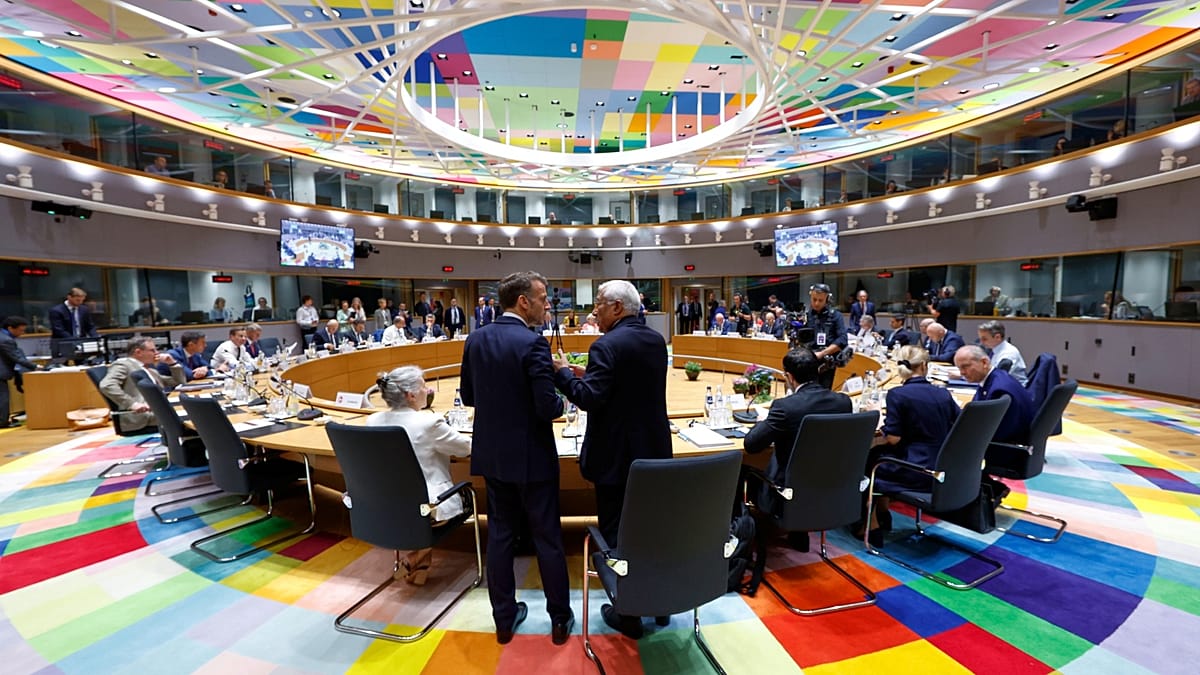
The two-day summit of EU leaders in Brussels opened with a packed agenda, but the most pressing issue was clear: energy prices. With oil hovering above $100 a barrel and gas trading at levels not seen since the winter of 2022, the cost of heating homes and powering factories has become a political liability for governments across the bloc. The recent escalation in the Middle East has only added to the pressure, and leaders are under mounting pressure to deliver tangible relief as the heating season begins.
Italian Prime Minister Giorgia Meloni and Greek Prime Minister Kyriakos Mitsotakis have been the most vocal in demanding that Brussels relax its fiscal rules to allow governments to finance temporary and targeted measures to cushion the energy crunch. But their push has met resistance from countries that fear excessive flexibility would encourage fossil fuel consumption and undermine the green transition. A proposal from six member states—Austria, Germany, Italy, Poland, Portugal, and Spain—to introduce an EU-wide windfall tax on energy companies' excess profits remains divisive and has not gained enough traction to move forward.
Trade tensions with China take centre stage
Energy was followed by another economic headache: the bloc's trade deficit with China, which currently runs at €1 billion a day. Brussels had given Beijing an October deadline to deliver tangible results, and last week Trade Commissioner Maroš Šefčovič returned from the Chinese capital with preliminary concessions on hybrid and plug-in hybrid cars, rare earths, permanent magnets, and market access for European firms. A senior diplomat expressed cautious satisfaction, saying, "We're satisfied with the results, but for us, it's only a first step because imbalances are not specific to one sector – there are across the board." The diplomat added, "Why is China agreeing to something that China has never agreed before? (Because) they're starting to realise they're killing their customers. We're not naïve."
The concessions have, for now, averted an all-out trade war. Leaders are expected to endorse continued "results-oriented dialogue" with China and to call for "urgently enhanced" trade tools to retaliate if necessary, according to draft conclusions seen by European Pulse. In a sign of exasperation, Germany and France have floated a "kill switch" that would cut off China's access to the EU market if the deficit remains unsustainable.
Budget battle: who pays for what?
The most contentious moment of the summit arrived on Thursday afternoon when the next seven-year EU budget was put on the table. The negotiations take place against a backdrop of steep borrowing costs, particularly alarming in France, and a political landscape shaken by Spanish Prime Minister Pedro Sánchez's surprise decision to call snap elections. European Council President António Costa has appealed to member states to move beyond their red lines and reach an agreement by the end of the year, so that the complex legislative work can be completed before January 2028.
Ireland, which holds the rotating presidency, has tabled a proposal that cuts the original draft by €141 billion. But the knife mostly spares agriculture and cohesion funds, falling instead on research, technology, climate action, security, and foreign policy. The Irish "nego-box" has made everyone unhappy. The so-called "frugals"—Austria, Denmark, Finland, the Netherlands, Sweden, and Germany—say the cuts need to go much deeper and across the board. The 17 "Friends of Cohesion" argue the opposite, that the cuts have gone far too deep. The European Commission warns that its vision of a modernised, flexible budget is in real danger.
On top of that, there is no agreement on which EU-wide taxes should be approved to collect additional revenue for the common pot. The clash of opinions and the unwillingness to compromise bode ill for Costa's ambition to have a unanimous deal in December. As one senior diplomat put it, "I don't think there will be blood on the wall, but it's important in these sorts of negotiations that leaders feel where the contradictions are. We are not in a hurry. We need a good deal. We don't feel any time pressure."
The first day ended with a strategic debate on how to prepare the 27-member bloc for the admission of new member states and reform its internal decision-making. Montenegro, the frontrunner in the accession race, aims to close all chapters this year. The opening of new accession talks with Ukraine remains a key part of the bloc's eastern strategy, though Hungary's earlier veto has been lifted.
Ukraine: unity in the face of Trump's overtures
Friday will be dedicated to Ukraine, with President Volodymyr Zelenskyy attending the summit in person. The peace talks took a dramatic turn after US President Donald Trump blindsided Europeans by cutting a deal with his Russian counterpart, Vladimir Putin, to bring tens of thousands of Russian diesel into the US market. Washington issued a sanctions waiver until April 2027 to enable what would until now have been a forbidden sale. The news jolted Europeans and prompted a scramble to close ranks and rally behind Ukraine to control the fallout from a unilateral, uncoordinated decision that has revived memories of the Trump-Zelenskyy showdown.
European leaders are expected to reaffirm their support for Ukraine, both in terms of military aid and financial assistance. The pressure on NATO allies to boost air defence for Ukraine is likely to be a key theme, as is the need to maintain unity in the face of Russian hybrid warfare. The IEA's warning that diesel prices in Europe may climb as the global supply crunch persists adds another layer of urgency to the discussions.
As the summit draws to a close, the bloc's ability to present a united front on energy, budget, and Ukraine will be tested. The divisions are real, but so is the recognition that Europe's credibility depends on finding common ground. Whether the leaders can turn that recognition into concrete action remains to be seen.