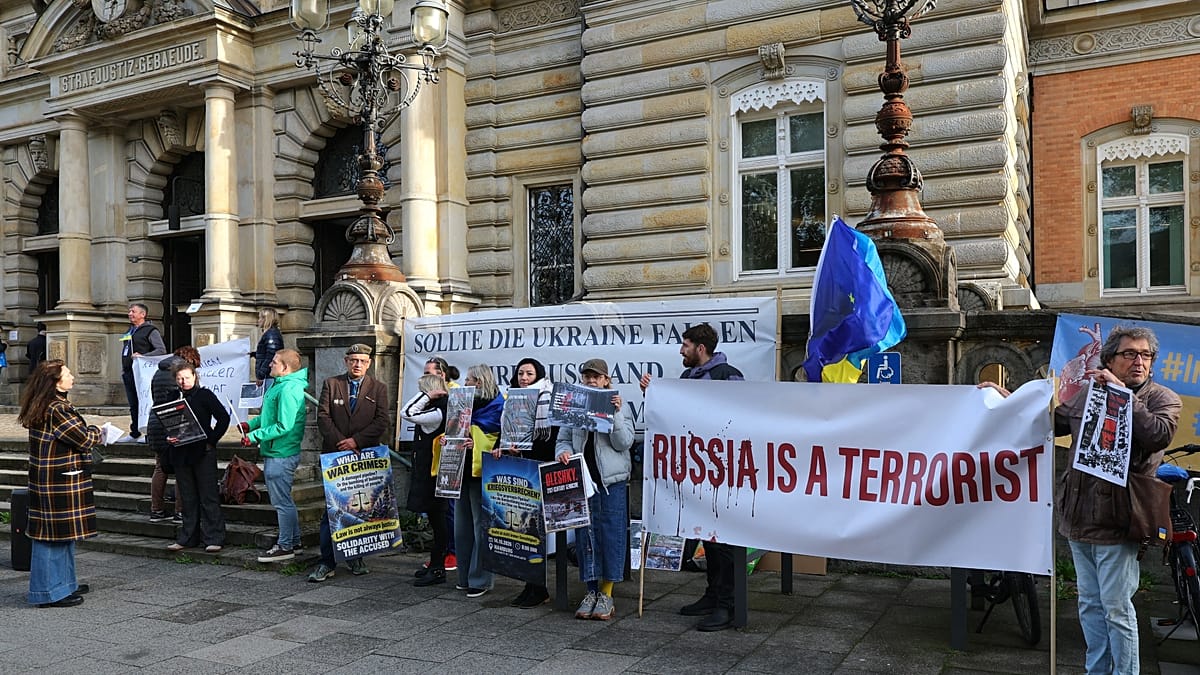
Hamburg's regional court became the focal point of a geopolitical storm on Wednesday as the trial opened for a former Ukrainian army officer accused of involvement in the 2022 Nord Stream pipeline explosions. Dozens of supporters, many carrying Ukrainian flags, gathered outside the courthouse to voice their solidarity with the defendant, who denies any role in the sabotage that severed the Baltic Sea gas links between Russia and Europe.
The explosions, which occurred in September 2022, ruptured three of the four Nord Stream pipelines near the Danish island of Bornholm, releasing vast amounts of methane into the atmosphere and effectively ending a key energy artery for Germany and other European states. The incident has remained shrouded in mystery, with investigations in Sweden and Denmark closed without public findings, while German prosecutors have pursued their own inquiry.
The accused, identified under German privacy laws as Volodymyr Z., is a 44-year-old Ukrainian national who previously ran a diving school. He was arrested in Germany in 2023 and has been in custody since. German federal prosecutors allege he was part of a team that used a chartered yacht to transport explosives to the pipelines. Two other Ukrainian diving instructors are also wanted in connection with the case, but they remain at large, reportedly in Ukraine.
Outside the court, the atmosphere was charged. Protesters held banners reading "Nord Stream: truth over propaganda" and "Free the divers," while some chanted slogans against Russian aggression. One demonstrator, a Ukrainian refugee now living in Hamburg, told European Pulse: "These men are heroes, not criminals. They tried to stop Russia's energy blackmail. The trial is a political show."
The case has stirred deep divisions in Germany and across Europe. For many, the sabotage was an act of sabotage against critical infrastructure, a serious crime that undermines European security. For others, it was a legitimate act of defense against Russian energy dominance, which had been used to fund the war in Ukraine. The trial is being watched closely in Kyiv, where officials have denied any state involvement, though they have not ruled out that rogue actors may have acted independently.
Legal and political stakes
The trial is not merely a criminal proceeding; it is a test of Germany's judicial independence in a case with profound diplomatic implications. Berlin has walked a careful line, supporting Ukraine militarily and financially while avoiding direct confrontation with Moscow over the pipeline issue. The proceedings could strain relations with Kyiv, especially if evidence emerges of official Ukrainian involvement.
Legal experts note that the case hinges on forensic evidence, including DNA traces and communications data. The prosecution has presented a detailed timeline, but the defense is expected to challenge the reliability of witness testimony and the chain of custody of evidence. "This will be a complex trial," said Dr. Anja Schmidt, a criminal law professor at the University of Hamburg. "The court will need to weigh circumstantial evidence against the political context, which is unusual."
The defendant's supporters argue that he is a scapegoat, pointing to the fact that the United States and other NATO allies had motives to disrupt the pipelines. They also note that the investigation has not produced a clear picture of who gave the orders. The defense team has signaled it will call for the release of their client on bail, citing his health and the lack of flight risk, but the court has so far rejected such requests.
The trial comes at a time when Europe is re-evaluating its energy security strategy. The Nord Stream pipelines were once a symbol of German-Russian economic interdependence, but they are now a rusting monument to a fractured relationship. The debate over EU budgets and the opening of Ukraine accession talks are reminders of how the war has reshaped the continent's priorities.
Meanwhile, the environmental impact of the blasts is still being assessed. The methane released was equivalent to the annual emissions of a small country, and the long-term effects on the Baltic Sea ecosystem remain uncertain. Environmental groups have called for a full investigation into the ecological damage, but so far, the focus has been on the criminal case.
As the trial proceeds, it is likely to draw further international attention. The court has scheduled multiple hearings over the coming months, with verdicts not expected until late 2025. For now, the supporters outside the courthouse have vowed to keep up their presence, turning the trial into a daily reminder of the unresolved questions surrounding the Nord Stream sabotage.
In a related development, the former Ukrainian officer's trial has already prompted discussions about the legal treatment of wartime actions. Some legal scholars argue that the case could set a precedent for how Europe handles acts of sabotage committed during conflicts. Others caution that the trial risks becoming a political football, with both Russia and Ukraine seeking to exploit it for propaganda purposes.
For now, the court in Hamburg is focused on the facts. But the echoes of the explosions are still being felt across Europe, from the debates over EU decision-making to the new night train connections that symbolize a continent trying to move forward. The trial is a reminder that the past is never fully buried, especially when it involves the fragile infrastructure that connects nations.