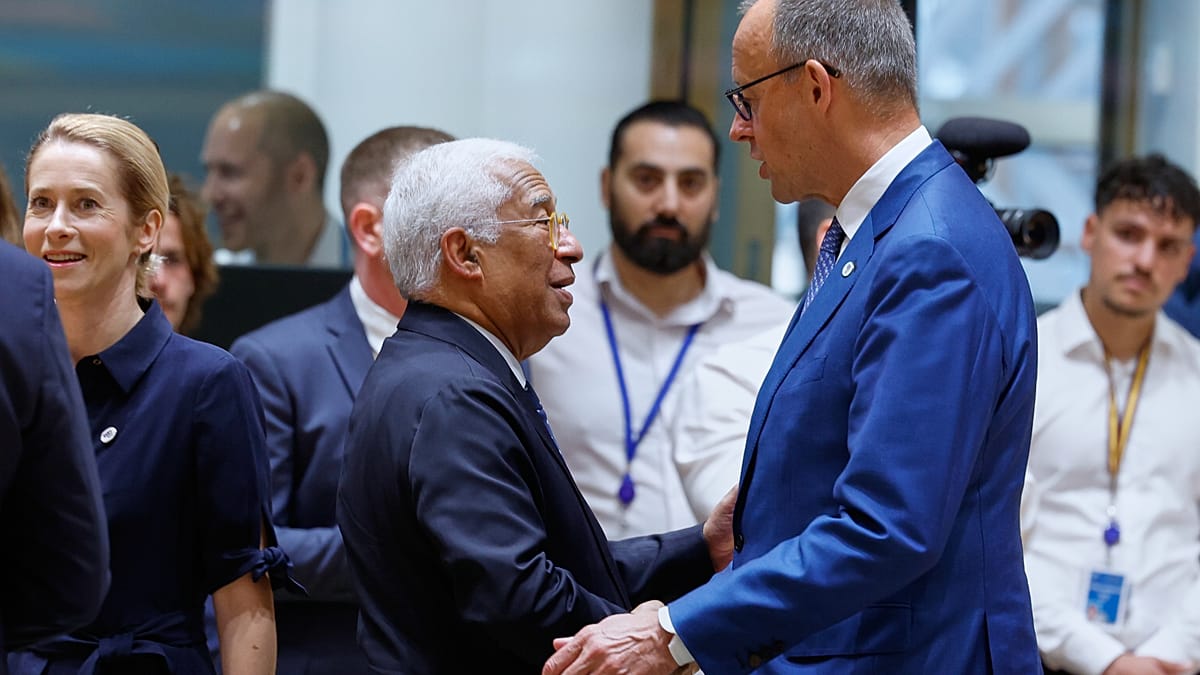
European Union leaders arrive in Brussels this week for a summit that is meant to set the bloc's spending course for most of the next decade — but the ground is already shifting beneath them. A compromise put forward by the Irish presidency of the Council on Saturday has drawn fire from both ends of the debate, leaving the Multiannual Financial Framework (MFF) for 2028–2034 without a settled majority.
The Irish text proposes trimming €141 billion from earlier drafts, bringing the seven-year envelope to €1.622 trillion in 2025 prices. For Berlin and a coalition of like-minded net contributors, that is still too generous. For the European Commission, the European Parliament and a broad group of member states, it is already too thin.
A revolt led from Berlin
German Chancellor Friedrich Merz was blunt in his response. "We are still far from an agreement," he said. "The size of the new proposal is not a basis for agreement. The EU budget must be affordable for those who bear the brunt of financing it." He added that "everyone must contribute to the necessary adjustments, because prioritising and modernising EU spending is a task for us all."
The objection is not only about the headline figure. Germany and its allies — the group that prefers to be called "modernisers" rather than "frugals" — argue that the savings are being extracted from precisely the areas the EU says it wants to strengthen. Under the Irish plan, competitiveness funding would fall by 13% and global cooperation by 17%, while the Common Agricultural Policy and cohesion funds escape with cuts of roughly 3%.
Finnish Prime Minister Petteri Orpo made the same point from Helsinki. "Defence, research and new technologies are being hit disproportionately hard," he said. "Europe needs to strengthen itself in these areas. Savings need to be found in a balanced way across the entire budget."
The Dutch and Swedish governments were equally dismissive. Finance Minister Eelco Heinen warned that "the Netherlands cannot accept this proposal. At this rate, there will be no deal by the end of the year," while Sweden's EU affairs minister, Jessica Rosencrantz, called the text "unreasonable" and said the Council was "nowhere near an agreement."
The cohesion camp holds its ground
On the other side sits the Friends of Cohesion, a bloc of 17 southern and eastern member states including Italy, Romania, Poland and Greece, which defends agricultural support and regional development spending as core EU functions. They welcomed the relative protection of their priorities but argue the overall budget is too small for the challenges ahead.
Excluding repayments on NextGenerationEU, the post-pandemic recovery instrument, the proposed budget would amount to just 1.02% of EU gross national income. Leading MEPs calculate that this represents a real-terms cut of around 10% compared with the current framework.
"The choice before us is not between a cheap and an expensive Europe. It is between an underfunded Europe at the mercy of the next crisis, and a properly funded Europe that can tackle challenges and respond to Europeans' needs." — MEP Carla Tavares (Portugal/S&D)
The Commission's director-general for budget, Stéphanie Riso, told EU ambassadors on Sunday that she had serious concerns — not only about the lack of ambition, but about the risk of making the budget far more rigid. She singled out cuts to the Commission's own administrative spending and a 40% reduction to the so-called EU Facility, an instrument designed to give the budget room to respond to shocks.
The deadlock is not new. A Cypriot presidency draft in June had already proposed cutting the European Competitiveness Fund and the Global Europe programme by nearly 4%, prompting similar complaints. One EU diplomat told reporters there was an "urgent need to strengthen the link between the political realities of the European leaders and the negotiations on the MFF."
The wider context is hardly calm. Leaders will also discuss support for Ukraine, where US pressure on Kyiv is complicating Europe's own planning. In Paris, Emmanuel Macron's approval ratings have sunk to their lowest level since 2017, weakening one of the traditional motors of EU integration. And in Brussels itself, Belgian austerity protests have reminded leaders that budget discipline carries a political price at home.
Thursday and Friday's European Council is expected to give political direction rather than a final figure. But with the modernisers demanding deeper cuts, the cohesion camp warning against a diminished Europe, and the Commission and Parliament insisting the current draft is already too austere, the search for a landing zone looks as difficult as any in recent memory.



