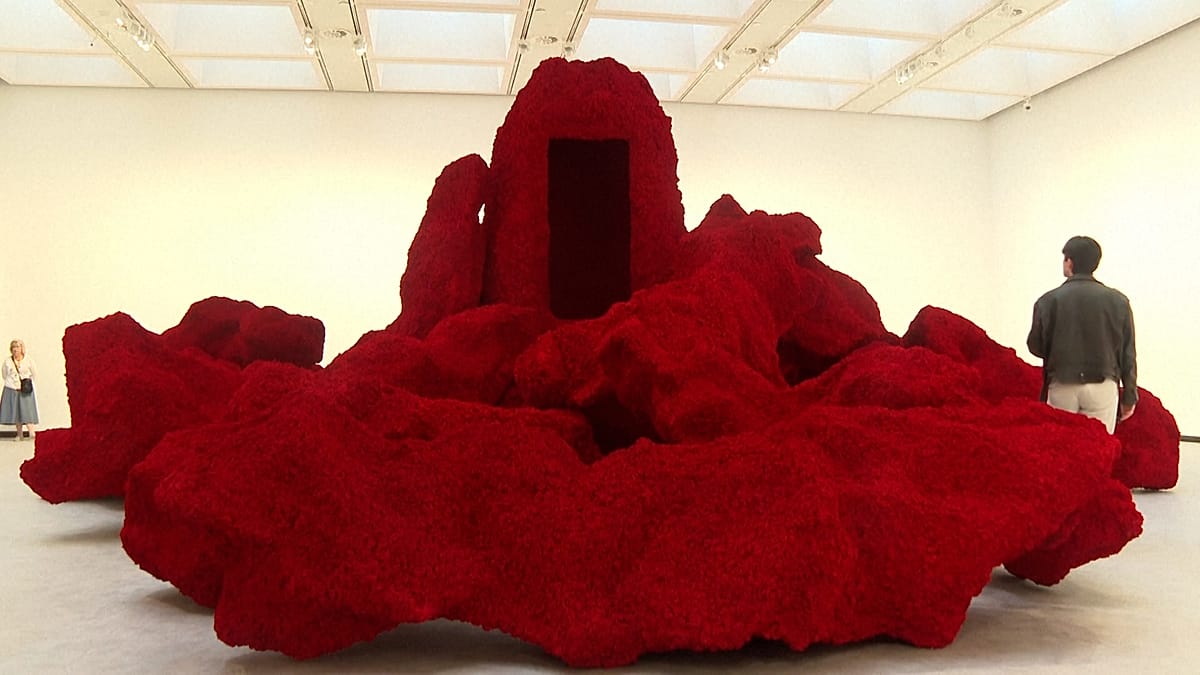
Turner Prize-winning artist Anish Kapoor has opened a major new exhibition at London's Hayward Gallery, bringing together a striking collection of works that challenge viewers' perceptions of space and reality. The show, which runs through early autumn, features blood-red suspended sculptures, distorted mirror installations, and void-like forms that warp the gallery's architecture.
Kapoor, born in Mumbai and based in London, is known for his monumental public sculptures—including the iconic Cloud Gate in Chicago and the ArcelorMittal Orbit in London's Olympic Park—but this exhibition returns to the intimate, immersive experiences that first brought him acclaim. The Hayward Gallery, a brutalist landmark on the South Bank, provides a fitting backdrop for Kapoor's exploration of darkness and light.
Darkness as Material
Central to the exhibition is Kapoor's ongoing fascination with the void. Several works use a proprietary material called Vantablack, one of the darkest substances known to science, which absorbs 99.96% of visible light. When applied to sculptural forms, it creates the illusion of infinite depth—a hole in the fabric of the gallery itself. Kapoor has controversially held exclusive rights to use Vantablack in art since 2014, a decision that sparked debate in the art world.
In one gallery, a massive concave mirror distorts reflections, turning viewers into elongated, unrecognizable shapes. Nearby, a blood-red wax sculpture drips from the ceiling, evoking both visceral bodily fluids and the sublime landscapes of the Scottish Highlands where Kapoor maintains a studio. The effect is disorienting, forcing visitors to question what is solid and what is illusion.
“I am interested in the space between things,” Kapoor said in a statement accompanying the exhibition. “The void is not empty—it is full of potential, of darkness, of the sublime. We are afraid of it, but we are also drawn to it.”
A European Context
Kapoor's work resonates across Europe, where public art often sparks similar debates about perception and public space. In Vienna, for instance, the city recently unveiled Austria's largest mural on an office tower for the Eurovision Song Contest, a project that also plays with scale and urban intervention. Meanwhile, in Spain, scientists are drilling 500 metres into a meteorite crater for clues about Mars, a scientific endeavor that echoes Kapoor's fascination with voids and hidden depths.
The Hayward Gallery show also coincides with a broader cultural moment in London. The city's art scene remains vibrant despite post-Brexit challenges, with galleries like the Tate Modern and the Serpentine drawing international audiences. Kapoor's exhibition is expected to attract visitors from across Europe and beyond, reinforcing London's status as a cultural capital.
Critical Reception
Early reviews have been mixed but largely positive. Critics praise the immersive quality of the installations, particularly the mirror rooms that create infinite reflections. Some, however, note that Kapoor's work can feel repetitive after two decades of similar themes. “Kapoor is a master of the sublime, but the sublime can become predictable,” wrote one reviewer in The Guardian. Still, the exhibition's ambition is undeniable, with some pieces requiring complex engineering to suspend tons of steel and wax from the gallery's ceiling.
The show also includes a series of smaller works on paper, offering a more intimate counterpoint to the large-scale installations. These drawings, in charcoal and ink, explore similar themes of darkness and form, but with a delicacy that surprises those familiar only with Kapoor's monumental public pieces.
For those unable to visit London, the Hayward Gallery has produced a virtual tour and a catalogue with essays by art historians. The exhibition runs until 1 September 2025, with extended hours on weekends.