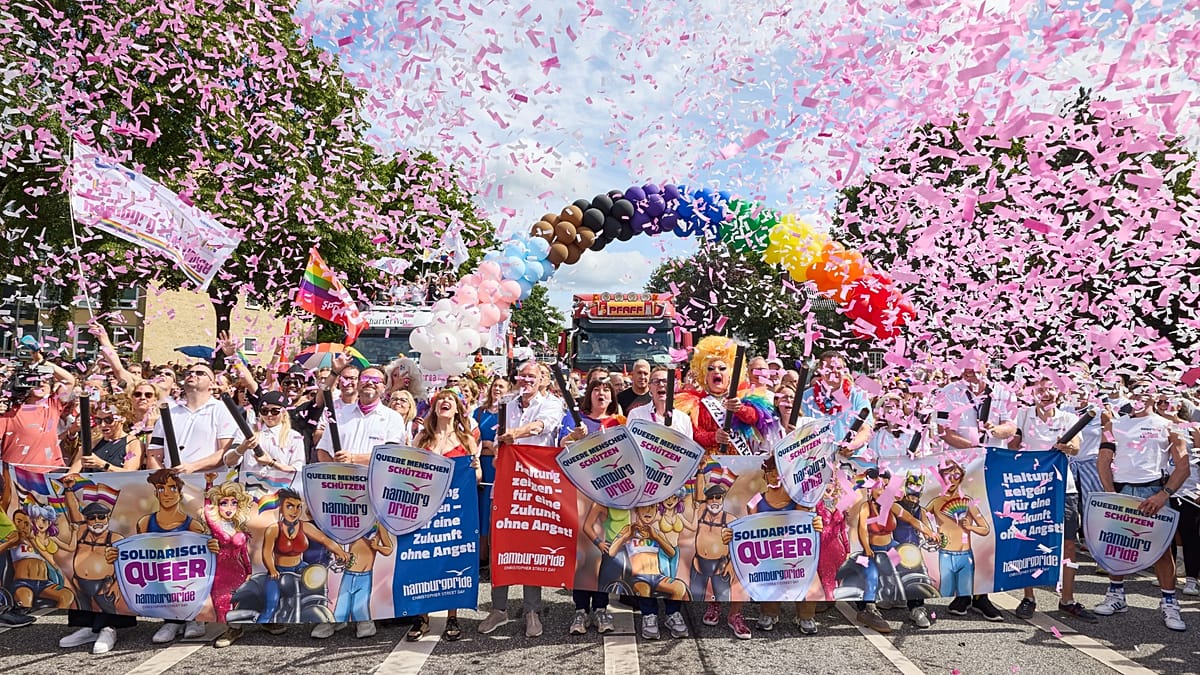
Hamburg's annual Pride parade, one of Germany's largest LGBTQ+ events, drew an estimated 250,000 participants on Saturday under a visibly reinforced police presence. The march took place exactly one week after a deadly attack near Berlin's Christopher Street Day (CSD) celebrations, which left one person dead and 29 injured.
This year's motto, “Queer in solidarity. Take a stand — for a future without fear,” resonated with particular urgency. Organizers added a truck representing Berlin's CSD, and those aboard were asked to wear dark clothing as a mark of respect for the victims.
A city on edge, but determined
Hamburg's police chief had announced earlier in the week that officer numbers for the event would be roughly double those of last year. The visible security presence along the parade route, including on Steindamm, was a direct response to the July 25 attack, in which a 21-year-old man drove a van into a crowd a few hundred meters from Berlin's closing party, then attacked people with what appeared to be a machete.
The suspect, Abdul Ballout, was killed in a confrontation with police the following day. Investigators later found a video in which a person believed to be him pledged allegiance to the Islamic State group. Prosecutors said Ballout, born in Germany with Lebanese roots, had traveled to Lebanon in 2025 with the intention of reaching Syria to join IS, and had made contact with suspected members.
The attack has reignited debates across Europe about intelligence sharing and counterterrorism coordination. As discussions on EU intelligence gaps intensify, the incident has also highlighted the lack of a unified terror watchlist, a point raised in analysis of the EU's security architecture.
For many in Hamburg, the decision to attend was both personal and political. “After the brutal attack on the CSD in Berlin, many are unsure in the queer community but also in society whether here and today is the right place,” said Katharina Fegebank, Hamburg's deputy mayor, in an interview with RTL television. “I say, now more than ever, let’s all take to the streets, stand up for diversity, for freedom, for an open society, and above all, in full solidarity with and for the queer community.”
Attendee Petra Schwab echoed that sentiment: “Well, when something like that happens, we all have to show that we’re not afraid, that we won’t let it get us down.”
The atmosphere along the route mixed defiance with celebration. Many marchers carried rainbow flags and placards, while others wore black armbands. The Berlin CSD truck, a late addition to the convoy, served as a moving memorial.
The attack has also fueled broader security debates in the EU as the summer recess begins, with member states weighing how to balance open societies with the need for vigilance. For now, Hamburg's Pride demonstrated that the city—and the country—refuses to be cowed.