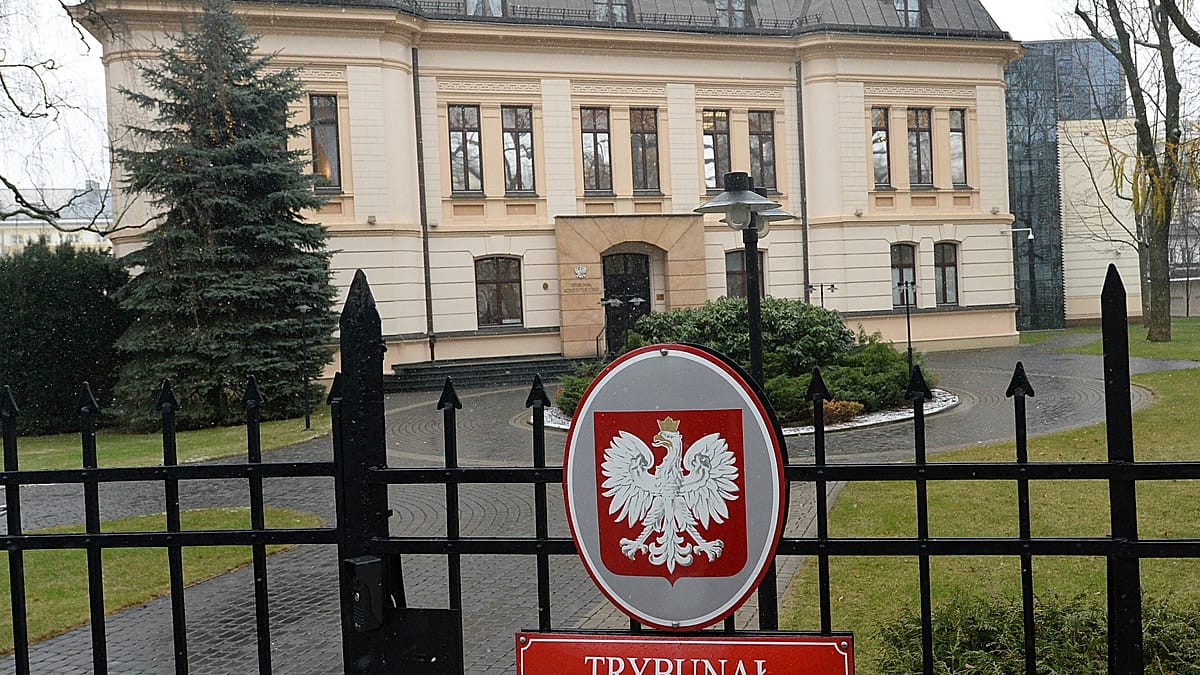
Polish President Karol Nawrocki abruptly turned his aircraft around mid-flight on Friday and returned to Warsaw, abandoning a planned visit to Senegal after armed police entered the country's Constitutional Tribunal and its president was suspended from duty. The extraordinary sequence of events has thrust Poland's long-running dispute over judicial independence back to the centre of national politics.
"At a moment like this, the President must be in Poland. I am cutting short my flight to Senegal. I am returning," Nawrocki wrote on X, confirming the decision to his followers as his plane was still in the air.
Police deployed as tribunal chief suspended
Dozens of officers were stationed outside the tribunal's headquarters in Warsaw, where supporters of the opposition Law and Justice (PiS) party gathered to protest. The suspension of tribunal president Bogdan Święczkowski was announced by Anna Korwin-Piotrowska, who identified herself as a judge of the court.
Justice Minister and Prosecutor General Waldemar Żurek told reporters that he had formally requested the lifting of immunity for both Święczkowski and his deputy, Bartłomiej Sochański. The government of Prime Minister Donald Tusk has been pursuing the removal of judges appointed during the eight years of PiS rule, arguing that the tribunal was improperly constituted.
The tribunal responded through its official X account with an unusually blunt denunciation. "Ms. Anna Korwin-Piotrowska is not a judge of the Constitutional Tribunal," the post stated. "All persons participating in these actions are committing the crime of a coup d'état."
A confrontation years in the making
The confrontation is the latest chapter in a conflict that has simmered since PiS held power between 2015 and 2023. During that period, the European Union repeatedly accused Poland's highest court of acting as an instrument of the governing party, and the tribunal issued rulings asserting the primacy of Polish law over EU legislation — a stance that placed Warsaw on a collision course with Brussels.
Since returning to office, Tusk's coalition has sought to reverse those changes, but has encountered resistance from institutions still staffed by PiS-era appointees. The suspension of Święczkowski marks one of the most direct attempts yet to assert control over the court.
Outside the building, the atmosphere was tense. PiS supporters chanted "Tusk traitor," according to an AFP journalist at the scene. Some knelt in prayer, clutching Catholic rosaries and religious images, underscoring the deep cultural and religious dimensions that the judicial dispute has acquired in Poland.
The events in Warsaw will be watched closely in Brussels and other European capitals. Poland's relationship with the EU improved markedly after the 2023 election, and the government has been keen to present itself as a reliable partner on rule-of-law matters. A prolonged standoff over the tribunal risks complicating that narrative, particularly as the bloc continues to manage the fallout from Ukraine's pipeline infiltration and broader security challenges on its eastern flank.
For now, the immediate question is whether the suspension will hold and how the tribunal's remaining judges respond. Nawrocki's decision to return home signals that the presidency — itself a PiS-aligned institution — intends to play an active role in the coming days. The president's office has not yet indicated what steps he might take upon landing.
Legal scholars in Warsaw are divided over the validity of Korwin-Piotrowska's action. Some argue that only a full sitting of the tribunal can suspend its president; others contend that the government's broader case against the court's legitimacy gives it legal cover. What is not in dispute is that Poland's constitutional order is once again being tested in public, with the country's international standing and domestic stability both at stake.