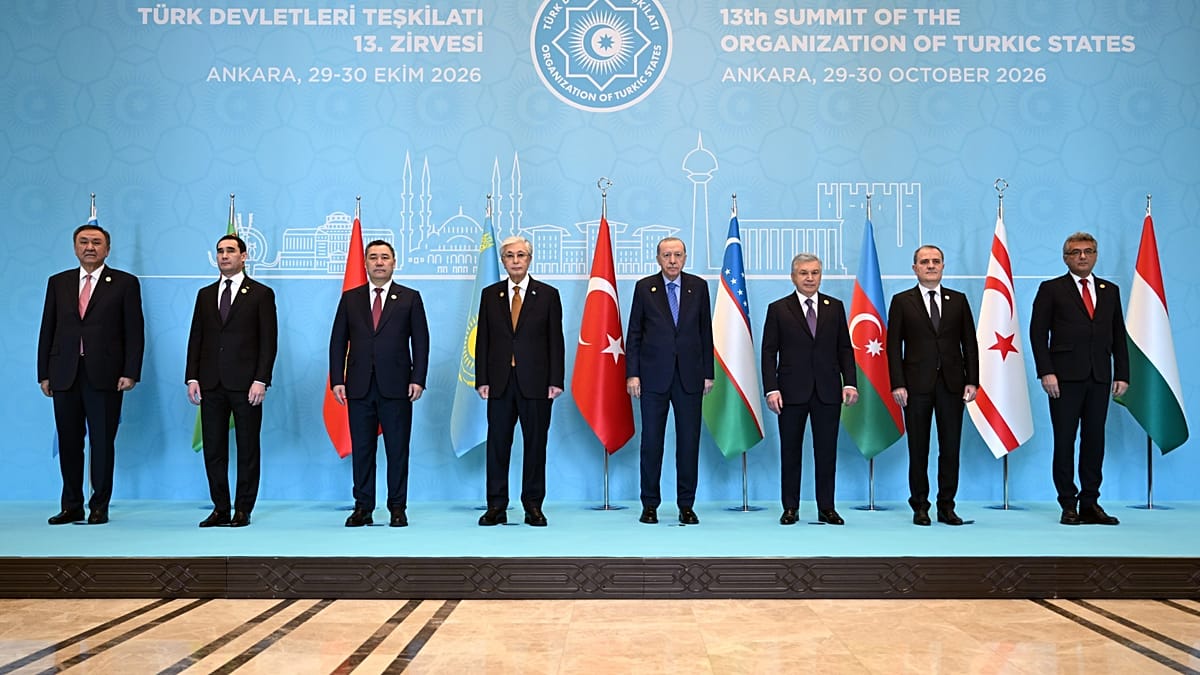
Leaders of the Turkic states gathered in Ankara on [date] for the 13th summit of the Organization of Turkic States (OTS), where they adopted the Ankara Declaration and mapped out deeper cooperation on transport, energy, and trade. The meeting came against a backdrop of ongoing Middle East instability, which is reshaping trade routes and creating new opportunities for the bloc.
In a surprise intervention, Kazakh President Kassym-Jomart Tokayev suggested that Russia be invited to participate in the OTS through its “OTS Plus” format or as an observer, arguing that this would “enhance the standing and credibility of our Organisation.” No formal decision was announced, and the proposal was not included in the final declaration.
The OTS, which comprises Turkey, Azerbaijan, Kazakhstan, Kyrgyzstan, and Uzbekistan, is an alliance aimed at boosting economic and political cooperation among Turkic-speaking nations. Turkmenistan, an observer state, was represented by President Serdar Berdimuhamedov, while Azerbaijan sent Foreign Minister Jeyhun Bayramov in place of President Ilham Aliyev. Turkey assumed the rotating chairmanship from Azerbaijan.
Digital and security cooperation
Turkish President Recep Tayyip Erdoğan used his address to stress the importance of unity amid geopolitical uncertainty, but focused largely on practical initiatives in cybersecurity, space technology, and digital trade. He proposed the creation of a common digital trade platform and the development of a shared Turkic large language model covering the Oghuz, Kipchak, and Karluk language groups.
The Ankara Declaration called for progress on a cybersecurity agreement and consultations on establishing an OTS Cybersecurity Council. It also welcomed the completion of a joint 12U CubeSat and the signing of a framework agreement on space-industry cooperation.
Uzbekistan's 100-project plan
Uzbek President Shavkat Mirziyoyev called for expanding the OTS's international partnerships through an “Organization of Turkic States Plus” format involving third countries. “The standing and prestige of the Organization in the international arena also depend on its ability to develop open and mutually beneficial relations with external partners,” he said.
He unveiled the “Turkic World – 100” programme, comprising 100 strategic joint investment and industrial projects, with an emphasis on technological cooperation. “Priority should be given to the full processing of rare and strategic minerals, the localization of production of equipment for green energy, and the manufacture of high-value added products,” Mirziyoyev stated.
On connectivity, he urged the transformation of the Middle Corridor and connected routes into an integrated economic system, supported by jointly managed logistics hubs. Other proposals included a multilateral agreement on mutual legal assistance in commercial matters, a Turkic Tourism Alliance, and simplified cross-border travel using national identity cards.
Kazakhstan highlights Middle Corridor growth
Tokayev underscored the growing importance of the Middle Corridor, which links Central Asia with Europe via the Caspian Sea and the South Caucasus. He reported that freight volumes along the route had increased by 30% during the first nine months of the year, while transit shipments had risen by 90%. Rail freight between Kazakhstan and OTS countries had approached 40 million tonnes.
For European markets, the Middle Corridor offers an alternative to transport links crossing Russia, although port capacity, border procedures, and infrastructure gaps remain significant constraints. The declaration also highlighted the China–Kyrgyzstan–Uzbekistan and proposed Trans-Afghan railways, endorsed closer customs cooperation, and encouraged a common transport corridors strategy.
Tokayev also called for closer coordination on cybersecurity and reiterated that the organisation should not become a military bloc. “The Organization of Turkic States is not and in the future should not turn into a military alliance. This is Kazakhstan's position,” he said.
Kyrgyz President Sadyr Japarov stressed the need to connect the China–Kyrgyzstan–Uzbekistan railway with the Middle Corridor and proposed hosting an informal OTS summit on 5-6 August 2027. Turkmenistan's Berdimuhamedov said his country was ready to use the infrastructure of its Turkmenbashi port to expand transit across the Caspian Sea and called for closer cooperation in energy, industry, and agriculture.
Azerbaijan's regional role
Azerbaijan's Foreign Minister Jeyhun Bayramov addressed his country's role in energy infrastructure, digital links, and the Middle Corridor, while supporting closer international engagement and efforts to secure OTS observer status at the UN General Assembly. On relations with Armenia, he said Azerbaijan's restoration of its territorial integrity had opened a new phase in the South Caucasus. “A de-facto state of peace exists in the region. Nevertheless, we expect Armenia to take the necessary political and legal steps towards the signing of a peace treaty,” Bayramov said.
The summit underscored the bloc's ambitions to become a more significant player in Eurasian trade and geopolitics. As the Middle Corridor gains traction, the Turkic states are positioning themselves as key transit hubs, with potential implications for European supply chains and energy security. The proposal to involve Russia, however, remains a delicate issue, given the ongoing war in Ukraine and the EU's sanctions regime. For now, the OTS appears focused on practical cooperation, even as it navigates a complex geopolitical landscape.