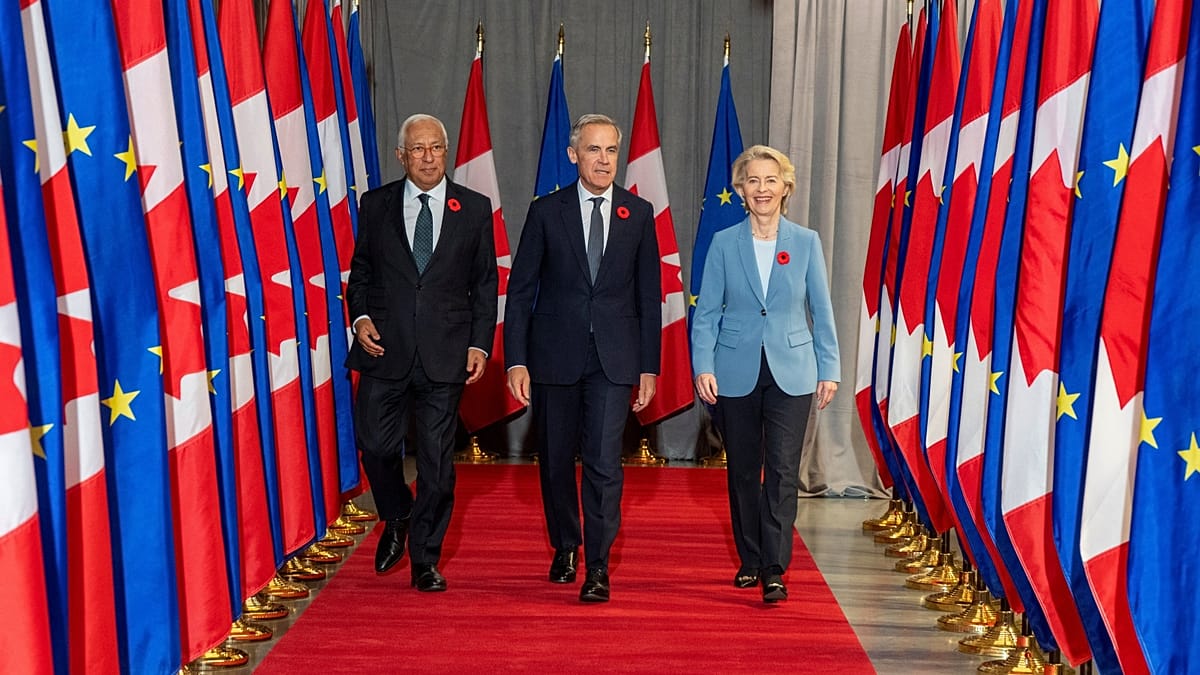
Canada and the European Union have set a target of June 2027 to conclude negotiations on a novel form of partnership that would make Canada the bloc's first-ever "associate member". The deadline was announced by Canadian Prime Minister Mark Carney following a bilateral summit in Montréal, where he stood alongside European Commission President Ursula von der Leyen.
The proposed status has no legal basis in the EU treaties, and its practical implications remain undefined. It is intended to deepen cooperation across three broad areas: policy, programmes and governance. The two sides also agreed to expand collaboration on digital trade, energy, critical raw materials, supercomputing, artificial intelligence and satellite technology.
A contested label
Ahead of the summit, Germany objected to the phrase "associate member" during negotiations on the joint declaration. The final text instead refers to an "ever closer association". Carney, however, made clear he intends to pursue the original vision.
"We are working towards the deepest possible partnership short of accession, because of our geography, with Canada becoming the European Union's first associate member," Carney told reporters at the closing press conference.
He added that the coming months would determine "the full substance, scale and scope of this new form of membership".
Von der Leyen surprised EU capitals in September when she proposed the associate membership concept without prior broad consultation with member states. Carney, who was in the audience for that announcement, initially appeared hesitant, reportedly concerned about implications for Canadian sovereignty. On Friday, he embraced the term, saying: "Today, we move towards associate membership for Canada, and we launch a new alliance for the future that will deliver now and in the future with like-minded nations. We're just getting started."
The Commission president highlighted immediate benefits, including Canada's full integration into the Horizon research programme and the Erasmus+ exchange scheme, as well as a €90 billion support loan for Ukraine. "The concept of an associate member is uncharted territory, but we have the ambition, trust and creativity to shape it together," von der Leyen said. "And to be crystal clear: this is a partnership, not against anyone else, but for our common strength. Bilaterally, this is the highest form of partnership."
German resistance and unanswered questions
Germany's opposition has been a persistent obstacle. German Chancellor Friedrich Merz was the first to float an "associate member" definition in the context of Ukraine's EU aspirations, an idea Kyiv rejected outright, insisting on full membership. Commission officials suspect Berlin's resistance to von der Leyen's initiative stems from Merz viewing the concept as his own. Asked directly about Germany's stance, von der Leyen sidestepped, saying there was "broad support" among member states for bringing Canada closer.
"We would have loved to discuss full-fledged membership, but it is impossible. We know that," she said, referring to EU treaties that reserve membership for European states. "This is the start of an intense work that we see here. We have the vision. We have an idea. We have to develop the framework. We have to fill it with life."
European Council President António Costa, who speaks for the collective position of EU governments, notably avoided the term "associate member", sticking to the joint declaration's language of an "ever closer association".
The European Commission and the Canadian government will hold a college-to-cabinet meeting in the spring to flesh out the proposal. Carney is then expected to attend an EU leaders' summit in June, when he hopes to conclude the negotiations. How the arrangement would be ratified across Europe remains unclear. Carney has previously pledged to put the proposal to a vote in the Canadian parliament.
The push for closer EU-Canada ties comes amid wider geopolitical shifts, with Washington's unpredictable trade posture prompting allies to diversify partnerships. As European Pulse has reported, the two sides have already moved to forge a deeper alliance in Montréal, and discussions have included a possible LNG deal to ease Europe's gas crunch. Yet the associate membership plan has not been universally welcomed; earlier reporting noted that EU capitals pushed back on von der Leyen's proposal. The coming months will test whether the vision can be translated into a workable framework that satisfies all 27 member states.