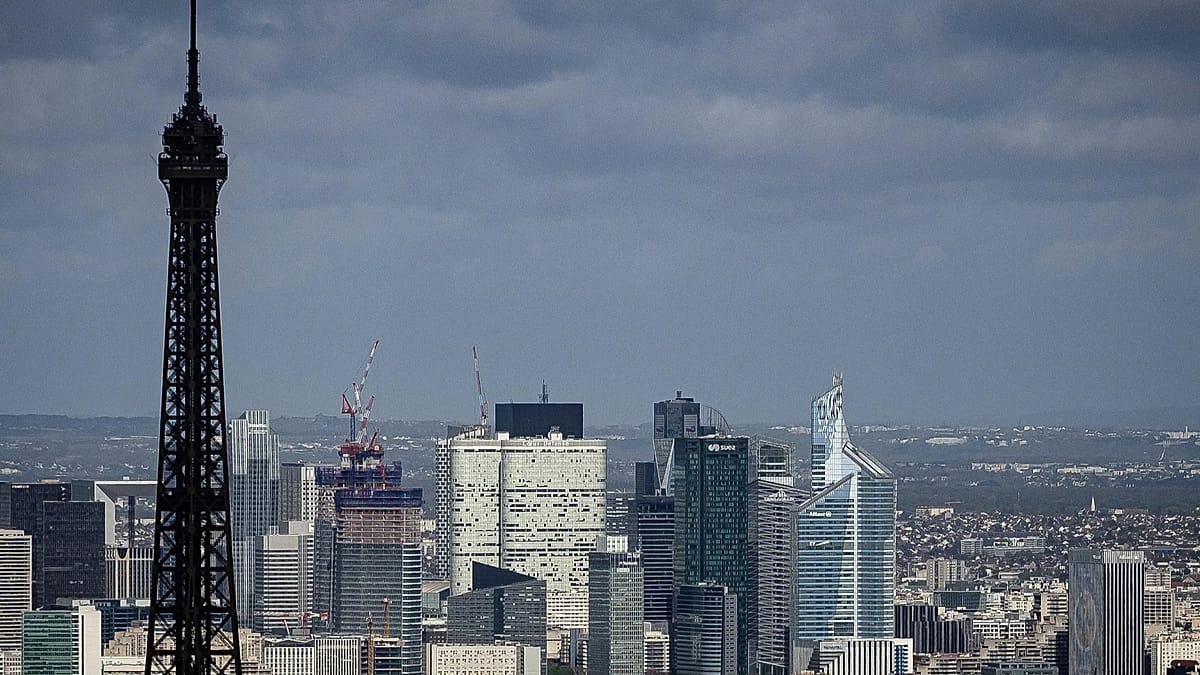
France's economy has ground to a halt. According to Insee, the national statistics agency, gross domestic product shrank by 0.1% in the third quarter, following zero growth in the previous three months and a 0.2% contraction at the start of the year. The eurozone's second-largest economy is now teetering on the edge of a technical recession, defined as two consecutive quarters of negative growth.
The figures landed as French borrowing costs remain elevated and social tensions simmer. A fresh nationwide day of mobilisation against the rising cost of living and in support of young people's demands is scheduled, adding pressure on a government that already lacks a parliamentary majority.
Inflation, meanwhile, accelerated to 3.4% year on year in October, up from 3.1% in September — the highest reading since January 2024, Insee said.
Political paralysis meets market scepticism
Economy and Finance Minister Roland Lescure, speaking on Franceinfo, described the economy as being "at a standstill" and warned the country "will hit the wall" if the so-called turnaround budget is not adopted. The government is pushing to pass the 2027 budget on time, but without a majority in the Assemblée nationale, its options are limited. It has not ruled out invoking article 49.3 of the constitution, which allows a bill to pass without a vote unless a no-confidence motion succeeds. Another possibility is governing by ordinance — a procedure never used to adopt a budget since the Cinquième République was founded in 1958.
Yet economists argue that the mere passage of a budget is not the central issue. "The main risk to the French economy is not the absence of a budget. It is the lack of visibility over the trajectory of public finances," said Jérôme Mathis, professor of economics at Paris-Dauphine University. He cautioned that a fiscal adjustment plan typically weighs on growth in the short term, and that the real cost of the deadlock lies in prolonged uncertainty rather than in the specific measures left unvoted.
Jérémie Peloso, chief strategist for Europe at BCA Research, told Euronews that a technical recession in the coming quarters is "very likely". He noted that this scenario was already conceivable before the recent budget turbulence and the collapse of the bond market.
Borrowing costs and the spread with Germany
France is borrowing ever more expensively. On Friday, the yield on 10-year French government bonds stood at 4.9%, just 0.17 points below the peak reached on 22 October. The French-German spread — the gap between the two countries' borrowing costs — hovered around 1.55 points. Each rise in interest rates gradually feeds through to the state budget, reducing future room for manoeuvre and ultimately weighing on private investment, Mathis warned.
Budget uncertainty can itself become a drag on activity. Companies postpone investments, households defer spending, and markets demand a higher risk premium. "Markets generally prefer a contested decision to a prolonged absence of decision," Mathis said. But if a budget adopted by ordinance is seen as fragile — liable to be challenged after the next presidential election or as evidence of a lasting inability to build majorities — the boost to confidence could be limited.
The European Central Bank's latest meeting passed without surprises, which helped calm markets somewhat, though ECB President Christine Lagarde declined to comment on the French situation. The respite may be temporary.
What sets this crisis apart from more conventional budget standoffs, Mathis argues, is that markets do not doubt France's technical capacity to raise taxes or repay its debt. "They doubt more its ability to slow its increase," he said. As long as that question remains unanswered, pressure on interest rates is likely to persist — whatever institutional vehicle is chosen to adopt the budget.
The stakes extend beyond Paris. As the eurozone's second-largest economy, France's fiscal credibility matters for the entire currency bloc. The deadlock also complicates broader EU discussions, including Ukraine's €70bn funding gap, which hinges on member states' willingness to commit resources. Meanwhile, French banks have sought to play down exposure to sovereign risk, with BNP Paribas striking a reassuring tone even as equities trading surged.
For now, the government's immediate challenge is to restore a semblance of fiscal predictability. Without it, the economy may remain stuck — not because of a missing budget alone, but because of the uncertainty that surrounds it.