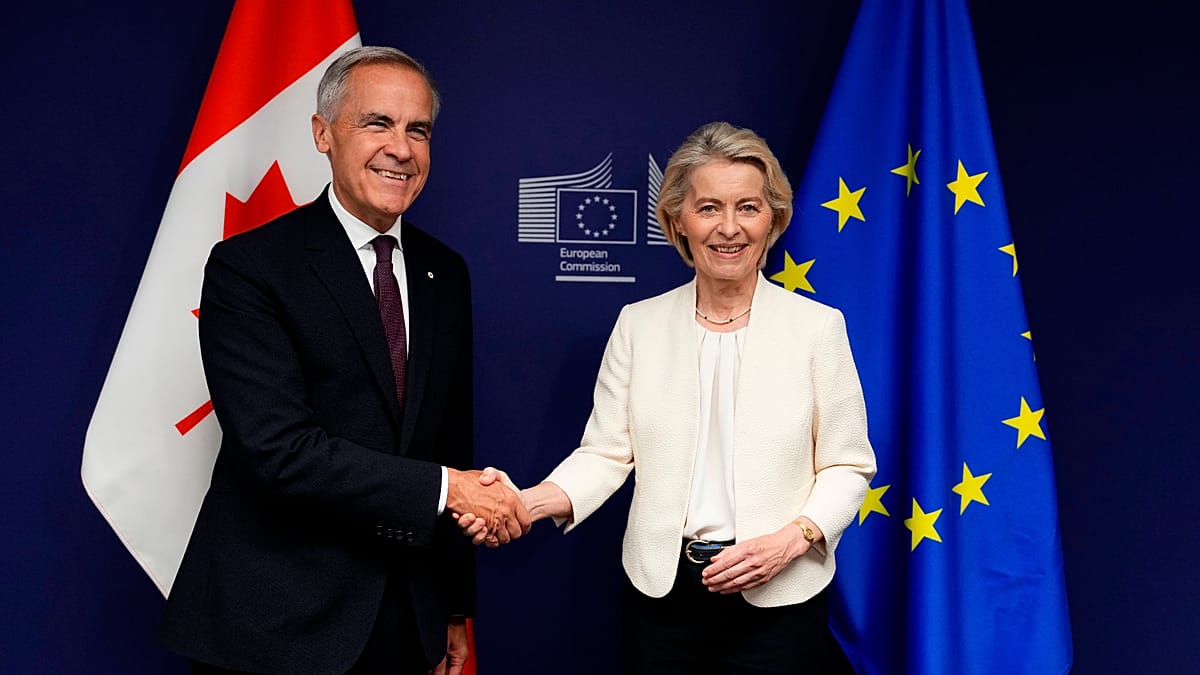
European Commission President Ursula von der Leyen's proposal to offer Canada a novel "associate membership" in the EU has triggered a diplomatic clash with several member states, including her own Germany, just days before a summit meant to showcase the bloc's closest partnership with a non-member country.
Five EU diplomats told European Pulse that Berlin, Paris, Rome and Athens have objected to including the term in a joint declaration to be adopted at the EU-Canada summit in Montreal on Thursday and Friday. The concept, which von der Leyen floated in her State of the Union speech in September, has no legal basis in the EU treaties and has never been formally defined.
"The main concern is that this is unknown terminology, it might bring up legal uncertainty and expectations from other third countries," one diplomat said. "This was not communicated previously from the Commission. We don't know what we are talking about."
The dispute reflects a broader tension between von der Leyen's ambition to forge a deeper strategic partnership with Ottawa and the member states' insistence on controlling the bloc's external relations. The proposed declaration, which would commit both sides to regular exchanges on major policy and regulatory initiatives, was revised last week to explicitly mention "associate membership" and to set a goal of defining the full scope of the partnership by 2027.
That wording drew immediate pushback. Germany, Italy, France and Greece all raised formal objections before the deadline for the so-called silent procedure, under which a document is adopted unless a member state objects. A new draft circulated on Monday evening sought to distance the member states from the concept by noting that it was "put forward by the European Commission," but that did not satisfy the critics.
The office of European Council President António Costa is now expected to circulate another version, with ambassadors due to meet again on Wednesday to try to bridge the gap before the summit opens. The disagreement threatens to overshadow the substance of the meeting, which is expected to cover defence, critical raw materials, energy, trade and border security.
A term without a definition
The core problem, diplomats say, is that "associate membership" is not a recognised category in EU law. It does not appear in the treaties, and no one has explained what it would mean in practice. "It does not mean anything, it is not in the treaties," a second diplomat said, adding that "we want to find a way to make the concept work."
For Berlin, the issue is procedural: member states should first agree on the content of the cooperation package, and only then decide what to call it. "We don't want to put the cart before the horse," a German official said. There is broad consensus on deepening ties with Canada, but the label itself has become a lightning rod.
The controversy echoes von der Leyen's 2023 migration deal with Tunisia, which she announced without a formal mandate from member states. "In the case of Tunisia, member states fully agreed with the objective of reducing arrivals, but they had to say that they did not 100% agree with the way it was done. It is a bit the same case here," a third diplomat said.
Some diplomats argue that the term, however imprecise, serves a useful political purpose. "It is a way of packaging what would otherwise inevitably look like a sector-by-sector technical exercise," one said. But others worry that it could create a precedent for other third countries, such as the UK or Ukraine, to demand similar status.
The idea was first proposed by German Chancellor Friedrich Merz, but he framed it as a way to anchor Ukraine to the EU during its accession process. Applying it to Canada, a non-European country that can never join the bloc, changes the meaning entirely. It would offer a blueprint for the closest possible partnership with a country outside the continent, which some member states find unsettling.
Even Canadian Prime Minister Mark Carney, who was von der Leyen's guest of honour at the State of the Union speech, has been lukewarm on the term, preferring to call the relationship an "alliance of the future." "What matters is the substance," he said when asked whether he was comfortable with the label.
The summit in Montreal is still expected to produce a joint declaration, but the battle over language may leave a sour taste. For von der Leyen's critics, the episode is another example of her habit of making grand announcements before thinking through the implications. For her supporters, it is a sign of her willingness to set a bold political vision and let the bureaucracy catch up.
As the EU and Canada prepare to deepen their ties, the dispute over a single word underscores the delicate balance between the Commission's ambition and the member states' authority. The outcome of Wednesday's ambassador-level talks will determine whether the summit can move beyond semantics and focus on the substance of a partnership that both sides say they want.