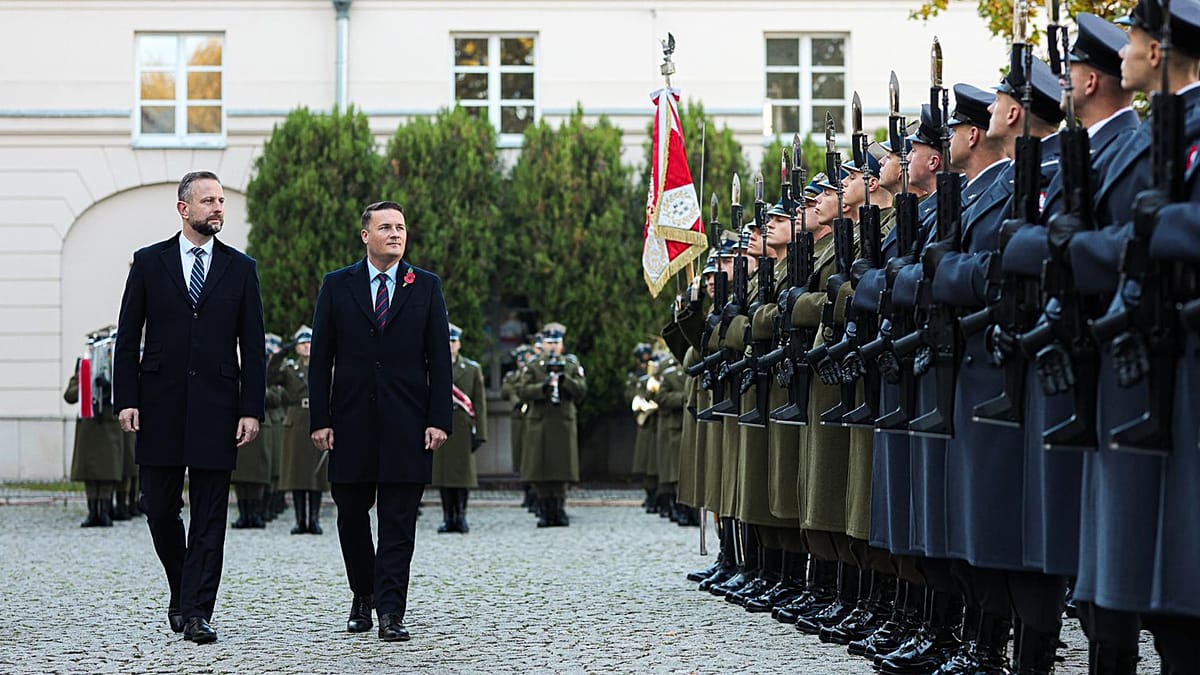
Warsaw and London have formalised a three-year defence cooperation plan, signed on Tuesday during a meeting between Polish Deputy Prime Minister and Defence Minister Władysław Kosiniak-Kamysz and UK Defence Secretary Wes Streeting. The agreement builds on the Polish-British treaty concluded earlier this year and sets out a roadmap for joint military efforts through 2028.
The plan prioritises emerging capabilities: artificial intelligence, drone and anti-drone systems, modern deterrence measures, and traditional exercises designed to enhance interoperability across different operational environments. Kosiniak-Kamysz highlighted several flagship programmes, including the Miecznik frigate project, the integrated air defence system incorporating Narew, Pilica and Pilica+, and a dedicated production line for 155 mm ammunition. "These are only part of our joint initiatives," he told reporters in Warsaw.
Shared stance on Ukraine and Russia
Both ministers insisted there is full unity and coordination in supporting Ukraine. Streeting, speaking in the Polish capital, explicitly described Russia's hybrid attacks against Poland as "terrorism". "We hear very clearly what Poland is experiencing every day in the form of what some describe as hybrid threats from Russia – I personally prefer to call this quite simply terrorism sponsored by a state – the daily mobilisation of your forces and air defences in the face of drone incursions," he said.
The remarks come as Poland continues to face regular drone incursions and other provocations along its eastern border, part of a broader pattern of Russian pressure on NATO's eastern flank. The two countries also discussed the transatlantic relationship, with Kosiniak-Kamysz stressing that both Warsaw and London favour strengthening NATO and building Europe's own defence capabilities, but not complete independence from the United States. "Poland and the United Kingdom support strengthening this alliance, the transatlantic alliance, because the United Kingdom is the best example – everything connected with the transatlantic alliance grew out of Britain. We are in favour of reinforcing it and building our own capabilities, of greater independence for Europe, but not independence from the United States," he said.
The defence pact comes at a time of heightened security concern across the continent, with European nations reassessing their military postures in response to Russia's war in Ukraine. Poland has emerged as a key logistics hub for Western aid to Kyiv, while the UK has been among the most vocal European supporters of Ukraine's defence.
The agreement also touches on industrial cooperation, particularly in ammunition production, a critical area as European stocks have been depleted by the conflict. The planned 155 mm ammunition line in Poland is part of a broader effort to reduce reliance on external suppliers and boost domestic manufacturing capacity.
Streeting's visit to Warsaw underscores the deepening bilateral relationship, which has grown closer since Russia's full-scale invasion of Ukraine in 2022. Both countries have consistently called for a robust response to Russian aggression, and this plan institutionalises that coordination.
Meanwhile, diplomatic efforts to end the conflict continue. The Trump administration has organised several rounds of negotiations, with the latest held in Geneva in February. Kremlin spokesman Dmitry Peskov indicated that the next talks could take place in Abu Dhabi around mid-November. Western governments backing the peace initiative are seeking a breakthrough, though territorial and security issues remain unresolved.
For Poland and the UK, the defence plan is a clear signal of long-term commitment to European security. As Kosiniak-Kamysz put it, the agreement reflects a shared understanding of current threats and a determination to stand together. The coming years will test whether that resolve translates into tangible capabilities on the ground.