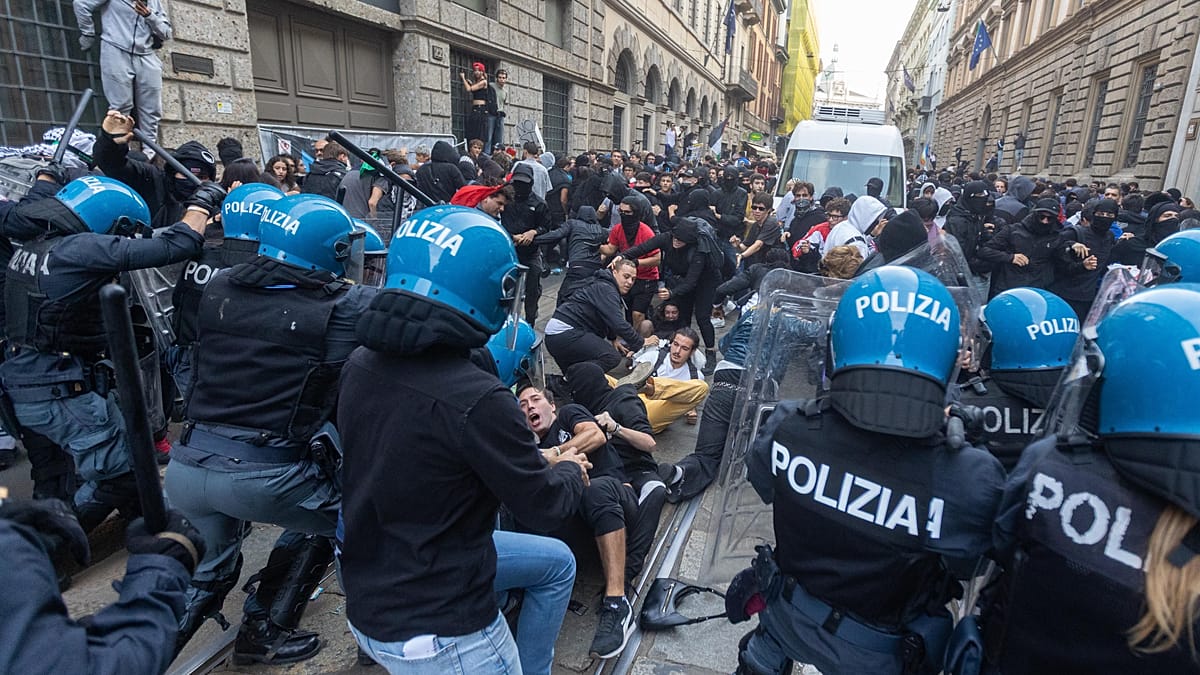
Investigations into the unrest that shook Milan's city centre on 17 and 18 October are advancing on two fronts. Police have uncovered a WhatsApp group with more than 230 members where participants discussed attacking officers, stealing their weapons, and setting fire to public buildings. Meanwhile, prosecutors are focusing on a 30-year-old researcher, Youssef Siher, who is accused of inciting violence through his role in the so-called 17 October Movement.
Siher, who was detained on 24 October, exercised his right to remain silent during questioning by preliminary investigations judge Tiziana Landoni at Milan's San Vittore prison on Tuesday. He faces charges of incitement to commit crimes with terrorist intent and organised violence during public demonstrations. Prosecutors Marcello Viola and Francesca Crupi have requested that he be held in prison pending trial, citing the risk of flight or reoffending. A decision is expected by 28 October.
Chats reveal plans for violence
The investigation took a significant turn when the Monza and Brianza Digos (General Investigations and Special Operations Division) found a message in a chat advising protesters not to put on balaclavas immediately, to avoid identification by police. Acting on a warrant from the Milan juvenile prosecutor's office, officers searched the home of the teenager believed to have written the message on 22 October. They found a balaclava and an Under Armour T-shirt thought to have been stolen during the looting of a shop in Milan. A search of another minor turned up a second such T-shirt, also believed to be looted.
But it was the first boy's mobile phone that yielded the most significant lead: access to a WhatsApp group with over 230 members. The conversations were rife with references to weapons, knives, smoke bombs, and firecrackers, as well as explicit plans to attack police, snatch their weapons, damage patrol cars, and torch government buildings. Messages cited by investigators include: “And we steal their weapons”, “Let's grab one, beat him up and take his weapon”, and “Hey guys, if we're going to protest, let's set fire to a government building”. Others urged participants to obtain knives, clubs, and pepper spray, while some discussed stealing cars and targeting businesses, with references to a “Gucci robbery” and a McDonald's.
The chats also mentioned further demonstrations planned for 24 October, which risked turning violent. This intelligence triggered a nationwide preventive operation.
Nationwide searches and seizures
On 24 October, around 150 personal and home searches were carried out across several Italian provinces, coordinated by the Central Directorate of Preventive Police and involving Digos units and Flying Squads from various cities. The primary aim was to find illegally held weapons and ammunition. In Brianza, checks covered 32 people living in 16 municipalities, including Monza, Seregno, Giussano, Carate Brianza, Limbiate, Nova Milanese, and Desio.
Officers seized folding and butterfly knives, a hatchet with “1312” engraved on its blade – a numerical code for the acronym ACAB (“All Cops Are B*****ds”) – knuckledusters, a telescopic baton, two blank-firing pistols missing their red safety caps, glass breakers, balaclavas, and other items classed as offensive weapons. Investigators are continuing to piece together the alleged conduct and identify anyone else responsible.
The Milan riots are part of a broader pattern of civil unrest across Europe, from cost-of-living protests in Lyon to housing protest camps in Lisbon and Porto. While the triggers vary, the response from authorities has often involved similar tactics, and the discovery of such violent planning in Milan raises questions about the potential for escalation elsewhere.
Siher's silence in court leaves many questions unanswered, but the evidence gathered from the chats and searches paints a troubling picture of premeditated violence. As the investigation continues, Italian authorities are likely to remain vigilant against further unrest.