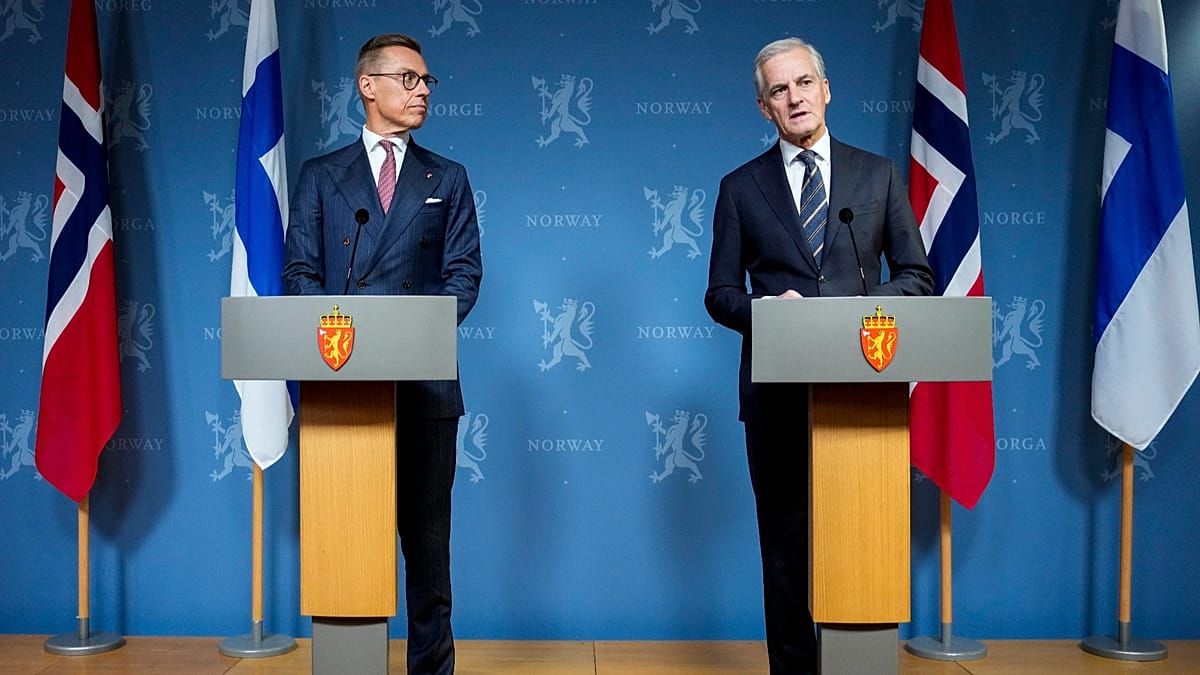
In a notable diplomatic move, Finnish President Alexander Stubb and Norwegian Prime Minister Jonas Gahr Støre spoke directly with Russian President Vladimir Putin on Wednesday, urging him to end the full-scale invasion of Ukraine and engage in serious negotiations. The call, initiated by the two Nordic leaders, marks one of the most direct high-level contacts between European leaders and the Kremlin since the war began.
Stubb described the conversation as "frank and substantive," emphasizing that as neighbours of Russia, Finland and Norway have a direct stake in the conflict's outcome. "The outcome of this war will have a direct impact on our and the broader European security," he said in a read-out. "Ending the war requires direct discussion."
Støre echoed those sentiments, highlighting the immense human and material costs of the conflict. "The suffering and destruction will impact generations," he said. "In the call, we stressed the importance of de-escalation." Both leaders made clear that their countries' substantial military aid to Ukraine would continue unabated, a message they conveyed directly to Putin.
The Kremlin's read-out of the call was predictably firm, with Putin stating that "achieving a just, long-term peace is only possible with full and unconditional consideration of the legitimate interests of the Russian Federation" — a formulation that suggests Moscow is not softening its maximalist demands.
Following the call, Stubb and Støre briefed Ukrainian President Volodymyr Zelenskyy. Zelenskyy thanked them for their "active" diplomatic support and stressed that "real de-escalatory steps are needed regarding our energy and infrastructure." He added, "Russia must stop dragging out the war."
Part of a broader diplomatic push
The conversation was framed as a follow-up to the Oslo peace talks, which Stubb and Støre jointly hosted last month. That meeting brought together senior officials from Ukraine, the United States, the United Kingdom, Germany, Italy, the European Commission, and NATO — but notably not Russia. Instead, US special envoy Steve Witkoff flew to St Petersburg to brief Putin on the outcome.
A new round of talks is expected in Abu Dhabi early next month, with a format similar to Oslo but this time including the Russian delegation. Brussels has already signalled its readiness to have European and Russian officials sit at the same table, something that has not yet happened in the negotiation process. The European Commission and the European Council are reportedly working to form a joint team to represent the EU's position, and both institutions were apparently informed in advance of the Stubb-Støre call.
The two Nordic leaders were careful to underline that they were not acting as special envoys for Europe, a sensitive issue that has divided EU member states for over a year. "Stubb and Støre took the call as leaders of their respective countries and did not speak on behalf of Europe as a whole," the read-out stated.
That clarification did not prevent criticism from Copenhagen. Danish Prime Minister Mette Frederiksen, in a rare display of Nordic discord, questioned the initiative. "I actually don't know what they think you can achieve with this," she said. "We have previously also emphasised in clear terms to the rest of Europe, when others have gone solo and travelled to Moscow, that it is important that we Europeans stand together."
The call comes as the EU pushes for a seat at the negotiating table, with Brussels seeking a stronger role in shaping the peace process. Meanwhile, the human toll continues to mount, as evidenced by recent drone attacks inside Russia that have killed civilians. The diplomatic landscape remains fluid, with trilateral talks between Ukraine, Russia, and the US reportedly scheduled for November.
Whether the Stubb-Støre initiative will break the deadlock remains uncertain. But it underscores a growing willingness among European leaders to engage directly with Moscow, even as they continue to arm Ukraine. The coming weeks, with the Abu Dhabi round and the EU's efforts to unify its position, will be critical in determining whether this overture translates into tangible progress.